-
2x2 rib knit is a stretchy, wide-ribbed knitted fabric made on a double-bed machine, with two knit and two purl wales alternating across the width. In the Turkish market 2x2 rib is called kaşkorse, while 1x1 rib is called ribana.
-
Acrylic is a synthetic fiber whose polymer chain is at least 85% acrylonitrile units by mass. It was developed to compete with wool, gives a light, soft hand and is used in socks, knitwear and blankets, and, for its sun resistance, in tent and awning fabric.
-
Aerobin is a Turkish trade name, used especially in modest clothing and women's clothing (tunics, ferace, dresses), for a fabric that sources describe as a lightweight, wrinkle-resistant woven. It is not a fiber or weave name, its composition varies by seller, and it has no established English equivalent.
-
Bamboo fabric is, in most cases, made from regenerated cellulose fiber (viscose, or rayon) produced chemically from bamboo cellulose; it is not the plant's own fiber. Under US FTC guidance, only fiber obtained mechanically from bamboo may be called “bamboo”.
-
Canvas is a heavy, closely woven plain-weave fabric, made mostly of cotton, linen or hemp. It is used where durability counts, in sails, tents and tarpaulins, as a painting surface, and in bags and shoes. Turkish suppliers call it kanvas.
-
Cardigan stitch (Turkish: selanik) is a thick, full-looking weft-knit structure in which tuck stitches and knit loops are made alternately on a double-bed machine. It is used in cardigans, sweaters, jackets and other winter products.
-
Chiffon is a thin, lightweight, sheer or semi-sheer fabric woven in plain weave from tightly twisted yarn. The first chiffons were silk; today it is also woven from nylon and other synthetic fibers, and from rayon (viscose). In Turkish it is called şifon.
-
Cotton is a cellulose-based natural plant fiber that surrounds the seeds of the cotton plant (Gossypium). It is a short-staple fiber, used in clothing and home textiles, pure or blended with fibers such as polyester. In Turkish it is called pamuk.
-
Crêpe (crepe) is a lightweight fabric with a finely wrinkled or pebbled surface, most often produced with highly twisted yarn. It is a surface name, not a fiber: crepe can be made of silk, cotton and other fibers. Turkish suppliers call it krep.
-
Denim is a durable woven fabric with indigo-dyed warp yarns and undyed weft yarns, most often made in a 3×1 or 2×1 twill weave. Turkish suppliers also call it kot; jeans are made from it.
-
Elastane (spandex in the US) is a synthetic elastic fiber made of at least 85% segmented polyurethane by mass, which returns quickly to its original length after being stretched to three times that length. In Turkish trade usage it is known as likra (Lycra).
-
Fabric weight is the mass of one square meter of fabric in grams (g/m²), known as GSM (grams per square meter). It shows how light or heavy a fabric is, but it is not a measure of thickness or quality. Turkish suppliers call it gramaj.
-
Gabardine is a strong, very closely woven twill fabric with fine, pronounced diagonal lines on the face and a flat back. It is used for trousers, jackets, suits, uniforms and raincoats. Turkish suppliers call it gabardin.
-
Interlock fabric is a stable, double-bed circular knit made by interlocking two 1x1 ribs, so both faces look flat, like the face of single jersey. With the same yarn it is thicker and more stable than single jersey, and its edges do not curl.
-
Jacquard is a weaving method that builds the pattern into the fabric structure on a loom that can control each warp yarn individually, instead of adding it later by printing or dyeing. The patterned fabric woven this way is also called jacquard, and some patterned knits carry the name too. Turkish suppliers say jakar.
-
Jersey is a knitted fabric. In English-language technical sources it means single-knit fabric (Turkish: süprem), while Turkish suppliers use jarse more broadly for stretchy knits of many fibers, including double-bed structures such as interlock.
-
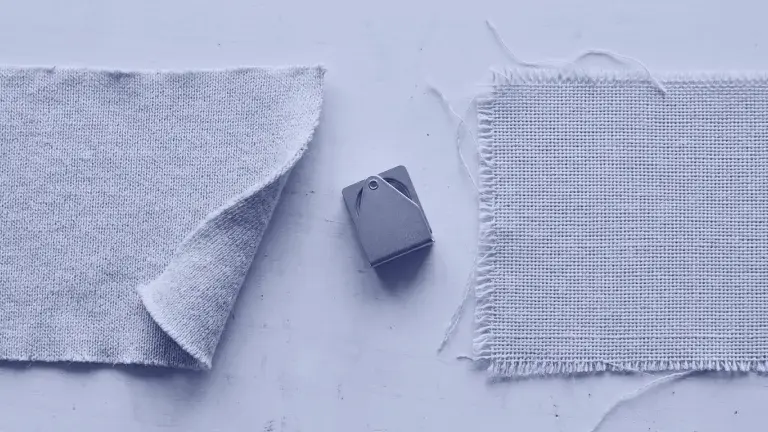
Knitted fabric is made by turning yarn into loops and intermeshing the loops with one another; the loop structure gives the fabric natural stretch. It falls into two main groups, weft knits and warp knits. Single jersey, rib and interlock are weft knits.
-
Linen is the cellulosic fiber obtained from the bast layer of the flax plant, and also the fabric woven from yarn spun from it. It is strong and absorbs moisture well, but stretches little and creases easily; it is used in clothing and in home textiles such as bedding. In Turkish it is called keten.
-
Lyocell is a regenerated cellulose fiber made by dissolving cellulose in an organic solvent without forming a derivative, then spinning it. It is stronger than viscose both dry and wet; Tencel is Lenzing’s brand name, used for lyocell and also for modal.
-
Mesh fabric is the general name for fabrics with regular openings (holes) that give the surface a net-like, porous look. The name describes appearance, not one structure: mesh can be knitted, woven or netted. Turkish suppliers call it file.
-
Modal is a regenerated cellulose fiber made by a modified viscose process, with high breaking force and high wet modulus. It is a type of viscose improved to be more stable when wet.
-
Muslin is a fine plain-weave cotton cloth. Dictionaries say it is made in a very wide range of fineness; in Turkey the name is used especially for soft, loosely woven cotton cloth, in single or multiple layers, for baby swaddles and summer clothing.
-
Organic cotton is cotton grown to organic agriculture standards, without synthetic toxic pesticides and fertilizers or genetically modified seed, and verified by third-party certification. It is not a fiber type: organic describes how the cotton is grown and its certification status.
-
Oxford cloth is a woven fabric in a 2×1 basket weave, a plain-weave variation in which two warp yarns are woven together as one. With its lightly textured surface, it is mostly woven from cotton and used in shirts and skirts. The name oxford is also used for a coated synthetic bag fabric.
-
Piqué is a single-bed knitted fabric in which tuck stitches are knitted alongside plain knit stitches, giving the surface a honeycomb-like texture with a visible micro-mesh look. It is common in polo shirts, sportswear and corporate wear; Turkish suppliers call it pike or lakost.
-
Plaid is a checked pattern formed when horizontal and vertical bands of different colors and widths cross at right angles; fabric with this pattern is also called plaid. The Turkish word ekose is a broad term that covers what English separates into plaid, tartan and check.
-
Plain weave is the simplest basic weave: each warp yarn passes over one weft yarn and under the next. The repeat is two warp and two weft yarns, written 1/1; poplin, canvas and chiffon are woven in it. In Turkish it is called bezayağı.
-
Polar fleece is a soft, fluffy knitted fabric whose surface is brushed to raise a pile, made mostly from polyester. The pile traps heat in air pockets, so the fabric is light yet warm; it is used for mid-layers, jackets and similar winter garments. Turkish suppliers call it polar.
-
Polyamide (nylon) is a synthetic fiber made from a polymer with repeating amide bonds in its chain. Polyamide and nylon are two names for the same fiber. It is strong, flexible and abrasion-resistant, and is used in hosiery, underwear, swimwear, sportswear, carpets and coil-zipper teeth.
-
Polyester is a fiber extruded from a long-chain synthetic polymer made from petroleum-derived chemicals. It is strong, resists creasing and shrinking, and dries quickly; it is used as continuous filament or as staple fiber.
-
Poplin is a strong plain-weave fabric with a fine, closely spaced crosswise rib on its surface, woven mostly from cotton. It is used for shirts, blouses and dresses.
-
Rib knit is a stretchy knitted fabric made on a double-bed machine, with knit and purl wales (loop columns) alternating across the width. It stretches strongly crosswise, recovers well and is widely used for collars, cuffs and waistbands; Turkish suppliers call the standard 1x1 rib ribana.
-
Satin is a woven fabric made in satin weave, in which long yarn floats on the surface give a smooth, lustrous face. The name describes the weave and the fabric, not the fiber: satin can be woven from silk, cotton or synthetic fibers. In Turkish it is called saten.
-
Scuba fabric (scuba knit) is a smooth-faced, full-bodied double-knit fabric, usually made from polyester and elastane and knitted in one piece on a double-bed machine. It is not the same as neoprene, a bonded fabric–foam–fabric laminate. Turkish suppliers also call it dalgıç kumaş.
-
Silk is an animal fiber made of the protein fibroin, obtained from the cocoons of silk-producing insects, mostly the Bombyx mori silkworm. Among natural fibers it is the exception in being a continuous filament; its luster and drape suit dresses, scarves, ties and bed linen.
-
Single jersey is a light, stretchy knitted fabric made on a single-bed circular knitting machine, with vertical loop columns (wales) on one face and loop rows (courses) on the other. It is widely used in T-shirts and underwear; Turkish suppliers call it süprem.
-
Three-thread fleece is a circular-knit fleece fabric made by adding a filler (pile) yarn, held in place by a tie-in yarn, to the ground yarn that forms the face. It is fuller and more stable than two-thread fleece and is used for sweatshirts, hoodies and joggers.
-
Twill is a basic weave in which warp and weft yarns interlace so that diagonal lines form on the fabric surface. Denim, gabardine and chino trouser fabrics are woven in twill. In Turkish it is called dimi.
-
Two-thread fleece is a single-bed circular knit made from two yarns: a ground yarn forms the loops on the face, and a backing yarn forms long floats and tuck links on the reverse. It is used for sweatshirts and joggers; Turkish suppliers call it iki iplik, and with an unbrushed reverse it is also called French terry.
-
Velour is a velvet-like fabric with a surface of cut short pile, made by knitting; it is described as the knitted counterpart of woven velvet. In the traditional method it is knitted on a circular machine with two yarns and the pile loops are cut afterwards. Turkish suppliers call it velur.
-
Velvet is a woven fabric whose surface is covered with a short, dense, soft pile formed by pile warp yarns. It is not a fiber name: velvet can be woven from silk, cotton, nylon, acetate and rayon. Turkish suppliers call it kadife.
-
Viscose (rayon in US FTC rules) is a regenerated cellulose fiber, made by chemically dissolving cellulose and re-forming it into fiber. Like cotton it is cellulose-based, but it loses about half of its strength when wet.
-
Wool is an animal fiber from the fleece of sheep or lambs, made of the protein keratin. Its scaly, crimped structure keeps you warm, absorbs water vapor and stretches; it felts if it is wet and agitated.
-
Woven fabric is made on a loom by interlacing lengthwise warp yarns with crosswise weft yarns at right angles. It is more stable than knitted fabric: its stretch is limited by yarn properties and weave structure.