What is Velvet?
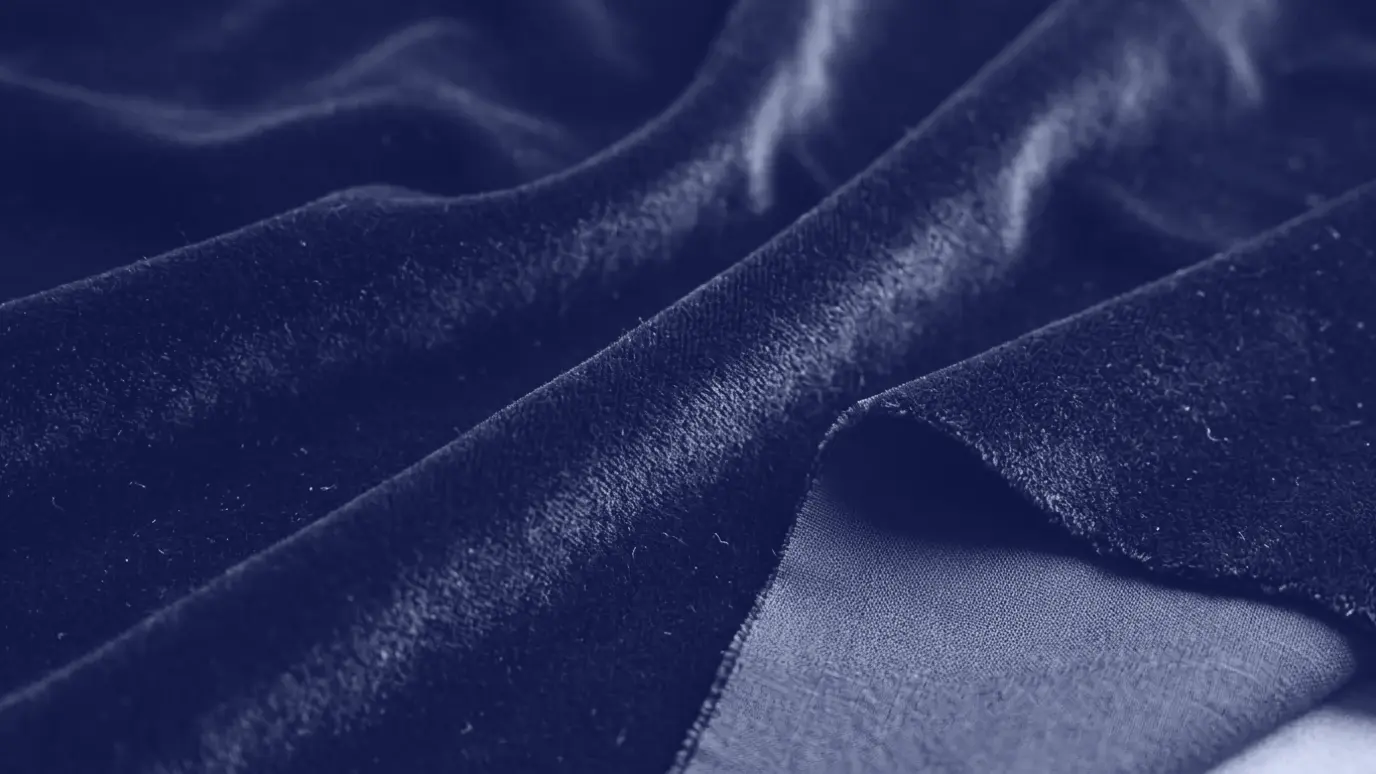
Velvet is a woven fabric whose surface is covered with a short, dense, soft pile formed by pile warp yarns. It is not a fiber name: velvet can be woven from silk, cotton, nylon, acetate and rayon. Turkish suppliers call it kadife.
- Published:
- Fact-checked by:
- Gizem Polat
Key facts
- Velvet is a woven fabric with a short, dense pile formed by extra warp yarns.
- According to CottonWorks, velvet pile is less than 1/8 inch (about 3 mm) high; fabrics with a taller pile are called plush.
- Velveteen and corduroy get their pile from the weft, not the warp; both are separate fabrics from warp-pile velvet.
- Velvet is a directional fabric: all pieces are cut in the same pile direction, so lay planning is one-way and fabric consumption can rise.
- Velvet is not a fiber name; dictionaries mention silk, cotton, nylon, acetate and rayon velvets.
Properties
- Fiber content
- Not specified by the name. Random House lists silk, nylon, acetate and rayon (the back is sometimes cotton); Collins says silk, cotton and nylon; Getty AAT says “usually silk”
- Structure
- Woven, warp pile. The pile is formed by an extra warp yarn and is cut or left looped (Getty AAT). According to CottonWorks, most velvets are woven as two fabrics, separated at the loom or in a later operation; pile height is under 1/8 inch (about 3 mm)
- Weight range
- No standard range; it varies with fiber, pile height and pile density. Ask for weight in g/m² with the test method (for example EN 12127); 1 oz/yd² ≈ 33.9 g/m²
- Uses
- Curtains, upholstery and garments: Collins gives “velvet curtains” as an example, TDK uses the adjective sense “covered with this fabric”, and Dictionary.com’s example sentences include a velvet coat. Use varies with fiber and pile structure
- Care
- Care instructions depend on fiber content and finishing; follow the label. A fabric glossary (TextileGlossary) recommends careful handling of quality velvet and pressing it on a velvet board. Dimensional change after washing is measured by ISO 5077, using ISO 6330 procedures.
Velvet is a woven fabric whose surface is covered with a short, dense pile formed by warp yarns. CottonWorks describes velvet as a warp-pile fabric with a woven cut pile: the pile is cut to a uniform height, which gives the fabric a lush, soft hand. The TDK (Turkish Language Association) dictionary defines kadife, the Turkish word for velvet, as a glossy, soft fabric whose surface is covered with fibers left at a set length (our translation).
Velvet structure
The Getty Art & Architecture Thesaurus describes velvet as a warp-pile weave in which an extra warp, woven above the ground fabric, is raised into loops over rods during weaving; the loops may be cut or left uncut. According to CottonWorks, most velvets are woven as two fabrics, separated at the loom or in a later operation. Pile height is under 1/8 inch (about 3 mm); for taller piles the source uses the name plush. A high number of pile yarns per inch improves the appearance and hand of the fabric (CottonWorks).
Velvet is not a fiber name. Random House lists silk, nylon, acetate and rayon, and mentions velvet whose back is sometimes cotton; Collins says silk, cotton and nylon; Getty AAT says “usually silk”. State the fiber and its percentage separately in the quotation.
Velvet, velveteen, corduroy and velour
| Name | How is the pile formed? | Difference from velvet | Source |
|---|---|---|---|
| Velveteen | Woven with two warps and one weft; the pile comes from the weft | The pile is shorter than velvet’s; it is made to resemble velvet. Very little is woven today because of weft counts that can reach 400 per inch | CottonWorks |
| Corduroy | The pile comes from the weft yarn; after weaving the weft floats are cut, and the cut weft yarns stand up to form vertical ribs (wales) | Ribbed surface. V pile is easy to cut but is more likely to come out of the fabric once cut; W pile is held more securely | CottonWorks |
| Velour (knitted) | Knitted velour is a sheared terry-looped knit | Knitted, not woven. The TDK dictionary treats the Turkish word velur as a synonym of kadife; state in the order whether you mean woven or knitted | CottonWorks; TDK |
| Plush | TDK: a velvet-like fabric with long fur on one face, soft and glossy | CottonWorks calls fabrics with a pile taller than 1/8 inch plush | TDK; CottonWorks |
Pile direction and cutting
Velvet is a directional fabric. TextileGlossary recommends cutting velvet with the pile running up for the deepest color, and cutting all pieces in the same direction. The MEGEP Spreading module of the Turkish Ministry of National Education likewise requires one-way spreading for directional fabrics such as velvet and plush, so that the nap runs in the same direction as the garment. Because the direction constraint limits marker planning (pastal), fabric consumption can be affected. For the calculation, use the fabric consumption calculator; for spreading methods, see the garment manufacturing process guide.
What to specify when sourcing velvet
- Name the pile structure: warp-pile velvet, velveteen, corduroy or knitted velour; also state the fiber and its percentage.
- Ask for the sample with the pile direction marked: because all pieces are cut in the same direction, keep the pile direction constant on the sample and on the rolls when comparing shade differences.
- Ask for the weight in g/m² and the method. Mass per unit area from small samples is measured to EN 12127; to calculate it from a sample, use the fabric GSM calculator.
- Ask for dimensional change after washing and rubbing fastness: ISO 5077 with ISO 6330 procedures; ISO 105-X12 for rubbing.
- Get ironing and care instructions in writing: quality velvet should be handled carefully and pressed on a velvet board (TextileGlossary).
To find suppliers, see velvet manufacturers and suppliers in Turkey; for the wider framework, see the fabric types guide.
Frequently asked questions
Is velvet breathable?
Velvet is the name of a pile structure, not a fiber. It can be woven from silk, cotton, nylon or another fiber, and sweating varies with fiber, pile structure and weight. No fabric stops sweating. Verify claims such as “breathable” or “keeps you warm” with air permeability (EN ISO 9237) and water-vapor resistance (EN ISO 11092) values. How to read the measurements is covered in breathable fabrics.
Is velvet the same as velveteen?
No. The pile of velvet comes from warp yarns, the pile of velveteen from weft yarns (CottonWorks). Velveteen is made to resemble velvet and its pile is shorter than velvet’s.
Is velvet woven or knitted?
Warp-pile velvet is woven. The TDK dictionary treats velur as the equivalent of velvet, while CottonWorks describes knitted velour as a sheared terry-looped knit. State in the order which one you mean, using the structure name.
Sources (18)
- TDK Güncel Türkçe Sözlük (Turkish Language Association dictionary), entry “kadife” (velvet; accessed October 11, 2026)
- TDK Güncel Türkçe Sözlük (Turkish Language Association dictionary), entry “velur” (velour; accessed October 11, 2026)
- TDK Güncel Türkçe Sözlük (Turkish Language Association dictionary), entry “pelüş” (plush; accessed October 11, 2026)
- Getty Research Institute, Art & Architecture Thesaurus: velvet (fabric weave) (AAT 300133711; accessed October 11, 2026)
- CottonWorks (Cotton Incorporated), Textile Encyclopedia: Velvet (accessed October 11, 2026)
- CottonWorks (Cotton Incorporated), Textile Encyclopedia: Velveteen (accessed October 11, 2026)
- CottonWorks (Cotton Incorporated), Textile Encyclopedia: Corduroy (accessed October 11, 2026)
- CottonWorks (Cotton Incorporated), Learning Hub: Complex Woven Fabric Designs (accessed October 11, 2026)
- CottonWorks (Cotton Incorporated), Learning Hub: Mechanical Finishing (knitted velour; accessed October 11, 2026)
- Dictionary.com, entry “velvet” (Random House Unabridged Dictionary; Collins English Dictionary; accessed October 11, 2026)
- TextileGlossary.com (TG Academy), Velvet (fabric glossary; accessed October 11, 2026)
- MEGEP (Republic of Türkiye Ministry of National Education), Serim (Spreading) module, section 1.3.1.1 Tek Yönde Serim (One-way spreading; Turkish; accessed October 11, 2026)
- EN 12127:1997 Textiles. Fabrics. Determination of mass per unit area using small samples (BS EN 12127:1998 record; applies to woven and knitted fabrics)
- ISO 5077:2007 Textiles: Determination of dimensional change in washing and drying (confirmed in 2022)
- ISO 6330:2021 Textiles: Domestic washing and drying procedures for textile testing
- ISO 105-X12:2016 Textiles: Tests for colour fastness, Part X12: Colour fastness to rubbing (EVS-EN ISO 105-X12:2016 record)
- EN ISO 9237:1995 Textiles: Determination of permeability of fabrics to air (EVS-EN ISO 9237:2000 record)
- EN ISO 11092:2026 Textiles: Physiological effects, measurement of thermal and water-vapour resistance under steady-state conditions (sweating guarded-hotplate test) (EVS record; valid from June 15, 2026)
Author and fact-checking
Written by
Fabrics and Fibers Editor
Elif Karaca is Tekstil Rehberi's fabrics and fibers editor. She writes guides and glossary entries on knitted, woven and nonwoven fabrics, fiber properties and choosing the right fabric for each product, and bases values such as GSM, width, shrinkage and color fastness on standards and mill technical data sheets.
Content by Elif KaracaFact-checked by: Gizem Polat
This content was prepared by the Tekstil Rehberi editorial team. Before publication, our verification editor checked its figures, dates and sources against primary sources.
Spotted an error? Email us at [email protected] How we work →