
Fabrics and Yarns
What GSM Should a T-Shirt Be? Fabric Weight for T-Shirts, Hoodies and Joggers
14 min read
Searches companies, categories, products, listings, guides and the glossary.
Browse sectors
Three-thread fleece fabric manufacturers and suppliers in Turkey for winter sweatshirts, hoodies and joggers. Ask about GSM after finishing, the pilling test and fabric lead time before you request quotes.
For buyers
No companies are listed on this page yet. You do not have to wait for the list: describe what you need and request quotes.
Tell us the product, quantity and delivery location. You confirm your request with the link we e-mail you; requests are screened for spam, and our team reviews your first request. It is then sent to up to 20 companies working in this field and stays open for quotes in their company panel for 30 days. You compare the quotes you receive on one page.
Fabrics and Yarns


Fabrics and Yarns

Fabrics and Yarns
Get your company listed on this page. If you manufacture or provide services in this field, create your free profile; companies are listed after our team has reviewed them.
List your company for freeThree-thread (üç iplik in Turkish) is a full fleece fabric used in winter sweatshirts, hoodies and joggers. According to CottonWorks, it consists of a face yarn, a binding yarn and a backing yarn that is brushed; because it uses three ends instead of two, it is the most stable and fullest of the fleeces and is used in cold-weather garments that need extra warmth. Three issues stand out for a buyer: season planning, pilling, and the way finishing changes GSM. The structure is explained in the three-thread fleece glossary entry. This page lists fabric suppliers; if you are looking for finished sweatshirts, see the sweatshirt and hoodie category.
In a winter collection, fabric lead time, cutting, sewing and shipping add up one after the other, so build the plan backwards from the date the product goes on sale. One supplier page also positions three-thread as a fall and winter fabric. In the order, get in writing whether the fabric comes from stock or from production, whether the color is approved, and the delivery date. For a lighter alternative, look at French terry suppliers.
Two risks stand out in three-thread. The first is the formation of pills on the surface; Hossain et al. (2021) describe pilling as a common surface defect in polyester-cotton (CVC and PC) fleece. The second is that finishing changes GSM: in the same study, a polyester-cotton three-thread fleece with a target weight of 300 g/m² (about 8.8 oz/yd²) measured 264–274 g/m² raw (about 7.8 to 8.1 oz/yd²) and 337–342 g/m² (about 9.9 to 10.1 oz/yd²) after the compactor, a finishing machine. A quote that says “300 g/m²” without saying which stage it means is therefore ambiguous.
As GSM rises, more yarn goes into each square meter. Add finishing such as brushing and compacting, the polyester-cotton ratio and the order quantity per color. At a price per kilogram, a meter of heavy fabric costs more; a worked example is in the fabric weight (GSM) guide by garment type.
For winter sweatshirt and jogger fabric, supplier pages give ranges that differ from each other, such as 250–350 g/m² (about 7.4 to 10.3 oz/yd²), 280–420 (about 8.3 to 12.4) and 310–380 (about 9.1 to 11.2); there is no standard classification. The same fabric weighs differently raw and after finishing, so state in the quote whether the GSM is raw or after finishing, and its tolerance.
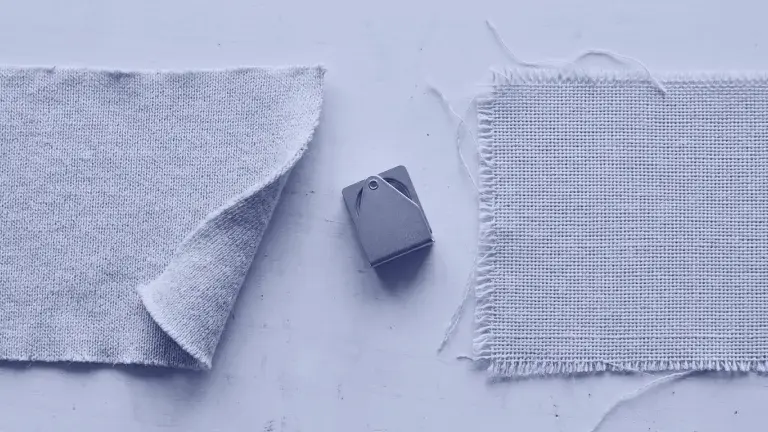
The reverse is different, so the handle and the intended use are different too. One supplier page lists brushed three-thread, unbrushed diagonal three-thread and a pilling-resistant fabric with a polar-fleece-type structure as separate products in the same 310–320 g/m² band. When the sample arrives, turn the fabric over and confirm the reverse.
By laboratory test. A study on polyester-cotton three-thread fleece (Hossain et al., 2021) measured pilling with the pilling box method (ISO 12945-1); the other standard method is modified Martindale (EN ISO 12945-2). Write the method and the pass grade into the contract, and have a supplier's “non-pilling” claim verified with a test report.
Backwards from the season. In a winter collection, fabric lead time, cutting, sewing and shipping add up one after the other, so build the plan from the date the product goes on sale. Get in writing whether the fabric comes from stock or from production, whether the color is approved and the delivery date. One supplier page positions three-thread as a fall and winter fabric; this is the claim of a single page, not a standard.
As GSM rises, more yarn goes into each square meter; finishing such as brushing and compacting, the polyester-cotton ratio and the order quantity per color add to it. Because the minimum can differ widely from company to company, get separate confirmation for each color. At a price per kilogram, a meter of heavy fabric costs more, so convert quotes to cost per meter before comparing.