What is Two-Thread Fleece (French Terry)?
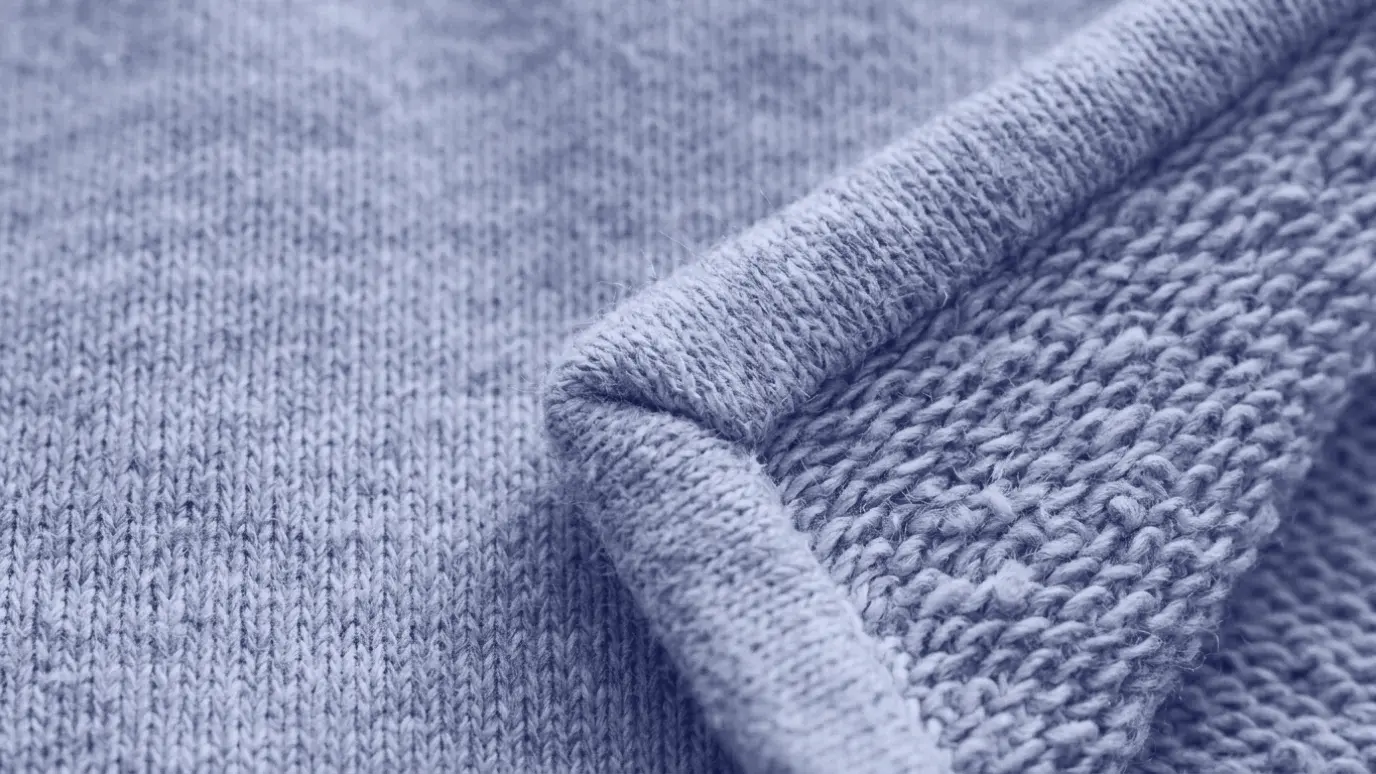
Two-thread fleece is a single-bed circular knit made from two yarns: a ground yarn forms the loops on the face, and a backing yarn forms long floats and tuck links on the reverse. It is used for sweatshirts and joggers; Turkish suppliers call it iki iplik, and with an unbrushed reverse it is also called French terry.
- Published:
- Updated:
- Fact-checked by:
- Gizem Polat
Key facts
- Two-thread fleece is knitted from two yarns: the ground yarn forms the face and the backing yarn forms the reverse.
- The face looks plain, like single jersey; the reverse shows floats and can be brushed.
- In English trade usage, two-thread (two-end) fleece with an unbrushed reverse is called French terry; brushing the reverse makes it fleece.
- It is knitted on a single-bed circular machine, with two belts and two pulleys to feed the ground and backing yarns separately.
- Supplier weight claims run from about 150 to 350 g/m²; there is no standard range.
Properties
- Fiber content
- Knitted from cotton, cotton-polyester and polyester yarns; elastane and viscose versions exist
- Structure
- Single-bed circular knit (“tek plaka”, single plate, in Turkish trade usage); knit, tuck and float; two separate yarns (ground and backing); the face looks like single jersey and the reverse shows floats
- Weight range
- No standard range. Supplier claims run from about 150 to 350 g/m² (4.4–10.3 oz/yd²), depending on the source. Measured research example: 188–197 g/m² (5.5–5.8 oz/yd²) in 100% cotton samples knitted on a 28-gauge machine
- Stretch
- Better dimensional stability than single jersey (Uyanık, 2023); there is no standard stretch value, and stretch direction and amount depend on elastane content and structure
- Uses
- Sweatshirts, hooded tops, cardigans, joggers; sportswear and outdoor garments
- Care
- Care instructions depend on fiber content and finishing. Dimensional change after washing is measured by ISO 5077, using ISO 6330 washing and drying procedures.
Two-thread fleece is a knitted fabric made from two separate yarns: the ground yarn forms the loops on the face and the backing yarn forms the reverse (Uyanık, 2023). The face looks plain, like single jersey, while the reverse shows floats. Turkish academic writing also calls it a backed knit (astarlı örgü) or fleece. It is the basic fabric of sweatshirts and joggers, sold in Turkey as iki iplik (“two thread”). In English, the version with an unbrushed reverse is called French terry and the brushed version fleece (CottonWorks), so this entry covers both names (see below).
Two-thread fleece structure
The ground yarn forms the loops on the face. The backing yarn makes long floats and attaches to the fabric at certain points by tucking (Uyanık, 2023). In a tuck the needle takes a new yarn without dropping the old loop; in a float the needle does not move and the yarn passes behind it (Dönmez, 2008). Because the backing yarn floats and tucks, it uses less yarn than the ground yarn (Uyanık, 2023). CottonWorks lists two-end fleece among the single-bed fabrics.
How two-thread fleece is knitted
Two-thread fleece is knitted on single-bed circular machines (Uyanık, 2023; Sasteks). It needs two belts and two pulleys to feed the ground and backing yarns separately, so it cannot be made on single jersey machines with a single track (Turkish: tek çelik yollu); single jersey machines also run finer (at a higher gauge) than two-thread machines (Uyanık, 2023).
The pulley setting determines the amount of backing yarn. In one study the amount of ground yarn was held constant while the amount of backing yarn was increased: weight and thickness rose, bursting strength fell partly, and spirality (Turkish: may dönmesi) and dimensional change rates were not affected (Uyanık, 2023).
Brushed and unbrushed two-thread fleece
If the reverse is brushed (napped), the fabric gets a soft, warm inner face (Fersan). CottonWorks names the brushing of the interior loops as the difference between fleece and French terry: it calls French terry a 2-end fleece that is not napped, and describes fleece as heavier and suited to cold-weather and active garments. Brushed two-thread feels warmer than unbrushed (Güneşoğlu et al., cited in Uyanık, 2023).
Two-thread fleece and French terry
This entry follows CottonWorks: two-thread fleece is the construction, French terry is its unbrushed version and fleece its brushed version. Naming is still inconsistent in the market. One manufacturer calls two-thread itself French terry (Fersan), while another uses that name for a heavy cotton fabric with terry loops, 420–440 g/m² (Altunkaya, 2024). Sources also disagree on brushing: Altunkaya (2024) writes that two-thread cannot be brushed, whereas Uyanık (2023), Karcem and Sasteks say the reverse is suitable for brushing, and Fersan offers a brushed two-thread. State in the order whether the reverse is brushed or unbrushed, and confirm with a sample and the weight.
Two-thread fleece weight (GSM)
Two-thread fleece has no standard weight range: the result depends on the yarn counts, how much backing yarn is fed, the fiber mix and finishing. Below are supplier claims and one measured value:
| Source | Fabric | Weight (g/m²) |
|---|---|---|
| Fersan, October 3, 2026 | Polyester two-thread (French terry); brushed type 220–350 | 150–350 |
| Karcem, September 26, 2026 | Cotton, polyester | 220–320 |
| Altunkaya, July 20, 2024 | Two-thread | about 180–260 |
| Sasteks, undated | Cotton or viscose with polyester; with / without elastane | 220 / 200 (±5%) |
| Uyanık, 2023 | 100% cotton, unbrushed; ground Ne 30/1 and backing Ne 20/1, both open-end; 28-gauge | 188–197 |
In the research samples, weight rose from 188.23 to 197.38 g/m² as the amount of backing yarn increased (TS EN 12127; Uyanık, 2023). The claims are individual product values; ask in what state (greige or finished) the weight was measured. To convert from imperial units, 1 oz/yd² is roughly 33.9 g/m².
Uses
Two-thread fleece is used in sweatshirts, hooded cardigans and jogger sets (Sasteks) and in the sweatshirt–jogger group (Karcem). Uyanık (2023) counts two- and three-thread fabrics among those sought for sportswear and outdoor garments because of good thermal comfort, low air permeability and protection against cold. For a broader comparison of fabric groups, read the fabric types guide; the guide to fabric weight by product covers T-shirts, hoodies and joggers.
How it differs from three-thread fleece
The three-thread version has one more yarn: a filler (pile) yarn that a separate tie-in yarn locks to the ground. CottonWorks notes that knitting with three yarns rather than two gives a fuller and more stable fleece. Two-thread is knitted without that third yarn; the three-thread fleece entry covers it in detail.
What to specify when sourcing two-thread fleece
- State the reverse: brushed or unbrushed.
- Composition and yarns: ask for fiber percentages and the ground and backing yarn counts. Because the amount of backing yarn changes the weight (Uyanık, 2023), ask for the backing ratio too.
- Have the shrinkage of two-thread fleece measured: the ISO 5077 result should be obtained with ISO 6330 washing and drying procedures. In Uyanık’s unbrushed cotton samples, width shrinkage was 1.7–2.3% and length shrinkage 6.7–7.3% (TS EN ISO 5077; the washing conditions are not stated in the article). In these samples length shrinkage is clearly higher than width shrinkage.
- Get the weight together with the measuring stage: greige or finished.
Frequently asked questions
Are two-thread fleece and French terry the same? According to CottonWorks, French terry is a 2-end fleece that is not brushed. Turkish suppliers use the name for different fabrics, so confirm with a sample and the weight.
Can two-thread fleece be worn in summer? Producers disagree: one recommends two-thread for spring, summer and early autumn (Altunkaya, 2024), while another says it is not preferred for summer because it is thick (Sasteks). Look at the weight and the state of the reverse.
Sources (10)
- Uyanık, S. (2023). İki iplik örme kumaşlarda farklı astar ipliği oranlarının kumaş özelliklerine etkileri (The effects of different backing yarn ratios on the properties of two-thread knitted fabrics; in Turkish). Çukurova University Journal of the Faculty of Engineering, 38(3), 819-826
- CottonWorks (Cotton Incorporated): Single Knits and Double Knits (accessed October 9, 2026)
- Dönmez, E. T. (2008). Yuvarlak örme kumaşlarda kumaş gramajına etki eden faktörler üzerine bir araştırma (A study on the factors affecting fabric weight in circular knitted fabrics; in Turkish). Dokuz Eylül University Graduate School of Natural and Applied Sciences, master’s thesis (pp. 17-18: tuck and float)
- Karcem Tekstil (raw knitted fabric manufacturer): Örme Kumaş: Çeşitleri, Gramaj Tablosu ve Üretimi (knitted fabric: types, weight table and production; Turkish; last updated September 26, 2026; accessed October 9, 2026)
- Fersan Tekstil (polyester knitted fabric manufacturer): İki İplik (French Terry) Kumaş Üreticisi (two-thread (French terry) fabric manufacturer; Turkish; updated October 3, 2026; accessed October 9, 2026)
- Altunkaya Tekstil: 2 İplik ve 3 İplik Farkı Nedir? (What is the difference between two-thread and three-thread?; Turkish; July 20, 2024; accessed October 9, 2026)
- Sasteks Örme: İki İplik Örme Kumaş (Two-thread knitted fabric; Turkish; undated; accessed October 9, 2026)
- EN 12127:1997 Textiles. Fabrics. Determination of mass per unit area using small samples (EVS-EN 12127:2000 record; applies to woven and knitted fabrics)
- ISO 6330:2021 Textiles: Domestic washing and drying procedures for textile testing
- ISO 5077:2007 Textiles: Determination of dimensional change in washing and drying (confirmed in 2022)
Author and fact-checking
Written by
Fabrics and Fibers Editor
Elif Karaca is Tekstil Rehberi's fabrics and fibers editor. She writes guides and glossary entries on knitted, woven and nonwoven fabrics, fiber properties and choosing the right fabric for each product, and bases values such as GSM, width, shrinkage and color fastness on standards and mill technical data sheets.
Content by Elif KaracaFact-checked by: Gizem Polat
This content was prepared by the Tekstil Rehberi editorial team. Before publication, our verification editor checked its figures, dates and sources against primary sources.
Spotted an error? Email us at [email protected] How we work →
Articles on this topic
What GSM Should a T-Shirt Be? Fabric Weight for T-Shirts, Hoodies and Joggers
GSM ranges for T-shirts, hoodies and joggers, what light, mid and heavy weights mean, why one fabric can carry different GSM figures, and how to write GSM into a supplier spec.