What is Silk?
Silk is an animal fiber made of the protein fibroin, obtained from the cocoons of silk-producing insects, mostly the Bombyx mori silkworm. Among natural fibers it is the exception in being a continuous filament; its luster and drape suit dresses, scarves, ties and bed linen.
- Published:
- Fact-checked by:
- Gizem Polat
Key facts
- The Turkish and EU fiber-name lists define silk as fiber obtained exclusively from silk-secreting insects; the name may not be used to describe the filament form of other fibers.
- Silk is made of the protein fibroin; in the cocoon two fibroin filaments are bound by sericin, which is removed during processing (CottonWorks).
- Turkey's fiber regulation accepts a moisture allowance of 11.00% for silk in fiber-content calculations, against 8.50% for cotton and 17.00–18.25% for wool.
- According to a textbook, silk loses up to 20% of its strength when wet; sunlight weakens the fiber, sweat can yellow it, and insects damage it.
- Satin is a weave, and chiffon and poplin are fabric names; none states the fiber and all can be made of non-silk fibers. In Turkish, “ipek baskı” means screen printing.
Properties
- Fiber content
- Animal protein fiber; core protein fibroin, binding protein sericin. “Silk” in the Turkish and EU fiber-name lists means fiber obtained exclusively from silk-secreting insects (no. 4)
- Structure
- Continuous filament; in the cocoon two fibroin filaments are bound by sericin, which is removed during processing (CottonWorks). The triangular, prism-like cross-section reflects light from different angles (INFLIBNET)
- Stretch
- Elasticity is moderate to poor and wrinkle resistance moderate (INFLIBNET)
- Uses
- Dresses, blouses, ties, scarves; bed linen, pillowcases, curtains; upholstery and decorative fabrics; fine suture thread in surgery
- Care
- Follow the care label. FabricLink: only pre-washed silk is washable and dry cleaning is mostly preferred; never use chlorine bleach
- Origin
- Silkworm cocoon; cultivated (farmed) silk is distinguished from wild (tussah) silk collected from nature (CottonWorks)
Silk is an animal fiber made of the protein fibroin, obtained from the cocoons of silk-producing insects, mostly the larva of the Bombyx mori silkworm (Pratt Institute; CottonWorks). The Turkish fiber-name and labeling regulation (Annex 1, no. 4; “the Turkish regulation” below) and the EU's Regulation 1007/2011 (Annex I, no. 4) define silk as fiber obtained exclusively from silk-secreting insects. The Turkish Language Association (TDK) dictionary describes ipek (silk) as a very fine, flexible and lustrous thread obtained by unwinding silkworm cocoons and used in weaving (our translation). Its luster, drape and softness make it a fiber sought after for dresses, blouses, scarves, ties and bed linen.
How silk is obtained
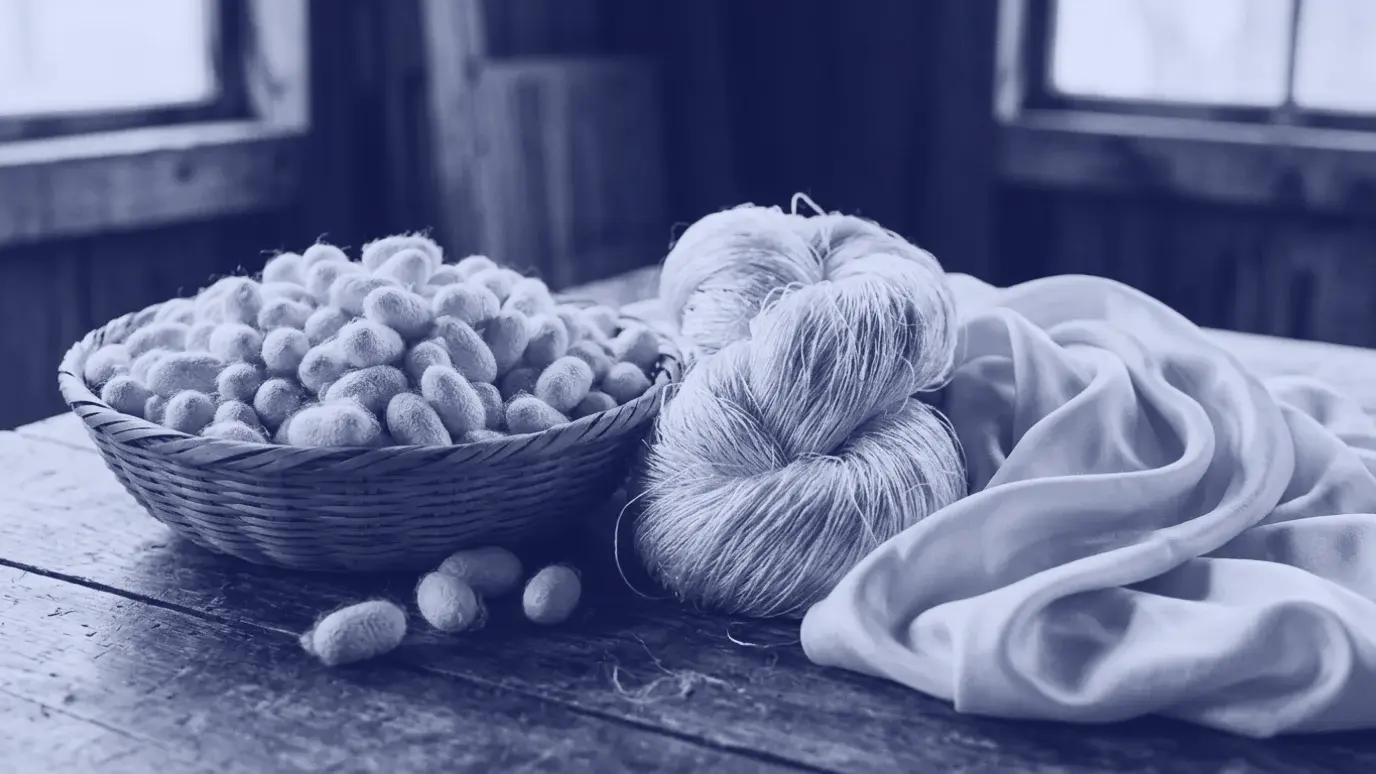
The larva spins a cocoon from the filament it secretes, and the silk is taken from this cocoon. According to CottonWorks, two fibroin filaments are bound into one thread by a second protein called sericin; during processing the sericin is removed and the fibroin remains. A textbook says silk consists of about 70–75% fibroin and 25–30% sericin (INFLIBNET). In traditional sericulture the cocoons are boiled to collect the fiber (Pratt Institute). Besides farmed silk, there is also wild (tussah) silk collected from nature (CottonWorks).
Natural fibers such as cotton and wool are classified as staple (cut) fibers; silk is the exception, because it is obtained as a continuous filament (Cotton Incorporated, Textile Yarns). Removing the sericin (degumming) makes the fabric lose weight; to make up for this loss, silk can be weighted with metal salts, and excessive weighting weakens the fabric (INFLIBNET).
Properties
- Strength: Pratt Institute calls silk one of the strongest natural fibers, and a textbook calls it the strongest. According to the same textbook it loses up to 20% of its strength when wet; its elasticity is moderate to poor and its wrinkle resistance moderate (INFLIBNET).
- Comfort: Pratt Institute writes that silk is breathable and moves moisture, and is comfortable in both warm and cool climates. Annex 9 of the Turkish regulation accepts an 11.00% moisture allowance for silk when calculating fiber content; this is a commercial calculation value, not a measurement.
- Luster: The fiber's triangular, prism-like cross-section reflects light from different angles (INFLIBNET); Pratt Institute counts natural luster and drape among silk's distinguishing qualities.
- Light, sweat and insects: Excessive sunlight weakens silk, sweat can cause yellowing, and soiled silk left in storage is a target for insects (INFLIBNET). For long-term storage, FabricLink recommends protecting silk from light, air and insects.
- Dyeing: Acid dyes color wool, silk and nylon, and basic dyes are also used on silk (INFLIBNET). For the use of reactive dyes on silk in printing, see the textile printing methods guide.
Names confused with silk
- Satin: Satin is a weave and fabric name; it does not state the fiber, and satin is woven from silk as well as from cotton or synthetic fibers. Chiffon and poplin are also fabric names.
- Artificial silk: The TDK dictionary lists the Turkish compounds suni ipek and yapay ipek (artificial silk) under the entry ipek. Under article 6 of the Turkish regulation, the fiber composition on a label is written only with the names in Annex 1; these names cannot be used for other fibers, and the term “silk” cannot be used to describe the shape of a fiber or a particular presentation of continuous filament yarn (Article 5 of the EU regulation is the same). A regenerated cellulose fiber obtained by the viscose process is listed as “viscose” (no. 25; see the viscose entry); cupro, modal and lyocell are also separate names.
- Silk printing (ipek baskı): In Turkish dictionary use, ipek baskı is a printing method and also means screen printing; it does not tell you the fiber content of the product.
- “Silky”, “silk touch”: These are marketing phrases and do not state the composition. Check the fiber name and percentage on the label.
What to check when buying silk fabric
- Ask for the fiber content as percentages. Article 8 of the Turkish regulation accepts “100%”, “pure” or “all” only for products made entirely of the same fiber. The articles cited come from the 2015 regulation text as read on October 11, 2026; have a regulatory specialist confirm the current rules in the market where you sell silk goods.
- Ask whether the silk is weighted. Weighting with metal salts improves the hand and drape, but too much of it weakens the fabric (INFLIBNET).
- Write the weight in g/m². To calculate it from a sample, use the fabric GSM calculator.
- Ask for dimensional change after washing. It is measured by ISO 5077, with ISO 6330 procedures.
You can find silk scarf and shawl makers in the Scarves and Hijabs category and silk fiber suppliers in the Textile Fibers category.
Care
According to FabricLink, only pre-washed silk is washable, and dry cleaning is mostly preferred. Garments without lining or embellishment can be carefully hand washed in lukewarm water with mild soap. Chlorine bleach is never used on silk. Always follow the product's care label.
Frequently asked questions
Does silk make you sweat?
Silk cannot stop sweating either; no fabric blocks the perspiration the body uses to cool down. Pratt Institute describes silk as a breathable fiber that moves moisture. But sweat is a risk for silk: a textbook writes that silk can yellow with sweat (INFLIBNET). Comfort in a silk fabric is also determined by yarn, structure and weight as well as the fiber; ask for air permeability (EN ISO 9237) and water-vapor resistance (EN ISO 11092) values. More in breathable fabrics for summer.
Are silk and satin the same?
No. Silk is a fiber; satin is a weave and fabric name. There is satin woven from silk, but there is also cotton, polyester or nylon satin.
Is artificial silk real silk?
No. In Annex 1, the name “silk” is reserved only for fiber obtained from silk-secreting insects. Learn which fiber it is from the fiber name and percentage on the label.
Can silk be washed?
It depends on the label. FabricLink writes that only pre-washed silk is washable, that dry cleaning is mostly preferred, and that chlorine bleach should never be used.
Sources (16)
- Tekstil Elyaf İsimleri ve Tekstil Ürünlerinin Elyaf Kompozisyonlarıyla İlgili Etiketleme ve İşaretleme Hakkındaki Yönetmelik (Turkey's regulation on textile fiber names and the labeling and marking of fiber composition of textile products; in Turkish), Ministry of Customs and Trade, Official Gazette 25.04.2015, no. 29337 (articles 6, 8; mevzuat.gov.tr text; accessed October 11, 2026)
- Annexes of the same regulation: Annex 1 (list of fiber names, no. 4 silk, no. 25 viscose) and Annex 9 (agreed allowances), Official Gazette 25.04.2015 (in Turkish; accessed October 11, 2026)
- Regulation (EU) No 1007/2011 on textile fibre names and related labelling, Article 5 (legislation.gov.uk copy) and Annex I no. 4 (accessed October 11, 2026)
- Pratt Institute Textile Research Lab: Protein Fibers (accessed October 11, 2026)
- CottonWorks (Cotton Incorporated), Textile Encyclopedia: Silk (accessed October 11, 2026)
- Cotton Incorporated, Textile Yarns (CottonWorks, “1970–2010: 40 Years of Progress” edition), Section 2.0 (classification of natural fibers other than silk as staple)
- K. Sangeetha, Natural Fibres, INFLIBNET e-Adhyayan, Textile manufacturing and testing (open e-book; accessed October 11, 2026)
- S. Karpagam Chinnammal, Preparatory Steps Prior to Finishing Textiles, INFLIBNET e-Adhyayan, Textile Colouration and Finishes (fibroin and sericin ratio, sericin removal; accessed October 11, 2026)
- S. Karpagam Chinnammal, Textile Finishes, INFLIBNET e-Adhyayan, Textile Colouration and Finishes (weighting of silk; accessed October 11, 2026)
- R. Sukanya Devi, Acid and basic dyes, INFLIBNET e-Adhyayan, Textile Colouration and Finishes (open e-book; accessed October 11, 2026)
- FabricLink, Fabric Seminar: Fiber/Fabric Care, “Silk” section (accessed October 11, 2026)
- Turkish Language Association (TDK), Güncel Türkçe Sözlük (current Turkish dictionary; in Turkish), entry “ipek” (accessed October 11, 2026)
- EN ISO 9237:1995 Textiles: Determination of permeability of fabrics to air (EVS-EN ISO 9237:2000 record)
- EN ISO 11092:2026 Textiles: Physiological effects, Measurement of thermal and water-vapour resistance under steady-state conditions (EVS record)
- ISO 5077:2007 Textiles: Determination of dimensional change in washing and drying (confirmed in 2022)
- ISO 6330:2021 Textiles: Domestic washing and drying procedures for textile testing
Author and fact-checking
Written by
Fabrics and Fibers Editor
Elif Karaca is Tekstil Rehberi's fabrics and fibers editor. She writes guides and glossary entries on knitted, woven and nonwoven fabrics, fiber properties and choosing the right fabric for each product, and bases values such as GSM, width, shrinkage and color fastness on standards and mill technical data sheets.
Content by Elif KaracaFact-checked by: Gizem Polat
This content was prepared by the Tekstil Rehberi editorial team. Before publication, our verification editor checked its figures, dates and sources against primary sources.
Spotted an error? Email us at [email protected] How we work →