What is Polyester?
Polyester is a fiber extruded from a long-chain synthetic polymer made from petroleum-derived chemicals. It is strong, resists creasing and shrinking, and dries quickly; it is used as continuous filament or as staple fiber.
- Published:
- Updated:
- Fact-checked by:
- Gizem Polat
Key facts
- Polyester is a synthetic fiber made by polymerization from petroleum-based raw materials, and one of the most widely used fabrics in the world.
- Under the EU definition, polyester is a fiber whose chain contains at least 85% by mass of an ester of a diol and terephthalic acid.
- It is produced as continuous filament by extruding plastic chips; for staple fiber, the filaments are cut to short lengths.
- Strong, resistant to creasing and shrinking, and quick to dry; it absorbs very little moisture, and blending with cotton can increase pilling.
- It does not biodegrade; recycled polyester is often obtained from post-consumer plastic bottles.
Properties
- Fiber content
- Synthetic, petroleum-based polymer; under the EU definition, an ester of a diol and terephthalic acid (e.g. polyethylene terephthalate, PET)
- Structure
- Continuous filament (flat or textured) or cut (staple) fiber
- Stretch
- Resistant to shrinking, stretching and creasing
- Uses
- Sports and everyday clothing; home textiles such as curtains, bedding, upholstery and carpets; industrial products such as rope, conveyor belts and packaging
- Care
- Absorbs very little moisture (hydrophobic), dries quickly and is easy to care for; can release microplastics in washing
Polyester is a fiber made from a long-chain synthetic polymer; Pratt Institute calls it one of the most widely used fabrics in the world. Fiber-naming rules used for labeling define polyester by its chemical structure. According to the EU textile fiber names regulation (1007/2011, Annex I, no. 35), polyester is a fiber made of linear macromolecules containing in the chain at least 85% by mass of an ester of a diol and terephthalic acid. The US Federal Trade Commission rule (16 CFR 303.7) likewise requires a long-chain synthetic polymer composed of at least 85% by weight of an ester of a substituted aromatic carboxylic acid, including but not restricted to substituted terephthalate units. Polyethylene terephthalate (PET), an ester of ethylene glycol (a diol) and terephthalic acid, falls within this definition.
These definitions are taken from texts in force at the date of this entry (October 2026). For the fiber name and percentage declaration on a label, check the current rules of the market you sell in, and consult a specialist if needed.
How polyester is made and what forms it comes in
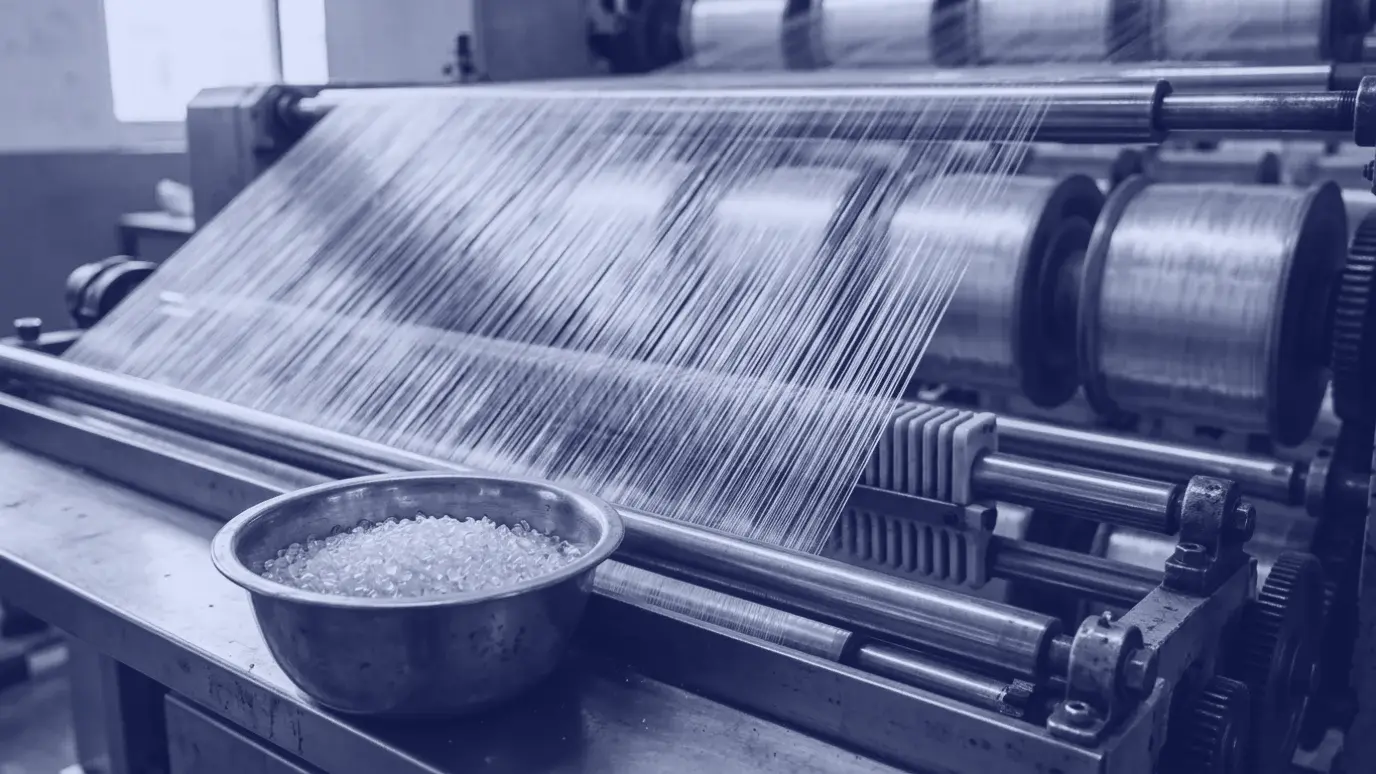
Polyester is made from petroleum-based raw materials by polymerization (Pratt Institute). Synthetic filaments are produced by extruding plastic chips through a spinneret, a die with fine holes (Cotton Incorporated, Textile Yarns).
- Continuous filament: Filament yarns are generally smoother, shinier and more even, and less absorbent. When the filament is textured, luster falls; stretch, bulk and softness rise, and moisture wicking improves (Textile Yarns).
- Staple (cut) fiber: Filaments from many extrusion heads are gathered into a bundle called tow, crimped and cut to short lengths. These cut fibers can be blended with fibers such as cotton and spun into blended yarns (Textile Yarns).
Properties
- Strength and care: Pratt Institute describes polyester as a strong, durable fiber that resists shrinking, stretching and creasing, dries quickly and is easy to care for.
- Thermal behavior: Polyester behaves as a thermoplastic at high temperature. In thermosol dyeing with disperse dyes the fabric is fixed at 200–220 °C; at this temperature the fiber becomes thermoplastic and the dye enters the fiber (Sukanya Devi, e-PG Pathshala). According to Cotton Incorporated, thermoplastic synthetics can be heat-set while cellulosic fibers cannot, and synthetic fibers also do not show cotton’s swelling-shrinking behavior (ISP 1009).
- Moisture behavior: Cui et al. (2025) classify polyester filament as hydrophobic and cotton yarn as hydrophilic. According to the same study, hydrophilic fibers absorb moisture well but are poor at transporting and releasing it, and hydrophobic fibers show the opposite. Pratt Institute gives moisture wicking as a reason polyester is preferred in sportswear.
- Pilling: In the introduction to their study on three-thread fleece fabric, Hossain et al. (2021) report, citing earlier work, that adding polyester to a fabric increased pilling and that polyester’s electrostatic properties can seed pill formation. Read this as a tendency, not a certain result for every fabric.
- Sublimation printing: The disperse dyes used in sublimation (heat transfer) printing most readily color fibers such as acetate, polyester, acrylic and nylon (Sukanya Devi, e-PG Pathshala). According to a garment distributor’s guide, in blends with less than 65% polyester the dye does not bond to cotton and washes out over time (SanMar U, 2024).
- Environment: Polyester is petroleum-based and does not biodegrade. Its production is energy-intensive, and it can release microplastics in washing (Pratt Institute).
Recycled polyester
Pratt Institute notes that recycled polyester is often obtained from post-consumer plastic bottles. For standards such as GRS that document recycled-content claims, see the textile certifications guide.
Telling polyester from cotton and viscose
Polyester is a petroleum-based synthetic fiber; cotton is a cellulose-based natural fiber. Viscose (rayon) is also cellulose-based, but it is a man-made fiber produced by chemically modifying cellulose, and it is not petroleum-based (CottonWorks, Natural vs. Synthetic Fibers). In cotton-polyester blends, polyester can improve dimensional stability: Hossain et al. (2021), citing another source, report that polyester-cotton blended garments are more durable and less likely to deform and shrink; in return, pilling tendency rises (see above).
In a quotation, state the form of the fiber (filament or staple), the blend percentage and, if a recycled-content claim is made, its certificate. You can find staple polyester fiber suppliers in the Textile Fibers category and polyester yarn suppliers in the Polyester Yarn category.
Frequently asked questions
Does polyester breathe?
Polyester absorbs very little moisture but transports it well; Pratt Institute stresses its moisture wicking, and Cotton Incorporated notes that textured filament improves wicking. Breathability and moisture management are determined not only by the fiber but also by yarn and fabric structure, so evaluate a sample in its conditions of use.
Can you print on polyester T-shirts?
Yes; the method depends on composition. The disperse dyes used in sublimation color synthetic fibers such as polyester (Sukanya Devi, e-PG Pathshala), so sublimation suits high-polyester fabric. According to a distributor’s guide, the dye does not bond to cotton, and below 65% polyester the print fades in washing (SanMar U, 2024). For a comparison of methods, see our textile printing methods guide.
Why is polyester blended with cotton?
The blend combines polyester’s dimensional stability and durability with cotton’s moisture absorption and comfort (Hossain et al., 2021; Cui et al., 2025; ISP 1009); the price is a higher tendency to pill. For fabric selection, see the fiber table in the T-shirt fabric types guide.
Sources (10)
- Regulation (EU) No 1007/2011 on textile fibre names and related labelling, Annex I (no. 35: polyester)
- 16 CFR 303.7, Generic names and definitions for manufactured fibers (US Federal Trade Commission, Textile Fiber Products Identification Rules)
- Pratt Institute Textile Research Lab: Synthetic Fibers (accessed October 9, 2026)
- Cotton Incorporated, Textile Yarns (CottonWorks, “1970–2010: 40 Years of Progress” edition)
- CottonWorks (Cotton Incorporated): Natural vs. Synthetic Fibers (accessed October 9, 2026)
- Cotton Incorporated, A Guide to Improved Shrinkage Performance of Cotton Fabrics (ISP 1009), 2004
- R. Sukanya Devi, Disperse and Sulphur dyes, Textile Colouration and Finishes, e-PG Pathshala (INFLIBNET), Chapter 7
- Cui, Y., Zhang, R. and Yu, J. (2025). Study on the Liquid Transport on the Twisted Profile Filament/Spun Combination Yarn in Knitted Fabric. Polymers, 17(15), 2065. DOI: 10.3390/polym17152065
- Hossain, M. S., Islam, M. M., Dey, S. C. and Hasan, N. (2021). An approach to improve the pilling resistance properties of three thread polyester cotton blended fleece fabric. Heliyon, 7(4), e06921. DOI: 10.1016/j.heliyon.2021.e06921
- SanMar U, Understanding Polyester Fabrics and Dye Sublimation Compatibility (March 1, 2024)
Author and fact-checking
Written by
Fabrics and Fibers Editor
Elif Karaca is Tekstil Rehberi's fabrics and fibers editor. She writes guides and glossary entries on knitted, woven and nonwoven fabrics, fiber properties and choosing the right fabric for each product, and bases values such as GSM, width, shrinkage and color fastness on standards and mill technical data sheets.
Content by Elif KaracaFact-checked by: Gizem Polat
This content was prepared by the Tekstil Rehberi editorial team. Before publication, our verification editor checked its figures, dates and sources against primary sources.
Spotted an error? Email us at [email protected] How we work →
Articles on this topic

Yarn Count Conversion: Ne, Nm, Tex and Denier Formulas and Tables
Conversion formulas and a table for Ne, Nm, tex and denier, how to calculate yarn count from a measurement, how to read plied counts such as 30/2, and the count mistakes that most often cause trouble in supplier orders.