Fabric Types and Properties: A Buyer’s Guide to Knit, Woven and Nonwoven Fabrics
How fabrics are classified by construction, fibre, yarn and finish; the main knit, woven and nonwoven types and their properties; the test methods behind them; and a checklist for ordering fabric.
- Published:
- Updated:
- Fact-checked by:
- Gizem Polat
Key facts
- Fabrics are described in four layers, construction, fiber, yarn and finish; by production method there are three main types: woven, knit and nonwoven.
- Penye is a yarn process, not a fabric structure: ‘penye süprem’ means single jersey made from combed cotton yarn.
- Weaving has three basic weaves, plain weave, twill and satin; poplin and Oxford belong to the plain-weave family, denim and gabardine to twill.
- In the ISO 9092 definition reported by EDANA, a nonwoven is an essentially planar fibrous structure bonded by means other than weaving, knitting or papermaking.
- GSM changes with the state of measurement: in a Cotton Incorporated example a cotton single jersey measured 135 g/m² as delivered and 176 g/m² relaxed (ISP 1009).
Fabric types and properties are described in four layers: construction (woven, knit or nonwoven), fibre (cotton, viscose, polyester and so on), yarn and finish. By production method there are three main types of fabric: woven, knit and nonwoven. Most fabric names describe only one layer: single jersey and poplin name a construction, cotton and polyester name a fibre, and the Turkish trade word penye names a yarn process.
This guide sorts fabrics by those layers, compares the main knit, woven and nonwoven types, introduces the fibre groups and shows which test measures each property. It also decodes Turkish trade names you will meet on quotations and ends with an ordering checklist. Individual fabrics are defined in our glossary.
Fabric types and properties come down to four layers
To describe a fabric completely, state its construction, fibre, yarn and finish separately. The table summarises the four layers and what each one changes.
| Layer | Question it answers | Example names | What it changes |
|---|---|---|---|
| Construction | How was the surface formed? | Woven, knit, nonwoven; plain weave, twill, satin; single jersey, rib, interlock | Stretch, stability, edge behaviour, appearance |
| Fibre | Which fibre? | Cotton, linen, wool, silk; viscose, modal, lyocell; polyester, polyamide, elastane | Moisture behaviour, dimensional stability, heat-settability |
| Yarn | How were the fibres spun into yarn? | Combed and carded; ring-spun and open-end; yarn count | Evenness, handle, strength |
| Finish | What treatment was applied to the fabric? | Shrinkage control (compacting), brushing (raising), calendering, crease resistance, water repellency | Handle, lustre, size change after washing, surface |
The yarn layer is the one most often confused with fabric names, and the best-known example is penye. Cotton is cleaned of short fibres, neps and small dirt particles on a combing machine. According to Cotton Incorporated, combing can significantly improve yarn evenness, handle, strength and lustre, and finer yarn counts are often spun from combed cotton (ISP 1006, 2003). So penye is a yarn process, not a fabric structure: “penye süprem” means single jersey made from combed cotton yarn. The Turkish Language Association dictionary (TDK) also defines penye as a kind of fine fabric finished with a special tool in weaving, which is why the two meanings blur. On a quotation, write construction and yarn separately.
The three main fabric groups by production method
The first split in the construction layer is how the surface is formed.
| Woven | Knit | Nonwoven | |
|---|---|---|---|
| How it forms | Lengthwise warp and crosswise weft yarns interlace at right angles (CottonWorks; Dönmez, 2008) | Yarn is formed into loops by needles; each loop is connected to the previous one and its neighbours (Dönmez, 2008) | A planar structure of fibres or filaments is bonded by physical and/or chemical means, excluding weaving, knitting and papermaking (EDANA, ISO 9092) |
| Stretch and stability | More stable than knit; stretch is limited by yarn properties and fabric structure (Dönmez, 2008) | The loop structure gives the fabric stretch of its own; stretch also depends on yarn and knit structure (Dönmez, 2008) | Structural integrity comes from the bonding method and is engineered for the purpose (ISO 9092) |
We compare woven and knit fabrics in more detail (behaviour, end use and cost) in knit vs woven fabric. The sub-types of each group follow.
Knit fabric types
Knit fabrics divide into weft knit and warp knit (Dönmez, 2008). In weft knitting a single yarn forms loops side by side, linked with the rows above and below. Flat and circular machines are used, and T-shirts, tracksuits, sweatshirts, jumpers, socks and underwear belong here. According to Cotton Incorporated, weft knit fabric can curl at the edges and unravel, and it stretches more across the width. In warp knitting the wales are formed by lengthwise yarns and the fabric generally does not unravel, or only lengthwise; swimwear, lace, tulle curtains, towels and filters are examples (Dönmez, 2008, citing Marmaralı).
The table compares the main circular knit (weft knit) fabrics used in clothing. The choice between single jersey, piqué, interlock and rib for T-shirts is covered in T-shirt fabric types.
| Fabric | Construction | Behaviour | Typical use |
|---|---|---|---|
| Single jersey (Turkish: süprem) | Knitted on a single-bed machine; one face shows plain (knit) stitches, the other purl stitches | Width-wise stretch is about twice the length-wise stretch (CottonWorks); the faces differ, so the edges curl (Dönmez, 2008) | T-shirts, underwear, swimwear (CottonWorks) |
| Rib: 1×1 rib (ribana) and 2×2 rib (kaşkorse) | Knitted on a two-bed machine; in the relaxed state plain stitches show on both faces | A balanced rib does not curl; width-wise stretch of up to 140% relative to the relaxed width can occur (Dönmez, 2008) | Collars, cuffs, waistbands; dresses and jumpers (CottonWorks) |
| Interlock | Formed by knitting two 1×1 ribs into each other | Very stable, does not curl (CottonWorks) | Garments that need a stable, non-curling fabric |
| Piqué (pike, “lakost”) | A visible micro-mesh (small-hole) texture on the surface | The micro-mesh structure is considered suitable for hot weather; double piqué is thicker than single piqué; six-feed piqué is more textured and stable than double piqué (CottonWorks) | Polo shirts |
| Two-thread fleece (iki iplik) | The ground yarn forms the face loops; the backing yarn forms the reverse with long floats and tie-ins at certain points (Uyanık, 2023) | Good thermal comfort, low air permeability; better dimensional stability than single jersey (Uyanık, 2023) | Sweatshirts, tracksuits, cold-weather and active garments (CottonWorks) |
| Three-thread fleece (üç iplik) | A third yarn is added to the two-thread structure; the reverse can be brushed | The most stable and fullest fleece structure (CottonWorks) | Winter jumpers and jacket-type garments (Hossain et al., 2021) |
Sweatshirt and tracksuit fabrics: two-thread, three-thread, fleece
In Turkish trade language these structures are called iki iplik and üç iplik (two-thread and three-thread), brushed (şardonlu) or unbrushed (şardonsuz). Academic papers call them “lined knits” (Turkish: astarlı örgü) or fleece (Uyanık, 2023). Brushing (şardon) means brushing the floats on the reverse; Cotton Incorporated says napping creates a pile of protruding fibre ends on the surface. CottonWorks distinguishes two-thread fleece from French terry by the brushing of the inner loops, and defines French terry as an unbrushed fleece with float loops on the reverse. Brushed two-thread fabrics feel warmer than unbrushed ones (Güneşoğlu et al., cited in Uyanık, 2023).
Woven fabric types
Weaving interlaces two sets of yarn: lengthwise warp yarns and crosswise weft yarns. Warp yarns are raised and lowered on the loom to form an opening (the shed), and weft yarns are inserted through it one by one (CottonWorks, Weaving Basics). Most woven designs rest on three basic weaves: plain weave, twill and satin.
The three basic weaves
| Weave | Structure | Fabric behaviour | Example fabrics |
|---|---|---|---|
| Plain weave | Each warp yarn passes over one weft yarn and under the next (1/1) | Has the most interlacing points, so the fabric is stiffer and drapes less, but it is very stable. Few problems with skew, seam slippage, picking (yarn pulls) and snagging | Chambray, broadcloth, canvas, sheeting; poplin and Oxford also belong to this family |
| Twill | A diagonal line (the twill line) forms on the face; repeats such as 2×1, 2×2 and 3×1 exist | Fewer interlacing points; 3×1 twill gives higher tear strength | Denim, chino, gabardine |
| Satin | Long floats; the interlacing points do not touch each other. Five-end satin is the most common | Smooth, lustrous surface and very good drape. In return, snagging, picking, skew and seam slippage can occur | Satin (silk), sateen (fibres other than silk) |
The table rests on CottonWorks’ page on basic woven designs. The same source uses satin for satin-weave fabric woven from silk and sateen for that woven from other fibres. The Turkish word saten does not name the fibre, so state it separately in your enquiry.
Woven fabric names by weave family
Most woven fabric names on the market describe a variant of these three weaves, a loom technique or a finishing process.
| Fabric | Family | What distinguishes it |
|---|---|---|
| Poplin | Plain weave | Fine-ribbed, sturdy plain-weave fabric; mostly cotton, but also woven in silk, wool and viscose (Collins and Random House dictionaries) |
| Oxford | Plain-weave derivative | Two warp yarns are woven as one; the weft is usually at least twice as thick as the warp (in pinpoint Oxford the yarns are of equal thickness) (CottonWorks) |
| Chiffon | Plain weave | Thin, sheer or semi-sheer; woven from fibres such as silk, nylon and viscose (Collins and Random House dictionaries) |
| Gabardine | Twill | Counted among the heavy bottom-weight fabrics woven in 3×1 twill (CottonWorks) |
| Denim | Twill | Warp dyed with indigo, weft undyed; usually 2×1 or 3×1 twill (CottonWorks) |
| Velvet | Pile weave | The pile is formed by warp yarns (CottonWorks) |
| Corduroy | Pile weave | Weft floats formed during weaving are cut; the remaining weft yarns form the vertical ribs (wales) (CottonWorks) |
| Flannel (Turkish: pazen) | Defined by finishing (brushing) | Brushed after weaving to raise the surface fibres (CottonWorks) |
| Jacquard and dobby | Loom technique | A jacquard loom controls each warp yarn independently and costs more because of its complexity and low speed. A dobby loom uses a limited number of frames for complex twills, satins, small geometric figures and stripes (CottonWorks) |
Denim: structure and dyeing combined, not a fibre
Denim is not a fibre name. According to CottonWorks, the warp is dyed with indigo and the weft left undyed; the construction is usually 2×1 or 3×1 twill, and the learning pages cite 3×1 as the standard. Indigo does not dye the yarn through: it leaves a coloured ring around a white core (CottonWorks, Denim Construction). Denim therefore cannot be described by one layer: twill weave (construction), indigo-dyed warp (dyeing) and, in CottonWorks’ definition, cotton (fibre) together make denim.
Company directory
Looking for manufacturers in this field?
Browse companies in the related categories or get quotes from several companies with one form.
Do you manufacture or offer services in this field?
Nonwoven fabrics
Based on ISO 9092, EDANA defines a nonwoven as an engineered, essentially planar fibrous structure that has been given a certain structural integrity by physical and/or chemical means, other than weaving, knitting or papermaking. The raw material can be natural or manufactured fibres, continuous filaments or chopped yarns. The properties of the product depend on the choice of raw material, the forming and bonding method, and finishing treatments such as printing, embossing and lamination (EDANA).
In weaving and knitting the surface is built from yarns; in a nonwoven, fibres or filaments are laid into a web and bonded. EDANA lists absorbent hygiene products (baby nappies, sanitary pads, adult incontinence products), construction, filtration, geosynthetics and civil engineering, medical and healthcare uses, and wipes as the main applications. Production methods such as spunbond, meltblown and needle-punching are outside the scope of this guide. The current edition of ISO 9092 dates from 2026; the definition used here is the one reported by EDANA.
Fabric groups by fibre
The fibre layer sets how a fabric reacts to moisture, heat and washing. Annex I of the EU Textile Fibre Names Regulation (1007/2011) lists the fibre names that may be used on labels and a definition for each. The table combines those definitions with general principles about fabric behaviour.
| Group | Main fibres | Definition (EU 1007/2011, Annex I) | General principle in fabric |
|---|---|---|---|
| Natural, plant | Cotton, linen, hemp | Cotton: fibre from the boll of the cotton plant (Gossypium). Linen (flax): fibre from the bast of the flax plant (Linum usitatissimum). Hemp: fibre from the bast of the hemp plant (Cannabis sativa) | Fibres that absorb a lot of moisture (such as cotton) dry more slowly than synthetics (Vasile et al., 2025). Cotton knits are sensitive to applied forces and can change dimensions during processing (ISP 1009) |
| Natural, animal | Wool, silk | Wool: fibre from the fleece of sheep or lambs. Silk: fibre obtained exclusively from silk-secreting insects | See the relevant glossary entries |
| Regenerated cellulose | Viscose, modal, lyocell, cupro | All are “regenerated cellulose fibres”, differing in production method. Viscose: viscose process. Modal: modified viscose process with high breaking force and wet modulus. Lyocell: dissolving and organic-solvent spinning, no derivative formed. Cupro: cuprammonium process | Cellulosic fibres cannot be heat-set, so they are harder to stabilise than thermoplastic synthetics (ISP 1009, a general principle written in a cotton context). Behaviour varies with fibre, yarn and finish |
| Synthetic | Polyester, polyamide (nylon), acrylic, elastane | Polyester: chain contains at least 85% by mass of an ester of a diol and terephthalic acid. Polyamide: chain has amide bonds, at least 85% of them linked to aliphatic or cycloaliphatic units. Acrylic: at least 85% by mass acrylonitrile units. Elastane: at least 85% by mass segmented polyurethane; recovers quickly after being stretched to three times its length | Hydrophobic fibres generally absorb little moisture but transport it well (Cui et al., 2025). Synthetics can be heat-set and do not show cotton’s swelling-and-shrinking behaviour (ISP 1009) |
On a quotation, write the fibre name and percentage rather than the class name: for example “95% cotton, 5% elastane”. Labelling itself is a legal matter. As of this article’s date, Regulation 1007/2011 requires the EU market to name all fibres with their percentage by weight in descending order (Article 9). Confirm the current labelling rules of the market you will sell in with an expert.
Blends offset the weaknesses of a single fibre. Writing about workwear, Vasile et al. (2025) note that fibre choice follows workplace risks and that blends drawing on the useful properties of several fibres are preferred today. For how fibre, construction and weight together affect summer coolness, see breathable fabrics for summer.
Fabric properties and how they are measured
Adjectives such as “soft”, “durable” or “breathable” do not work in a contract; fabric properties are defined by test method. The table lists the properties buyers ask for most often. Standard numbers and editions follow EVS (the Estonian standards body) records as of October 2026. For how each test is run, its result scale and how to read a lab report, see the fabric testing guide.
| Property | What it describes | Method | Note |
|---|---|---|---|
| Weight (GSM, g/m²) | Mass per unit area; weight and fullness | EN 12127 (woven and knitted fabrics, small specimens) | Varies with the state of measurement (see below). Ranges by product: fabric weight by product |
| Stitch density (knits) | Courses and wales per centimetre | EN 14971 | Read together with weight, width and shrinkage (ISP 1009) |
| Dimensional change (shrinkage) | Change in length and width after washing and drying | Procedure: EN ISO 6330; calculation: EN ISO 5077 | Cotton knits are particularly sensitive (ISP 1009). State which programme and limit apply |
| Pilling | Formation of pills on the surface | EN ISO 12945-2 (modified Martindale) | Write the acceptance limit into the contract |
| Abrasion | Resistance to rubbing | EN ISO 12947-2 (Martindale, specimen breakdown) | Covers fabrics including nonwovens; coated and laminated fabrics are out of scope |
| Strength | Tensile and bursting strength | Strip method: EN ISO 13934-1 (mainly woven; nonwovens out of scope). Bursting: EN ISO 13938-2 (knitted, woven, nonwoven, laminated) | Use the bursting method for knits and nonwovens |
| Colour fastness | Resistance of colour to washing, rubbing and perspiration | EN ISO 105-C06 (washing), EN ISO 105-X12 (rubbing), EN ISO 105-E04 (perspiration) | Write all three into the specification |
| Air permeability | Passage of air through the fabric | EN ISO 9237 | Not “breathability” on its own; ask for the measurement that matches the conditions of use |
| Thermal and water-vapour resistance | Resistance to heat and moisture transfer (sweating guarded-hotplate) | EN ISO 11092 (2026 edition) | The standard notes that the test conditions do not represent specific comfort states |
Weight depends on the state of measurement. In Cotton Incorporated’s example, a 100% cotton single jersey knitted from combed Ne 30/1 ring-spun yarn on a 28-gauge machine measured 135 g/m² greige as delivered and 176 g/m² relaxed; the tubular width fell from 91 cm to 76 cm. After finishing the values were 149 g/m² delivered and 166 g/m² relaxed (ISP 1009, Table I). State which condition you mean, and whether the width is tubular or open. (1 oz/yd² ≈ 33.9 g/m².)
Turkish fabric names on a quotation
Quotations from Turkish mills and suppliers often use local trade names, and names vary by region and supplier. Check the structure, yarn and weight on a sample rather than relying on the name.
| Turkish term | English term | What to know |
|---|---|---|
| pike, “lakost” | piqué | Calling piqué “lakost” is common in Turkey; Lacoste is a brand name, the fabric is piqué |
| ribana, kaşkorse | 1×1 rib, 2×2 rib | Market usage (Dönmez, 2008, p. 15) |
| scuba, “dalgıç” | scuba knit | Scuba is also called “dalgıç” (literally “diver”); ask for structure, yarn and weight instead of the name |
| penye | combed (yarn) | A yarn process, not a fabric structure |
| saten | satin (silk), sateen (other fibres) | The Turkish word does not name the fibre; write it separately |
| tüp en, açık en | tubular width, open width | Say which width the quoted figure refers to |
| çekmezlik işlemi | shrinkage-control finish | Treatment for stability in washing |
Fabric ordering checklist
- State the use and care. Fix the product, the washing and drying conditions and the printing or dyeing method up front; the fabric is chosen to match.
- Write construction, fibre, yarn and finish separately. A single word such as “penye”, “cotton” or “synthetic” is not enough.
- Describe the fabric in one line. Construction or weave, composition (with percentages), yarn, weight (with the state of measurement), width (tubular or open) and finish. Cotton Incorporated says a knit specification can also state the machine gauge, cylinder diameter, number of needles, stitch density, and yarn type and count. Example: “Single jersey, 95% cotton – 5% elastane, Ne … combed ring-spun yarn, … g/m² (relaxed), … cm open width, shrinkage-control finish”.
- Ask for delivered and relaxed measurements. Have weight, width and stitch or thread density measured in both states.
- Put the tests that suit the product into the contract. From the table above, state which method applies, with which limit value, for dimensional change, pilling, abrasion, strength and colour fastness.
- Compare the sample with the lot. Compare the approved sample’s weight, width and colour with the production lot.
Summary
The first step in choosing fabric is to name it correctly. When you write construction (woven, knit, nonwoven and the weave or knit structure), fibre, yarn and finish separately, quotations become comparable and it is clear which test to request. Commercial terms such as MOQ, lead time and price depend on the supplier; for where and how to buy fabric in Turkey, see sourcing fabric from Turkey. If you are looking for a fabric supplier, browse the knitted fabric, woven fabric, nonwoven and denim fabric categories in our company directory.
Frequently asked questions
What are the main types of fabric?
By production method there are three main groups: woven (warp and weft yarns interlacing at right angles), knit (yarn formed into interlooped stitches) and nonwoven (a web of fibres or filaments bonded without weaving or knitting). Fibre group (natural, regenerated cellulose, synthetic), yarn and finish are added on top. Names such as poplin, single jersey and denim mostly describe construction; cotton, linen and polyester describe the fibre.
What are the types of woven fabric?
Weaving has three basic weaves: plain weave, twill and satin, and most names on the market build on one of them. Poplin and Oxford sit in the plain-weave family, denim and gabardine in the twill family, and satin and sateen in the satin family. Velvet and corduroy are pile fabrics, and flannel is a fabric brushed after weaving. The family you choose shapes drape, stability and surface appearance.
What are the types of knit fabric?
In circular knitting the main types are single jersey (single-bed), rib (1×1 and 2×2; Turkish: ribana and kaşkorse), interlock, piqué, and two-thread and three-thread fleece. Single jersey is used in T-shirts and underwear, rib in collars and waistbands, piqué in polo shirts, and two- and three-thread fleece in sweatshirts and tracksuits. Names vary between suppliers, so confirm the structure and weight on a sample.
What is the difference between natural and synthetic fabric?
The difference is the origin of the fibre: natural fibres come from plants or animals (cotton, linen, wool, silk), while synthetic fibres are spun from chemically produced polymers (polyester, polyamide, acrylic, elastane). Viscose, modal and lyocell are regenerated cellulose fibres and form a separate category between the two. Yarn, construction and finish shape fabric behaviour as much as the fibre does, so blends are common.
Is nonwoven fabric woven or knitted?
No. In the ISO 9092 definition as reported by EDANA, a nonwoven is an essentially planar fibrous structure that has been given structural integrity by physical and/or chemical means other than weaving, knitting or papermaking. The raw material can be natural or manufactured fibres, continuous filaments or chopped yarns. EDANA lists hygiene products, construction, filtration, medical applications and wipes among the main uses.
Does fabric weight (GSM) show quality?
Not on its own. GSM is mass per unit area (g/m²) and changes with the state of measurement: in a Cotton Incorporated example, a 100% cotton single jersey knitted from combed Ne 30/1 ring-spun yarn on a 28-gauge machine measured 135 g/m² greige as delivered and 176 g/m² relaxed. Quality is set by yarn, stitch or thread density, finish, and dimensional change, pilling and colour fastness tests taken together.
Related calculator
Sources (39)
- CottonWorks (Cotton Incorporated), Learning Hub: Weaving Basics (accessed October 8, 2026)
- CottonWorks (Cotton Incorporated), Learning Hub: Basic Woven Fabric Designs (accessed October 8, 2026)
- CottonWorks (Cotton Incorporated), Learning Hub: Complex Woven Fabric Designs (accessed October 8, 2026)
- CottonWorks (Cotton Incorporated), Learning Hub: Knit Basics (accessed October 8, 2026)
- CottonWorks (Cotton Incorporated), Learning Hub: Single & Double Knits (accessed October 8, 2026)
- CottonWorks (Cotton Incorporated), Learning Hub: Denim Construction (accessed October 8, 2026)
- CottonWorks (Cotton Incorporated), Learning Hub: Mechanical Finishing (accessed October 8, 2026)
- CottonWorks (Cotton Incorporated), Learning Hub: Chemical Finishing (accessed October 8, 2026)
- CottonWorks (Cotton Incorporated), Textile Encyclopedia: Oxford (accessed October 8, 2026)
- CottonWorks (Cotton Incorporated), Textile Encyclopedia: Corduroy (accessed October 8, 2026)
- CottonWorks (Cotton Incorporated), Textile Encyclopedia: Flannel (accessed October 8, 2026)
- CottonWorks (Cotton Incorporated), Textile Encyclopedia: Sateen (accessed October 8, 2026)
- CottonWorks (Cotton Incorporated), Textile Encyclopedia: Denim (accessed October 8, 2026)
- Cotton Incorporated, Cotton Spun Yarns for Knit and Woven Fabrics (ISP 1006), 2003
- Cotton Incorporated, A Guide to Improved Shrinkage Performance of Cotton Fabrics (ISP 1009), 2004
- Dönmez, E. T. (2008). Yuvarlak örme kumaşlarda kumaş gramajına etki eden faktörler üzerine bir araştırma (A study on the factors affecting fabric weight in circular knitted fabrics). Dokuz Eylül University Graduate School of Natural and Applied Sciences, master’s thesis, in Turkish (pp. 1–3, 13–16)
- Uyanık, S. (2023). İki iplik örme kumaşlarda farklı astar ipliği oranlarının kumaş özelliklerine etkileri (Effects of different backing yarn ratios on the properties of two-thread knitted fabrics). Çukurova Üniversitesi Mühendislik Fakültesi Dergisi, 38(3), 819-826, in Turkish
- Hossain et al., An approach to improve the pilling resistance properties of three thread polyester cotton blended fleece fabric, Heliyon, 2021
- EDANA, What are nonwovens? (accessed October 8, 2026)
- EN ISO 9092:2026 Nonwovens - Vocabulary (EVS record; current edition valid since May 4, 2026)
- Regulation (EU) No 1007/2011 on textile fibre names and related labelling, Annex I (consolidated text)
- Vasile et al., Thermal and Moisture Management Properties of Knitted Fabrics for Skin-Contact Workwear, Materials, 2025
- Cui, Zhang, Yu, Study on the Liquid Transport on the Twisted Profile Filament/Spun Combination Yarn in Knitted Fabric, Polymers, 2025
- TDK Güncel Türkçe Sözlük (Turkish Language Association dictionary), entry “penye” (accessed October 8, 2026)
- Collins English Dictionary and Random House Unabridged Dictionary, entry “poplin” (via Dictionary.com, accessed October 8, 2026)
- Collins English Dictionary and Random House Unabridged Dictionary, entry “chiffon” (via Dictionary.com, accessed October 8, 2026)
- EN 12127:1997 Textiles - Fabrics - Determination of mass per unit area using small samples (EVS-EN 12127:2000 record)
- EN 14971:2006 Textiles - Knitted fabrics - Determination of number of stitches per unit length and unit area (EVS record)
- EN ISO 6330:2021 Textiles - Domestic washing and drying procedures for textile testing
- EN ISO 5077:2008 Textiles - Determination of dimensional change in washing and drying
- EN ISO 12945-2:2020 Textiles - Determination of fabric propensity to surface pilling, fuzzing or matting - Part 2: Modified Martindale method
- EN ISO 12947-2:2016 Textiles - Determination of the abrasion resistance of fabrics by the Martindale method - Part 2: Determination of specimen breakdown
- EN ISO 13934-1:2013 Textiles - Tensile properties of fabrics - Part 1: Determination of maximum force and elongation at maximum force using the strip method
- EN ISO 13938-2:2019 Textiles - Bursting properties of fabrics - Part 2: Pneumatic method for determination of bursting strength and bursting distension
- EN ISO 105-C06:2010 Textiles - Tests for colour fastness - Part C06: Colour fastness to domestic and commercial laundering
- EN ISO 105-X12:2016 Textiles - Tests for colour fastness - Part X12: Colour fastness to rubbing
- EN ISO 105-E04:2013 Textiles - Tests for colour fastness - Part E04: Colour fastness to perspiration
- EN ISO 9237:1995 Textiles - Determination of permeability of fabrics to air (EVS-EN ISO 9237:2000 record)
- EN ISO 11092:2026 Textiles - Physiological effects - Measurement of thermal and water-vapour resistance under steady-state conditions (sweating guarded-hotplate test) (EVS record; replaced the 2014 edition on June 15, 2026)
Author and fact-checking
Written by
Fabrics and Fibers Editor
Elif Karaca is Tekstil Rehberi's fabrics and fibers editor. She writes guides and glossary entries on knitted, woven and nonwoven fabrics, fiber properties and choosing the right fabric for each product, and bases values such as GSM, width, shrinkage and color fastness on standards and mill technical data sheets.
Content by Elif KaracaFact-checked by: Gizem Polat
This content was prepared by the Tekstil Rehberi editorial team. Before publication, our verification editor checked its figures, dates and sources against primary sources.
Spotted an error? Email us at [email protected] How we work →
Related articles
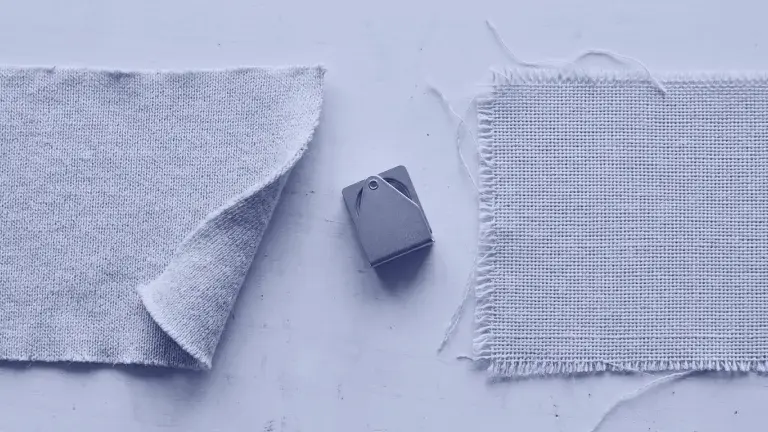
Knit vs Woven Fabric: How to Tell Them Apart
How knit and woven fabrics differ, five checks to tell them apart, the cases that mislead, how to choose by product, and what changes in production, testing and customs classification.
Breathable Fabrics for Summer: Linen, Cotton, Viscose and Modal
No fabric stops sweating, but some manage sweat better. What test data show for linen, cotton, viscose and modal, how construction and weight change the result, and which tests to ask a fabric supplier for.
How to Source Fabric from Turkey: Find, Verify, Compare and Order
What Turkish fabric mills make and who they sell to, where to find them, what to plan for on MOQ and lead time, which tests to request, how EU, UK and US duty rules differ and how to verify a supplier.