Trims and Accessories
What Are Garment Trims? Buttons, Zippers, Labels, Interlining and Elastic
15 min read
Searches companies, categories, products, listings, guides and the glossary.
Browse sectors
Sector
Button and metal trim, zipper, label, interlining, elastic, tape, sewing thread, packaging and hanger suppliers in Turkey in one guide. Pick a sub-sector, then compare companies by location and need.
For buyers
No companies are listed on this page yet. You do not have to wait for the list: describe what you need and request quotes.
Tell us the product, quantity and delivery location. You confirm your request with the link we e-mail you; requests are screened for spam, and our team reviews your first request. It is then sent to up to 20 companies working in this field and stays open for quotes in their company panel for 30 days. You compare the quotes you receive on one page.
Trims and Accessories
Get your company listed on this page. If you manufacture or provide services in this field, create your free profile; companies are listed after our team has reviewed them.
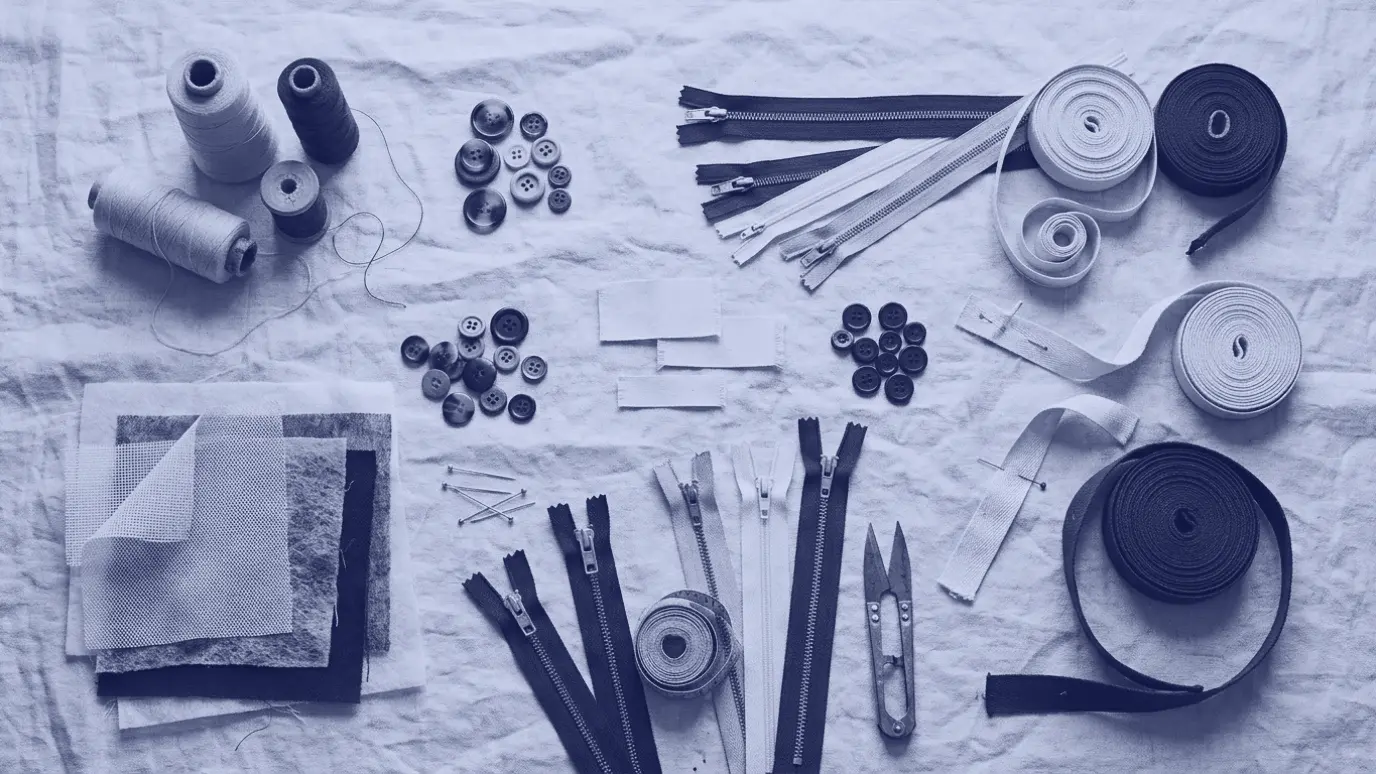
List your company for freeIn garment production, trims (called aksesuar in Turkish trade) are every auxiliary material that goes into a product apart from the fabric: closures, labels, interlining, elastic, tape, sewing thread and packaging. The unit price looks low, but a single wrong or late item can hold up cutting and sewing. This page shows buyers, workshops and sourcing teams which sub-sector to look at first and what to ask the companies.
The directory splits trims into these sub-sectors:
Fabric, lining and industrial cone yarn for knitting and weaving are outside this sector; they are listed in their own sectors (fabrics, yarns). Non-textile items such as jewelry and phone accessories are out of scope too.
In two trims product code groups of the TOBB Industry Database, most manufacturers with a valid capacity report are in Istanbul: 249 of 379 firms under narrow woven fabrics, elastic tape, labels and braids (code 13.96.17) and 137 of 165 under buttons, snap fasteners and zippers (code 32.99.23) (October 2026). Under the first code, Bursa (38) and Denizli (20) follow Istanbul. These codes do not cover interlinings, sewing thread, packaging or hangers. The count includes only manufacturers with a valid capacity report; workshops and trading firms without one are not counted. The province is that of the production facility named in the report. TOBB is the Union of Chambers and Commodity Exchanges of Türkiye.
Which button, zipper and label to use is written in the tech pack and finalized at the sampling stage. In a CMT (contract) model the buyer usually supplies the trims, while in full-package production the manufacturer sources them (see our contract manufacturing guide). This also decides who deals with the trims supplier, so settle it in writing before the order.
Material (metal, plastic, polyester), size and design complexity, custom color, logo and mold, order quantity, packaging and freight set the price. To compare quotes, send every supplier the same written specification and ask for the same price basis (for example ex-works or FOB). If size, color or test requirements differ, the prices cannot be compared.
It depends on the production model. In Turkish trade, contract manufacturing (fason) most often means a model where the buyer supplies the fabric and trims, while in full-package production the manufacturer sources both. Agree in writing which model applies before you place the order.
At the sampling stage. Buyers usually want the pre-production (PP) sample sewn with the real fabric and trims, and bulk production does not start until that sample is approved. Changing a trim after that point disturbs both the approval and the delivery date.
Product information that defines size, material and color, plus an approved sample, are the basic documents. For metal parts that touch the skin (buttons, snaps, zippers), ask for a nickel release test report. If your buyer requires OEKO-TEX STANDARD 100, check that the supplier's certificate covers the product group you are buying and has not expired; a certificate is valid for one year.
They vary by trim type and by company, so no single number applies. Minimum quantity and lead time are set separately for standard stock items and for custom production (custom color, logo or mold); custom production needs preparation, so both can differ from stock items. State size, material, color and quantity in the quote, and ask separately for the lead time from stock, the lead time from production and the reorder time.
In two trims product code groups of the TOBB Industry Database, most manufacturers with a valid capacity report are in Istanbul: 249 of 379 firms under narrow woven fabrics, elastic tape, labels and braids (code 13.96.17) and 137 of 165 under buttons, snap fasteners and zippers (code 32.99.23) (October 2026). Under the first code, Bursa (38 firms) and Denizli (20 firms) follow Istanbul. The count includes only manufacturers with a valid capacity report; workshops and trading firms without one are not counted. These codes do not cover interlinings, sewing thread, packaging or hangers.