What is Gabardine?
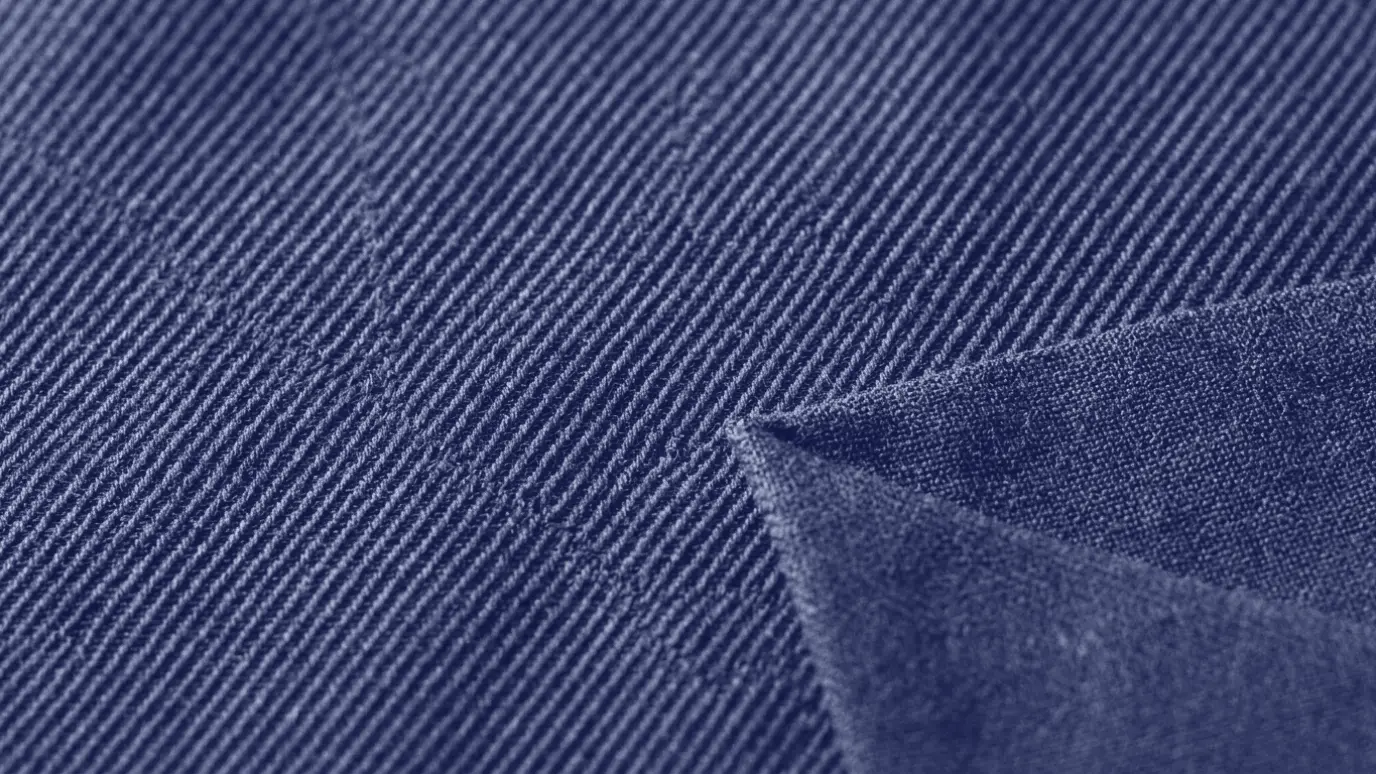
Gabardine is a strong, very closely woven twill fabric with fine, pronounced diagonal lines on the face and a flat back. It is used for trousers, jackets, suits, uniforms and raincoats. Turkish suppliers call it gabardin.
- Published:
- Fact-checked by:
- Gizem Polat
Key facts
- Gabardine is a warp-faced, very densely woven twill, with fine diagonal lines on the face and a flat back.
- The warp is much denser than the weft; Kadolph writes that the warp count is often about twice the weft.
- The diagonal line angle can be 45° (regular) or 63° (steep); 63° gabardine is common in menswear.
- Gabardine is the name of a structure, not a fiber; it is traditionally woven from wool, and also from cotton and other fibers.
- Kadolph gives gabardine weight as 7–11 oz/yd², which is roughly 240–370 g/m².
Properties
- Fiber content
- Generally wool (worsted); cotton, silk, synthetic fibers and blends are also used
- Structure
- Twill (diagonal) weave, warp-faced; warp count often about twice the weft; diagonal angle 45° or 63°
- Weight range
- Kadolph gives 7–11 oz/yd², which is roughly 240–370 g/m² (1 oz/yd² ≈ 33.9 g/m²; our conversion). Commercial products may differ, so confirm on the technical data sheet
- Stretch
- As a woven fabric, stretch is limited by yarn properties and weave structure
- Uses
- Trousers, jackets, suits, uniforms, skirts, raincoats and weather-resistant coats, sportswear and ski clothing
- Care
- Care instructions depend on fiber content and finishing (wool, cotton and synthetic gabardines are cared for differently). Dimensional change after washing is measured by ISO 5077, using ISO 6330 procedures.
Gabardine is a strong, very densely woven twill fabric with fine, pronounced diagonal lines on its face. According to Kadolph it is warp-faced, with far more warp yarn than weft; TRC Needles also writes that the face shows far more warp than weft and that the back is flat. The TDK (Turkish Language Association) dictionary defines gabardin as a kind of thin wool or cotton fabric woven densely (our translation). Gabardine is used in trousers, jackets, suits, uniforms and raincoats.
Gabardine structure
Gabardine belongs to the twill family: a diagonal line forms on the face (CottonWorks). According to Kadolph, the fabric’s distinguishing features are:
- Warp density: There is far more warp yarn than weft, often about twice as much.
- Diagonal angle: The line angle is 45° or 63°. Steep (63°) gabardine is common in menswear and regular (45°) gabardine in womenswear.
- Surface: Fine, slightly raised lines on the face and a flat back (TRC Needles). The luster is matte (Kadolph).
CottonWorks lists gabardine among heavy bottom-weight fabrics woven in 3×1 twill; in a 3×1 twill each warp yarn passes over three weft yarns and under one, which gives higher tear strength. Gabardine is a woven fabric, so its stretch is limited by yarn properties and weave structure (Dönmez, 2008).
Fiber and yarn
Gabardine is generally woven from wool; the best qualities use two-ply worsted yarn (Kadolph). According to Kadolph, gabardine exists in many fiber types, weights and qualities; TRC Needles describes the original fabric as worsted wool, sometimes with cotton added. TDK mentions wool and cotton types.
Gabardine weight (GSM)
Kadolph gives gabardine weight as 7–11 oz/yd². That is roughly 240–370 g/m² (1 oz/yd² ≈ 33.9 g/m²; the conversion is ours). This is a general range from an encyclopedia entry, and the weight of commercial gabardines may differ. Request the weight from the technical data sheet and verify it by ISO 3801 (woven fabric) or EN 12127 (small specimen).
Properties
Kadolph describes gabardine as a strong, durable fabric with a hard or clear finish. Thanks to the tight construction and the firm finish it repels dirt and water and does not crease easily. These properties vary with the fiber, the yarn and the finish; not every gabardine behaves the same way.
Uses
Kadolph writes that gabardine is used in trousers, jackets and suits, uniforms, skirts, raincoats and coats suited to all weather, sportswear, riding clothes, ski clothing, hats and fabric shoes. The fabric is associated with the trench coat: Burberry says its founder developed gabardine in 1879, and TRC Needles says Thomas Burberry patented the fabric in 1888. The dates differ between sources (development and patent may be separate events).
How gabardine differs from similar fabrics
| Fabric | Weave | Distinguishing feature |
|---|---|---|
| Gabardine | Twill, warp-faced | Very dense warp; fine, steep diagonal line (45° or 63°); flat back (Kadolph; TRC Needles) |
| Twill (general name) | Twill | Diagonal line on the face; repeats such as 2×1, 2×2 and 3×1 (CottonWorks). Gabardine is the densely woven member of this family; not every twill is gabardine |
| Denim | Twill (standard 3×1) | Warp dyed with indigo, weft left undyed (CottonWorks) |
| Poplin | Plain weave | No diagonal line; fine rib on a smooth surface |
What to specify when sourcing gabardine
- Write all the components: fiber and percentage, yarn (single or two-ply), warp and weft density (ISO 7211-2), diagonal type (45° or 63°) and weight.
- Ask for the weight in g/m² and with the test method: ask whether the value was measured by ISO 3801 or EN 12127. A value given in oz/yd² can be converted to g/m² by multiplying by about 33.9.
- Have a water-repellency claim documented: Kadolph describes the tight construction and hard finish, and TRC Needles describes the yarns of historic gabardine being treated with lanolin before weaving. The name gabardine alone does not give water repellency; ask for the finish and a test report.
- Put the shrinkage figure in the report: width and length change of gabardine is measured to ISO 5077, and washing and drying follow ISO 6330.
For a general classification of fabrics see the fabric types guide; for gabardine suppliers see the gabardine category.
Frequently asked questions
Is gabardine the same as twill?
Gabardine is a twill fabric, but not every twill is gabardine. Gabardine is a warp-faced, very densely woven twill with fine diagonal lines (Kadolph); twill is the general name of the weave and also covers other fabrics such as denim (CottonWorks).
Does gabardine wrinkle?
According to Kadolph it does not crease easily because of its tight construction and firm finish. This varies with the fiber, yarn and finish of the fabric.
What fiber is gabardine made of?
Gabardine is the name of a structure. It is traditionally woven from wool (worsted), and also from cotton, other fibers or blends (Kadolph; TRC Needles; TDK).
Is gabardine waterproof?
Not every gabardine is waterproof. The tight weave and firm finish help repel dirt and water (Kadolph); according to TRC Needles, the water resistance of Burberry’s historic gabardine came from treating the yarns with lanolin before weaving. Ask for a test report for any water-repellent or waterproof claim.
Sources (12)
- Kadolph, S. J., “Gabardine”, Encyclopedia of Clothing and Fashion (Gale), Encyclopedia.com (accessed October 9, 2026)
- Textile Research Centre Leiden, TRC Needles: Gabardine (WV, March 23, 2022)
- TDK Güncel Türkçe Sözlük (Turkish Language Association dictionary), entry “gabardin” (accessed October 9, 2026)
- CottonWorks (Cotton Incorporated): Basic Woven Fabric Designs (accessed October 9, 2026)
- CottonWorks (Cotton Incorporated): Denim Construction (accessed October 9, 2026)
- Burberry, Trench Coat: Heritage (accessed October 9, 2026)
- Dönmez, E. T. (2008). Yuvarlak örme kumaşlarda kumaş gramajına etki eden faktörler üzerine bir araştırma (A study on the factors affecting fabric weight in circular knitted fabrics; in Turkish). Dokuz Eylül University Graduate School of Natural and Applied Sciences, master’s thesis (p. 1)
- ISO 3801:1977 Textiles: Woven fabrics: Determination of mass per unit length and mass per unit area (EVS record)
- ISO 7211-2:2024 Textiles: Methods for analysis of woven fabrics construction: Determination of number of threads per unit length (BSI record, published August 22, 2024)
- EN 12127:1997 Textiles. Fabrics. Determination of mass per unit area using small samples (BS EN 12127:1998 record; applies to woven and knitted fabrics)
- ISO 6330:2021 Textiles: Domestic washing and drying procedures for textile testing
- ISO 5077:2007 Textiles: Determination of dimensional change in washing and drying (confirmed in 2022)
Author and fact-checking
Written by
Fabrics and Fibers Editor
Elif Karaca is Tekstil Rehberi's fabrics and fibers editor. She writes guides and glossary entries on knitted, woven and nonwoven fabrics, fiber properties and choosing the right fabric for each product, and bases values such as GSM, width, shrinkage and color fastness on standards and mill technical data sheets.
Content by Elif KaracaFact-checked by: Gizem Polat
This content was prepared by the Tekstil Rehberi editorial team. Before publication, our verification editor checked its figures, dates and sources against primary sources.
Spotted an error? Email us at [email protected] How we work →