What is Three-Thread Fleece?
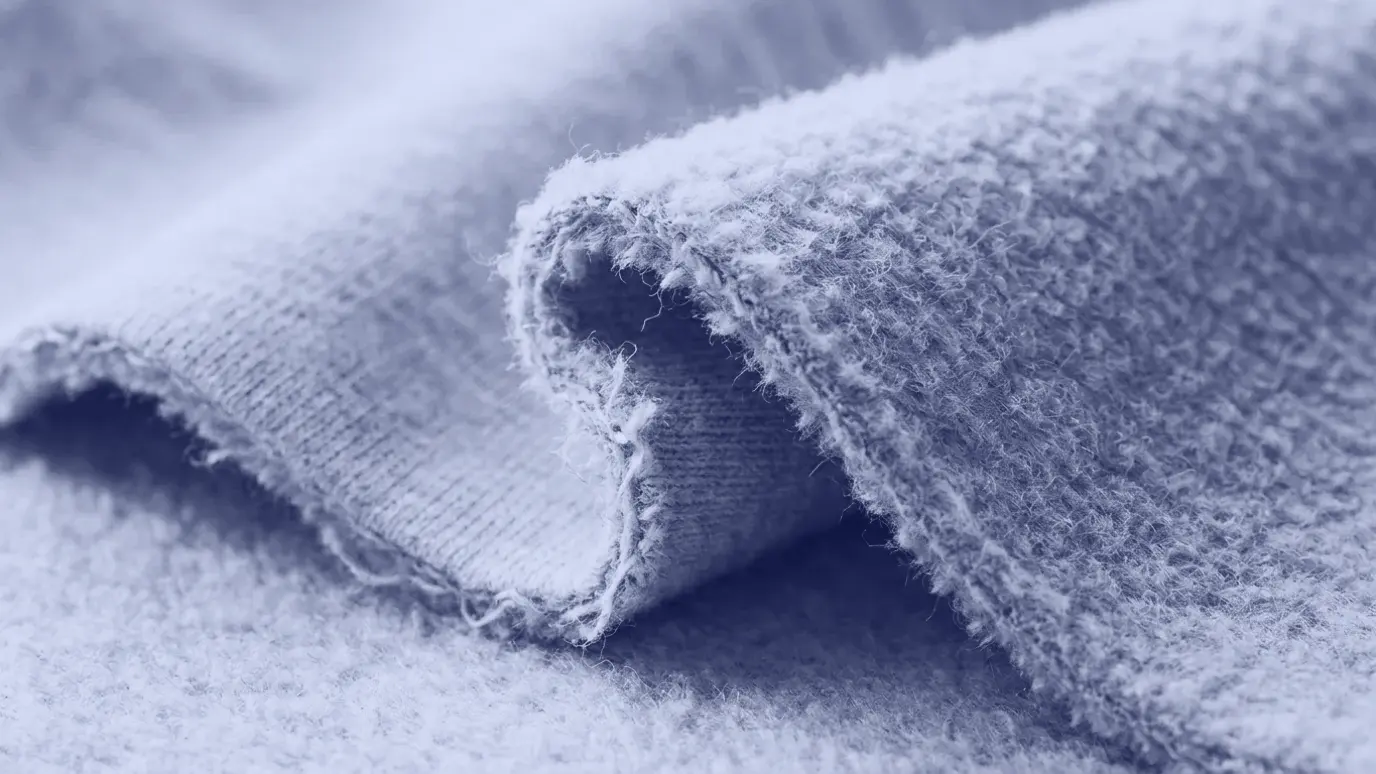
Three-thread fleece is a circular-knit fleece fabric made by adding a filler (pile) yarn, held in place by a tie-in yarn, to the ground yarn that forms the face. It is fuller and more stable than two-thread fleece and is used for sweatshirts, hoodies and joggers.
- Published:
- Updated:
- Fact-checked by:
- Gizem Polat
Key facts
- Three-thread fleece adds a filler (pile) yarn and a tie-in yarn to the ground yarn.
- CottonWorks describes three-end fleece as the most stable and fullest fleece, because it uses three yarns instead of two.
- The reverse can be left unbrushed or brushed to give a soft, fluffy inner face.
- Supplier weight claims run from about 200 to 420 g/m²; there is no standard range.
- Pilling is a common surface defect in cotton-polyester blend fleece fabrics.
Properties
- Fiber content
- Cotton, cotton-polyester blends (CVC, PC) and polyester; elastane versions exist
- Structure
- Circular knit; three-yarn system (ground, tie-in and filler/pile yarn); reverse brushed or unbrushed
- Weight range
- No standard range. Supplier claims run from about 200 to 420 g/m² (5.9–12.4 oz/yd²), and brushed types are quoted at 250–420 g/m² (7.4–12.4 oz/yd²), depending on the source. In one study the target weight for finished fleece was 300 g/m² (8.8 oz/yd²)
- Stretch
- Described as the most stable and fullest fleece structure (CottonWorks); there is no standard stretch value
- Uses
- Sweatshirts, hoodies, joggers; winter sweaters and jacket-type garments
- Care
- Care instructions depend on fiber content and finishing. Dimensional change after washing is measured by ISO 5077, using ISO 6330 washing and drying procedures.
Three-thread fleece is a fleece fabric knitted by adding a filler (pile) yarn, held in place by a tie-in yarn, to the ground yarn that forms the face. CottonWorks says three-end fleece makes “the most stable and fullest fleece” because it uses three yarns instead of two. The reverse can be left unbrushed or brushed, and the fabric is used for sweatshirts, hoodies and joggers. Turkish suppliers call it üç iplik (“three thread”).
Three-thread fleece structure
CottonWorks counts three yarns: the face (ground) yarn, the tie-in yarn and the pile yarn. Sources name the yarn roles differently: Fersan speaks of base, filler and tie-in yarns, and Hossain et al. (2021) of top, middle and bottom layers. In the fabric studied by Hossain et al., the face yarn was a Ne 30 cotton-polyester blend, the tie-in yarn was a 100-denier polyester filament and the filler (fleecy) yarn was Ne 10 cotton; the fabric was knitted on a 34-inch, 20-gauge machine. Uyanık (2023) treats two- and three-thread fabrics together under the name backed knit (Turkish: astarlı örgü, fleece).
Brushed and unbrushed three-thread fleece
According to one manufacturer, the reverse can be left unbrushed or brushed to give a soft, fluffy inner face (Fersan). For fleece, CottonWorks states that the loops on the technical back are brushed, and that the structure is used in cold-weather garments that need extra warmth protection. One producer recommends brushed three-thread for autumn and winter and the unbrushed “diagonal” type for the in-between seasons (Altunkaya, 2024).
Three-thread fleece weight (GSM)
There is no standard weight range for three-thread fleece; weight varies with yarn counts, fiber composition, brushing and finishing. Supplier claims and one measurement:
| Source | Fabric | Weight (g/m²) |
|---|---|---|
| Fersan, October 3, 2026 | Mostly polyester three-thread; brushed 250–350, unbrushed 220–330 | 200–350 |
| Karcem, September 26, 2026 | Cotton, polyester; brushed | 280–420 |
| Altunkaya, June 30, 2026 | Summer sweatshirt (French terry, diagonal three-thread) / winter jogger (brushed) | 280–320 / 310–380 |
| Hossain et al., 2021 | CVC and PC blend fleece: greige / after compacting | 264–274 / 337–342 |
Hossain et al. report that the weight of the same fabric rose through the finishing steps and that the target was 300 g/m². Have the stage of measurement (greige or finished) written into the order. An ounce-per-square-yard figure becomes g/m² when multiplied by roughly 33.9.
Uses
Karcem and Fersan present three-thread as a sweatshirt, hoodie and jogger fabric; Fersan calls it the basic fabric of heavy sweatshirts, winter hoodies and joggers (our translation from the Turkish). Hossain et al. (2021) list sweaters and jackets among garments worn in outdoor activities, especially in winter. For a comparison of fabric groups see the fabric types guide, and for weight by product see fabric weight for T-shirts, hoodies and joggers.
Pilling
Pilling (balls of fiber forming on the surface) is a common surface defect in cotton-polyester blend fleece fabrics (Hossain et al., 2021). Drawing on earlier studies, the same paper notes that adding polyester fiber to a fabric increases pilling; in its own experiment it measured pilling by the ISO 12945-1 (pilling box) method. ISO 12945-1 (pilling box) and ISO 12945-2 (modified Martindale) are the test methods in use; write the acceptance limit into the contract.
How it differs from two-thread fleece
Two-thread fleece is knitted with a ground and a backing yarn; three-thread with a ground, a tie-in and a filler yarn. Fersan says the filler yarn adds body and warmth that two-thread does not have. Supplier weight claims are also generally higher for three-thread (Karcem: two-thread 220–320 g/m², brushed three-thread 280–420 g/m²). See the two-thread fleece entry for details.
What to specify when sourcing three-thread fleece
- Write the composition as a percentage (for example the cotton-polyester ratio) and state whether the reverse is brushed or unbrushed.
- Ask for the weight with its state of measurement: greige and finished values differ.
- Ask for the pilling result: by ISO 12945-1 or -2, together with the acceptance grade.
- Request shrinkage results for three-thread fleece: for the ISO 5077 change in width and length, the sample goes through ISO 6330 washing and drying procedures.
Frequently asked questions
Is three-thread fleece a winter fabric? Brushed three-thread is recommended for autumn and winter (Altunkaya, 2024; Fersan). Unbrushed and lighter types can also be used in the in-between seasons; look at the weight and the reverse.
What is the difference between two-thread and three-thread fleece? Three-thread has an extra filler yarn and a tie-in yarn, and the fabric is fuller and more stable (CottonWorks). Weight claims are generally higher.
Sources (11)
- CottonWorks (Cotton Incorporated): Single Knits and Double Knits (accessed October 9, 2026)
- Hossain, M. S., Islam, M. M., Dey, S. C., Hasan, N. (2021). An approach to improve the pilling resistance properties of three thread polyester cotton blended fleece fabric. Heliyon, 7(4), e06921. DOI: 10.1016/j.heliyon.2021.e06921
- Uyanık, S. (2023). İki iplik örme kumaşlarda farklı astar ipliği oranlarının kumaş özelliklerine etkileri (The effects of different backing yarn ratios on the properties of two-thread knitted fabrics; in Turkish). Çukurova University Journal of the Faculty of Engineering, 38(3), 819-826
- Fersan Tekstil (polyester knitted fabric manufacturer): Üç İplik Kumaş (three-thread fabric; Turkish; updated October 3, 2026; accessed October 9, 2026)
- Karcem Tekstil (raw knitted fabric manufacturer): Örme Kumaş: Çeşitleri, Gramaj Tablosu ve Üretimi (knitted fabric: types, weight table and production; Turkish; last updated September 26, 2026; accessed October 9, 2026)
- Altunkaya Tekstil: Kumaş GSM (Gramaj) Nedir? (What is fabric GSM (weight)?; Turkish; June 30, 2026; accessed October 9, 2026)
- Altunkaya Tekstil: 2 İplik ve 3 İplik Farkı Nedir? (What is the difference between two-thread and three-thread?; Turkish; July 20, 2024; accessed October 9, 2026)
- EN ISO 12945-1:2020 Textiles: Determination of fabric propensity to surface pilling, fuzzing or matting. Part 1: Pilling box method (EVS record)
- EN ISO 12945-2:2020 Textiles: Determination of fabric propensity to surface pilling, fuzzing or matting. Part 2: Modified Martindale method (EVS record)
- ISO 6330:2021 Textiles: Domestic washing and drying procedures for textile testing
- ISO 5077:2007 Textiles: Determination of dimensional change in washing and drying (confirmed in 2022)
Author and fact-checking
Written by
Fabrics and Fibers Editor
Elif Karaca is Tekstil Rehberi's fabrics and fibers editor. She writes guides and glossary entries on knitted, woven and nonwoven fabrics, fiber properties and choosing the right fabric for each product, and bases values such as GSM, width, shrinkage and color fastness on standards and mill technical data sheets.
Content by Elif KaracaFact-checked by: Gizem Polat
This content was prepared by the Tekstil Rehberi editorial team. Before publication, our verification editor checked its figures, dates and sources against primary sources.
Spotted an error? Email us at [email protected] How we work →
Articles on this topic
What GSM Should a T-Shirt Be? Fabric Weight for T-Shirts, Hoodies and Joggers
GSM ranges for T-shirts, hoodies and joggers, what light, mid and heavy weights mean, why one fabric can carry different GSM figures, and how to write GSM into a supplier spec.