What is Denim?
Denim is a durable woven fabric with indigo-dyed warp yarns and undyed weft yarns, most often made in a 3×1 or 2×1 twill weave. Turkish suppliers also call it kot; jeans are made from it.
- Published:
- Updated:
- Fact-checked by:
- Gizem Polat
Key facts
- Denim is a woven fabric with an indigo-dyed warp and an undyed weft, made in a twill weave.
- Indigo does not dye the yarn through: the dye collects in the outer layers and leaves a white core in the middle of the yarn.
- Denim weight is quoted in oz/yd²; 1 oz/yd² is about 33.9 g/m².
- Finished denim mostly runs from 3.5 to 16.5 oz/yd²: lighter types go into shirts, heavier ones into trousers and jackets.
- Standard denim has little stretch; stretch denim is woven with elastane-core yarn.
Properties
- Fiber content
- Mostly cotton; cotton-polyester blends and blends containing elastane are common. Studies have also been made with other fibers, such as modal and Tencel-brand fibers
- Structure
- Woven; indigo-dyed warp, undyed weft; the warp dominates the face. Mostly 3×1 or 2×1 twill, also broken 3×1 twill
- Weight range
- No single standard. According to CottonWorks, finished denim runs from 3.5 to 16.5 oz/yd² (about 119–559 g/m²): 3.5–8 oz/yd² is used in blouses and shirts, 8–16.5 oz/yd² in trousers, jeans and jackets
- Stretch
- Standard denim has little stretch; stretch types are woven with elastane-core yarn
- Uses
- Jeans, jackets and coats; lighter denims in shirts and blouses
- Care
- Care instructions depend on fiber content and wash finish. Dimensional change is measured by ISO 5077 (with ISO 6330 procedures); transfer of indigo to other surfaces is measured by ISO 105-X12 (color fastness to rubbing).
Denim is a fabric woven with indigo-dyed warp yarns and undyed weft yarns, most often in a twill weave and most often from cotton. Turkish suppliers also call it kot. The Turkish Language Association (TDK) defines denim as “a type of cotton fabric used in making kot and similar items” (our translation). Denim is not a fiber name: the twill weave (structure) and the indigo-dyed warp (dyeing) together make denim. For a comparison of woven fabric families, see the fabric types guide.
Denim fabric structure
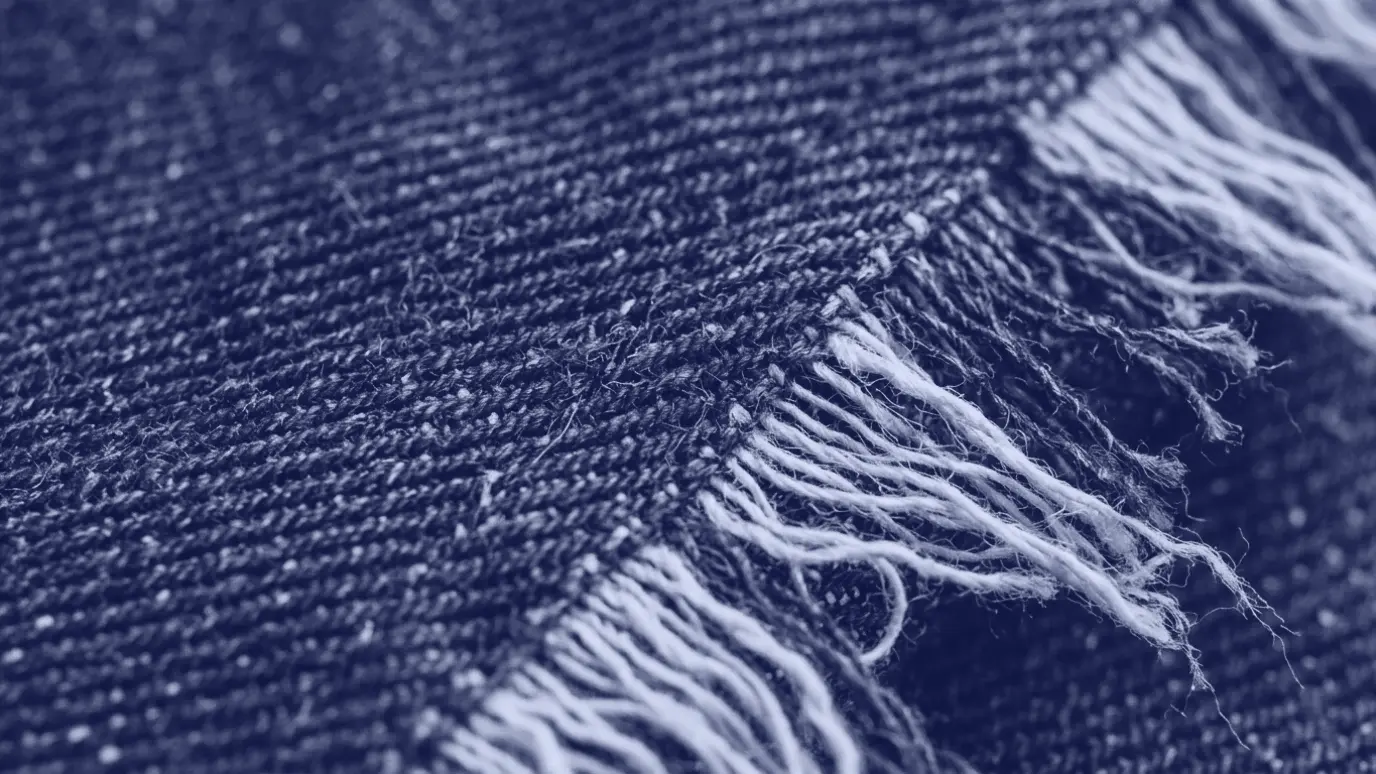
Denim’s distinguishing feature is a dyed warp, an undyed (white) weft, and a face on which the warp dominates (Gündüz, 2023, p. 3; CottonWorks). The Getty Art & Architecture Thesaurus likewise defines denim as a heavy, twill-woven fabric with a warp-dominant (warp-flush) face.
Indigo does not dye the yarn all the way through: the dye collects in the outer layers and leaves a white core. With most dyes this “ring dyeing” counts as a defect; with indigo it is the intended result. For a dark blue the warp is usually dipped in the dye bath three to nine times (CottonWorks, Denim Construction).
The weave is mostly 3×1 twill, 2×1 twill or broken 3×1 twill (Gündüz, 2023, p. 4). CottonWorks mentions 2×1 and 3×1 twill, gives 3×1 twill as the standard denim structure, and also describes broken twill, where the twill line is broken at intervals. In 3×1 twill the floats are longer, there are fewer binding points and tear strength is higher (CottonWorks, Basic Woven Fabric Designs). In twill the floating yarns stack on one another, which increases thickness and weight (Bottan, 2012, cited in Gündüz, 2023, p. 5).
Yarn counts in denim are generally Ne 4–13 (English cotton count). Ring-spun and open-end yarns are both used, with open-end often chosen for the weft (Acar, 2005, cited in Gündüz, 2023, p. 4). The spinning system of warp and weft is written in that order as “Ring-Ring”, “OE-OE” or “Ring-OE”. Ring yarn is chosen for higher strength and a softer handle; open-end yarn is generally cheaper at the same count (CottonWorks).
Denim weight: oz/yd² and g/m²
Denim weight is quoted in oz/yd² (ounces per square yard). 1 oz/yd² is about 33.9 g/m² (NIST SP 811: 0.03390575 kg/m²), and the g/m² values below are calculated with that factor:
| Use | oz/yd² | g/m² (approx.) | Source |
|---|---|---|---|
| Blouses, tops, shirts | 3.5–8 | 119–271 | CottonWorks |
| Trousers, jeans, jackets | 8–16.5 | 271–559 | CottonWorks |
| Shirting | 4.5–7.5 | 153–254 | Acar (2005), cited in Gündüz (2023) |
| Summer trousers | 9–13.5 | 305–458 | Acar (2005), cited in Gündüz (2023) |
| Trousers and coats | 14–15 | 475–509 | Acar (2005), cited in Gündüz (2023) |
CottonWorks puts finished denim at 3.5–16.5 oz/yd². The denim publication Denimhunters treats under 12 oz as light, 12–16 oz as medium and over 16 oz as heavy, and stresses that these are traditions, not a global standard. So the thresholds depend on the source: in a quotation, give weight in both oz/yd² and g/m², with the test method. For small specimens, EN 12127 is the method for weight per square meter; it covers woven as well as knitted fabric.
Fiber and type differences
- Cotton and cotton-polyester: Cotton is the most common fiber (Gündüz, 2023, p. 3). Cotton-polyester denims are widely used for their stretch performance (Gündüz, 2023, p. 4).
- Stretch denim: Elastane is added because the elasticity of natural fibers is insufficient (Kertmen, 2021, cited in Gündüz, 2023, p. 4). Elastane-core yarns can be made on ring spinning machines, and also on air-jet and open-end machines; standard denim has little stretch (CottonWorks).
Washing and finishing
Denim can be washed as fabric or as a finished garment. The main wash types are bleaching, enzyme wash, stone wash and rinse (Gündüz, 2023, pp. 6–8). CottonWorks describes stone wash as adding pumice stones to the wash to speed up fading and softening, and rinse as desizing, softening and brightening color without an abrasion step. According to the same source, enzymes can cause weight loss and sometimes a drop in fiber strength. In a study comparing rinse, enzyme and enzyme-stone washing, all washes reduced strength, and the largest strength loss was measured after enzyme-stone washing (Karazincir and Duru Baykal, 2014, cited in Gündüz, 2023, p. 9).
What to specify when sourcing denim
- Ask for the spinning system and count of warp and weft yarn. A notation such as “Ring-OE” lets you compare two fabrics.
- State fiber composition as percentages. Higher-elastane denims have been reported to show more shrinkage, mass change and thickness change after washing (Kan and Yuen, 2009, cited in Gündüz, 2023, pp. 8–9).
- Get the shrinkage as a number: denim's width and length change is measured to ISO 5077, and the washing and drying steps rely on ISO 6330 procedures. In the same study the dimensions of elastane denims stabilized after the fifth wash; as this is a single study, ask for repeated wash trials on your own fabric.
- Test for indigo rub-off: rubbing fastness to ISO 105-X12. Indigo leaves the surface with washing and abrasion, so write the fastness limit into the specification for washed products.
Frequently asked questions
Is denim the same as kot?
In Turkish the two are mostly used with the same meaning. TDK defines denim as “a type of cotton fabric used in making kot and similar items”, and kot as coarse cotton fabric and the garment made from it (jeans); both are our translations. To reduce confusion with Turkish suppliers, say “denim” for the fabric and “jeans” for the garment.
What is the difference between denim and twill?
Twill is a weave that forms diagonal lines on the fabric surface. Denim is a fabric woven in that weave with an indigo-dyed warp and an undyed weft; not every twill fabric is denim. CottonWorks also lists 3×1 twill in chino and gabardine, other heavy bottom-weight fabrics.
Sources (15)
- CottonWorks (Cotton Incorporated), Textile Encyclopedia: Denim (accessed October 9, 2026)
- CottonWorks (Cotton Incorporated), Learning Hub: Denim Basics (finished denim weights, broken twill; accessed October 9, 2026)
- CottonWorks (Cotton Incorporated), Learning Hub: Denim Construction (accessed October 9, 2026)
- CottonWorks (Cotton Incorporated), Learning Hub: Denim Finishing (accessed October 9, 2026)
- CottonWorks (Cotton Incorporated), Learning Hub: Basic Woven Fabric Designs (accessed October 9, 2026)
- Getty Research Institute, Art & Architecture Thesaurus: denim (AAT 300014068; accessed October 9, 2026)
- Gündüz, Y. Ş. (2023). Denim kumaşlarda üretim parametrelerinin tutum ve performans özellikleri üzerine olan etkisinin araştırılması (Investigation of the effect of production parameters on the handle and performance properties of denim fabrics; in Turkish). Bursa Uludağ University Graduate School of Natural and Applied Sciences, master’s thesis (pp. 3–9)
- NIST Special Publication 811, Guide for the Use of the International System of Units, Appendix B.8: Factors for units listed alphabetically (oz/yd² to kg/m²; accessed October 9, 2026)
- Denimhunters, Denim Weight: What Is ‘Ounce’ and Why Does It Matter? (denim publication; undated; accessed October 9, 2026)
- Turkish Language Association (TDK), Güncel Türkçe Sözlük (current Turkish dictionary; in Turkish), entry “denim” (accessed October 9, 2026)
- Turkish Language Association (TDK), Güncel Türkçe Sözlük (current Turkish dictionary; in Turkish), entry “kot” (accessed October 9, 2026)
- EN 12127:1997 Textiles. Fabrics. Determination of mass per unit area using small samples (EVS-EN 12127:2000 record; applies to woven and knitted fabrics)
- ISO 5077:2007 Textiles: Determination of dimensional change in washing and drying (confirmed in 2022)
- ISO 6330:2021 Textiles: Domestic washing and drying procedures for textile testing
- ISO 105-X12:2016 Textiles: Tests for colour fastness, Part X12: Colour fastness to rubbing (EVS-EN ISO 105-X12:2016 record)
Author and fact-checking
Written by
Fabrics and Fibers Editor
Elif Karaca is Tekstil Rehberi's fabrics and fibers editor. She writes guides and glossary entries on knitted, woven and nonwoven fabrics, fiber properties and choosing the right fabric for each product, and bases values such as GSM, width, shrinkage and color fastness on standards and mill technical data sheets.
Content by Elif KaracaFact-checked by: Gizem Polat
This content was prepared by the Tekstil Rehberi editorial team. Before publication, our verification editor checked its figures, dates and sources against primary sources.
Spotted an error? Email us at [email protected] How we work →
Related calculator
Articles on this topic
Denim Wash Types and Techniques: Stone, Enzyme, Ozone, Laser
Denim wash types explained: dry and wet processes, stone, enzyme, rinse, bleach, ozone and laser, their effects on strength and shrinkage, the sandblasting ban in Turkey and what to ask a washing plant.