What is Twill?
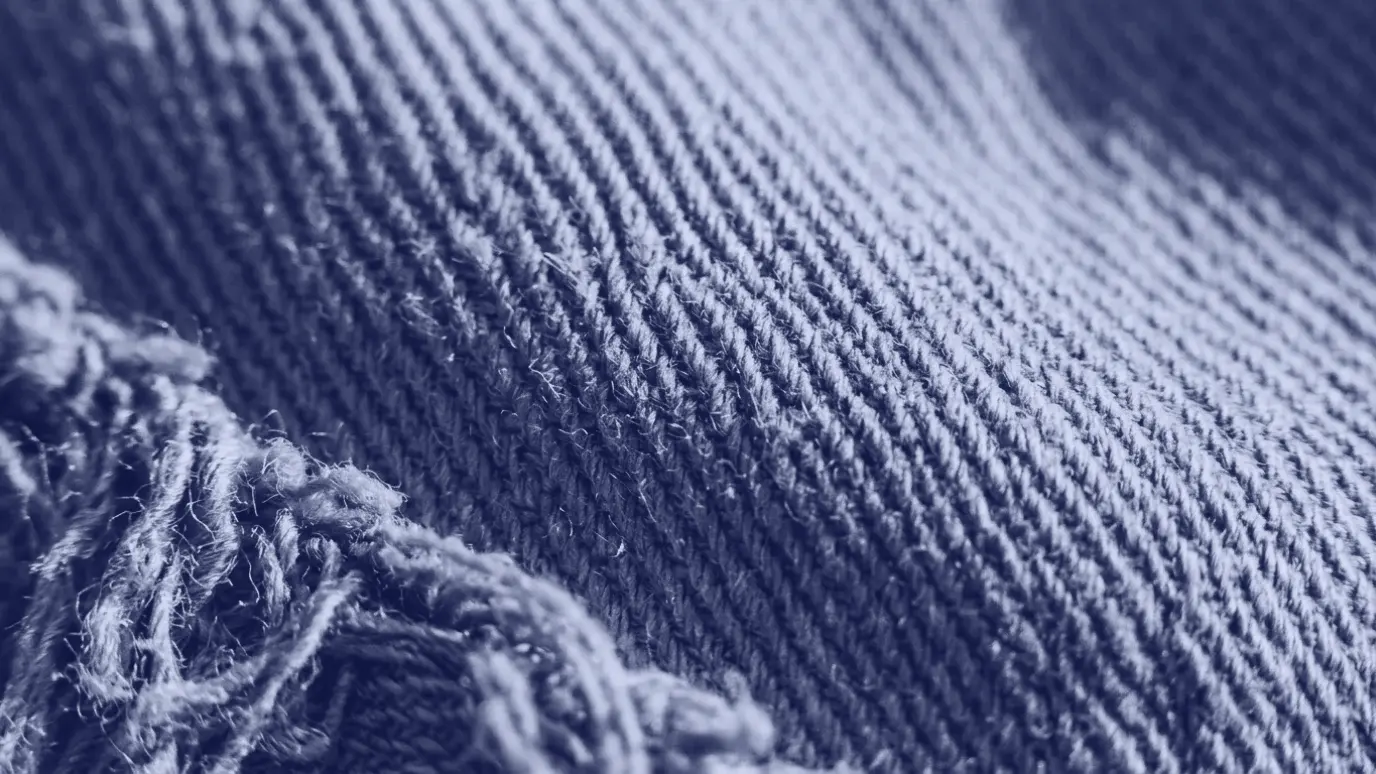
Twill is a basic weave in which warp and weft yarns interlace so that diagonal lines form on the fabric surface. Denim, gabardine and chino trouser fabrics are woven in twill. In Turkish it is called dimi.
- Published:
- Fact-checked by:
- Gizem Polat
Key facts
- Twill forms diagonal lines on the fabric surface; with plain weave and satin it is one of the three basic weaves.
- The smallest twill repeat is 3 warp × 3 weft; the weave is written 2/1, 2/2 or 3/1.
- A diagonal rising to the right is right-hand twill (Z), to the left left-hand twill (S); per CottonWorks, direction should not change weaving cost.
- In heavy bottom-weight fabrics such as denim, gabardine and chino, the most common twill is 3/1 right-hand twill.
Properties
- Structure
- One of the basic weaves; a diagonal line on the surface (the twill line); smallest repeat 3 warp × 3 weft (2/1 twill)
- Fiber content
- The weave is independent of fiber type; cotton twills such as denim and chino are common
- Uses
- Denim, gabardine, chino, serge, whipcord; herringbone and chevron patterned fabrics
Twill is a weave in which warp and weft yarns are bound so that diagonal lines (the twill line) form on the fabric surface. It is one of the three basic weaves, with plain weave and satin, and the diagonal line on the face is the easiest way to recognize it (CottonWorks). The Turkish word is dimi, and in Turkish it is sometimes the name of a fabric rather than of the weave: the Turkish Language Association (TDK) dictionary also defines the word as “a type of closely woven cotton fabric” (our translation). Writing the weave and the fiber separately in a quotation avoids this confusion.
Twill structure
In twill the binding points shift one step at each neighboring warp yarn, and this shift forms continuous diagonal rows on the surface. Twill cannot be made with a repeat shorter than three yarns; its smallest repeat is therefore 3 warp × 3 weft (İTÜ course material; CottonWorks).
- Notation. Twill is written 2/1, 2/2 or 3/1. The upper number shows how many weft yarns one warp yarn passes over (floats over), the lower number how many it passes under. A 2/1 twill repeats on 3 warp × 3 weft, 2/2 and 3/1 twill on 4 × 4 (CottonWorks). CottonWorks also writes the same weave as “2 x 1” and “3 x 1”; the denim entry here uses the 3×1 form, and 3×1 and 3/1 are the same weave.
- Direction. If the diagonal rises to the right it is right-hand twill (Z); if it rises to the left it is left-hand twill (S) (İTÜ; CottonWorks). According to CottonWorks, there should be no difference in weaving cost between right-hand and left-hand twill.
- Balanced and unbalanced twill. Balanced twills such as 2/2, 3/3 and 4/4 show both yarn sets equally on the face when used in a square fabric with equal warp and weft density. In unbalanced twills such as 3/1 the warp dominates the face (warp-faced); in ones such as 1/2 the weft does (weft-faced). Denim is an example of a fabric woven in warp-faced 3/1 twill (İTÜ).
Properties of twill
- Density and weight. With the same yarn, twill can be given a higher density than plain weave, which makes it possible to weave a heavier fabric from similar yarn. If the density is kept the same, twill gives a looser structure than plain weave (İTÜ). According to Pratt Institute, twill is generally woven more densely and is therefore a stronger, more durable fabric.
- Long floats, few binding points. In 3/1 twill the floats are longer than in other twills and there are fewer binding points; CottonWorks says this structure gives fabrics with high tear strength. The float has a limit: if it is too long the fabric can lose its balance and become prone to sagging (İTÜ).
- How pronounced the line is depends on float length. 2/1 twill has shorter floats than 4/1 twill. If warp and weft differ in color, yarn thickness or twist, the diagonal line looks more pronounced (İTÜ).
- The angle of the line depends on density. If the warp density is higher than the weft density, the line is steeper; comparing serge and gabardine in the same 2/2 structure, the line looks steeper in gabardine, whose warp count is twice the weft count (İTÜ).
Fabrics woven in twill
| Fabric | Relation to twill |
|---|---|
| Denim | Warp-faced 3/1 twill (İTÜ); Pratt Institute notes denim is generally twill |
| Gabardine, chino | CottonWorks lists denim, chino and gabardine among heavy bottom-weight fabrics woven in 3/1 twill; the most common twill in this group is 3/1 right-hand twill. İTÜ, however, explains gabardine with a 2/2 twill example; the structure can vary by fabric |
| Serge | 2/2 twill, balanced (İTÜ) |
| Whipcord | Some whipcord fabrics are woven with partly long floats to give a steep, sharp diagonal line (İTÜ) |
| Flannel | The İTÜ course material lists it in its table of fabrics made from twill weaves; CottonWorks, however, defines flannel as a brushed woven fabric without naming a weave. So not every flannel is twill |
| Herringbone, chevron | Made from 2/2 right-hand twill by changing the order in which warp yarns are drawn through the harnesses (CottonWorks) |
Telling twill from other weaves and names
- Plain weave: warp and weft pass over and under each other in turn (Pratt Institute). In twill, parallel diagonal ridges are visible on the surface (Pratt Institute). For a comparison of the three basic weaves, see the fabric types guide.
- Plaid: plaid is a pattern, twill is a weave. The İTÜ table of twill fabrics also lists houndstooth and glen plaid, so a plaid pattern can be woven in twill.
- Twill fabric (dimi kumaş): according to TDK, dimi can also be a fabric name. In an expression such as “dimi trouser fabric”, make clear whether the weave or the closely woven cotton fabric is meant.
How to write it in a quotation
Write the weave, the fiber and the measurements separately: “3/1 Z twill, 100% cotton, warp and weft yarn counts, density (ends/cm and picks/cm), weight, finish”. Settle the choice of right-hand or left-hand twill at sample approval; according to CottonWorks, direction should not change weaving cost.
Frequently asked questions
What is the difference between twill and plain weave?
In plain weave warp and weft pass over and under each other in turn; in twill, diagonal ridges form on the surface. According to Pratt Institute, twill is generally woven more densely and gives a stronger, more durable fabric.
Is denim a twill?
Yes. Denim is generally woven in twill (Pratt Institute); warp-faced 3/1 twill is given as an example (İTÜ).
Is there a difference between right-hand and left-hand twill?
The difference is the direction of the diagonal line: a line rising to the right is right-hand twill (Z), one rising to the left is left-hand twill (S). According to CottonWorks, the weaving cost of the two directions should not differ.
Sources (6)
- CottonWorks (Cotton Incorporated): Basic Woven Fabric Designs (accessed October 9, 2026)
- CottonWorks (Cotton Incorporated): Textile Encyclopedia, Twill (accessed October 9, 2026)
- CottonWorks (Cotton Incorporated): Textile Encyclopedia, Flannel (accessed October 9, 2026)
- Pratt Institute Textile Research Lab: Wovens (accessed October 9, 2026)
- Istanbul Technical University (İTÜ), Tekstil Teknolojisi (textile technology course material; in Turkish), section “Dimi Dokumalar” (twill weaves) and Table 9 “Dimi dokumadan yapılan kumaşlar” (fabrics made from twill weaves) (accessed October 9, 2026)
- Turkish Language Association (TDK), Güncel Türkçe Sözlük (current Turkish dictionary; in Turkish), entry “dimi” (accessed October 9, 2026)
Author and fact-checking
Written by
Fabrics and Fibers Editor
Elif Karaca is Tekstil Rehberi's fabrics and fibers editor. She writes guides and glossary entries on knitted, woven and nonwoven fabrics, fiber properties and choosing the right fabric for each product, and bases values such as GSM, width, shrinkage and color fastness on standards and mill technical data sheets.
Content by Elif KaracaFact-checked by: Gizem Polat
This content was prepared by the Tekstil Rehberi editorial team. Before publication, our verification editor checked its figures, dates and sources against primary sources.
Spotted an error? Email us at [email protected] How we work →
Articles on this topic
Bed Linen Fabric Types: Percale, Sateen and Thread Count
Percale, sateen, ranforce and flannel compared: what thread count means per inch and as the Turkish per-centimeter “tel”, why “600 thread count” can mislead, and a checklist for writing a spec.
Knit vs Woven Fabric: How to Tell Them Apart
How knit and woven fabrics differ, five checks to tell them apart, the cases that mislead, how to choose by product, and what changes in production, testing and customs classification.
How to Source Fabric from Turkey: Find, Verify, Compare and Order
What Turkish fabric mills make and who they sell to, where to find them, what to plan for on MOQ and lead time, which tests to request, how EU, UK and US duty rules differ and how to verify a supplier.