What is Rib Knit?
Rib knit is a stretchy knitted fabric made on a double-bed machine, with knit and purl wales (loop columns) alternating across the width. It stretches strongly crosswise, recovers well and is widely used for collars, cuffs and waistbands; Turkish suppliers call the standard 1x1 rib ribana.
- Published:
- Updated:
- Fact-checked by:
- Gizem Polat
Key facts
- Rib knit is a double-bed knit in which knit and purl wales alternate across the width; Turkish suppliers call the standard 1x1 rib ribana.
- Crosswise stretch is about twice that of single jersey and the fabric returns to size after stretching, which is why it is used for collars, cuffs and waistbands.
- In Turkey ribana mostly means 1x1 rib and 2x2 rib is called kaşkorse, so write 1x1 or 2x2 in your order.
- As the wales widen, for example from 2x1 to 3x3, the fabric gets thicker and stretches less.
- There is no standard weight range; one knitted-fabric manufacturer quotes 180–260 g/m² for ribana (Karcem, September 2026).
Properties
- Fiber content
- Cotton is common; cotton-elastane and polyester ribs are also made
- Structure
- Double-bed knit (on circular machines: cylinder and dial, “çift plaka”, double plate, in Turkish trade usage); knit and purl wales alternate (1x1, 2x2, etc.)
- Weight range
- No standard range. One knitted-fabric manufacturer quotes 180–260 g/m² (5.3–7.7 oz/yd²), and ranges differ by source. Research samples in Ne 30/1 cotton yarn had target weights of 125–145 g/m² (3.7–4.3 oz/yd²); weight varies with yarn count, machine gauge, stitch density and elastane content
- Stretch
- Crosswise stretch is about twice that of single jersey; lengthwise stretch is roughly the same as single jersey. Stretch decreases as the wales get wider (2x2, 3x3); elastane improves recovery
- Uses
- Collars, cuffs and waistbands; also dresses, sweaters, casual wear, loungewear and close-fitting garments
- Care
- Care instructions depend on fiber content and finishing. Dimensional change after washing is measured by ISO 5077, using ISO 6330 washing and drying procedures.
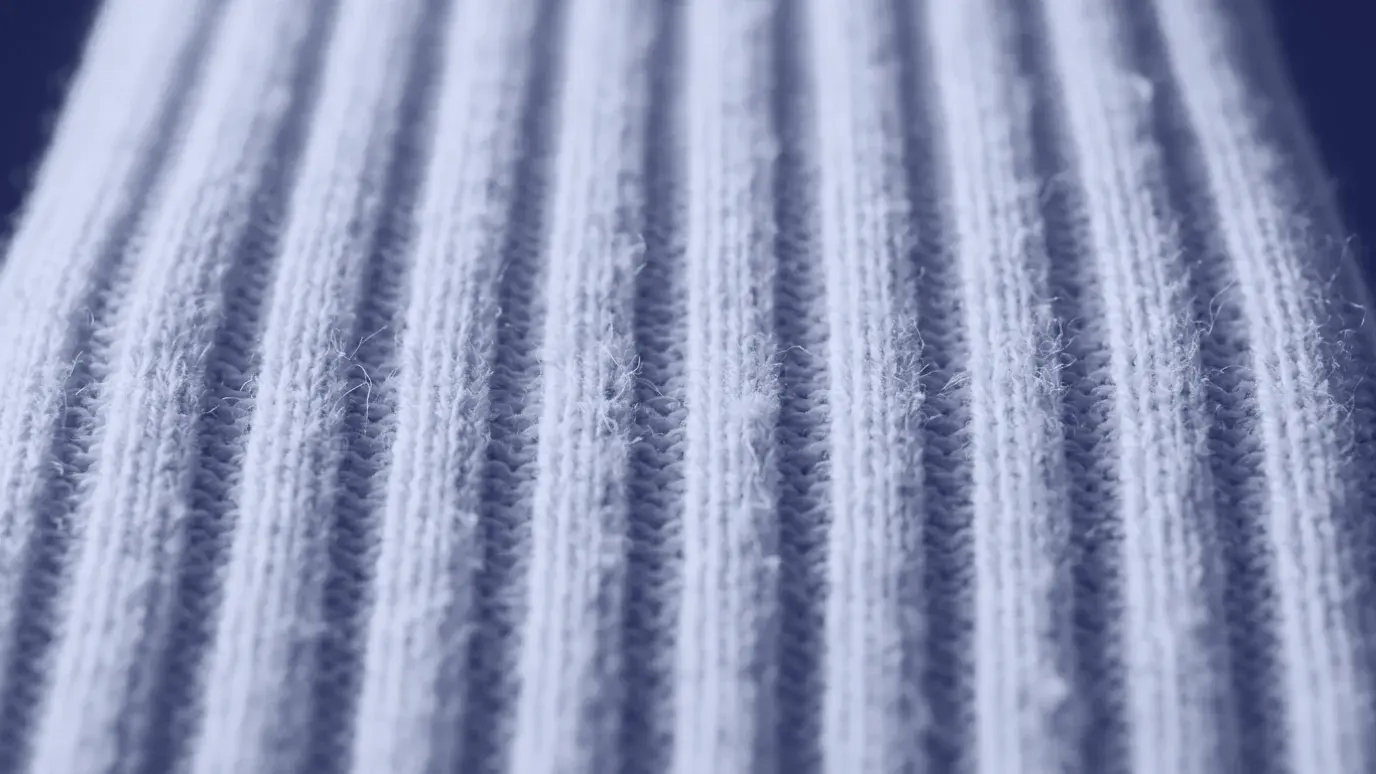
Rib knit is a knitted fabric made on a double-bed machine, with knit and purl wales alternating across the width. It has a vertically ribbed look, stretches strongly crosswise and returns to size after stretching. That is why it is used for T-shirt collars, cuffs and waistbands, where the garment must hug the body; it is also knitted as a body fabric. In Turkey the standard 1x1 rib is called ribana.
Rib knit structure
Knit wales and purl wales alternate side by side; in a balanced rib the face and back look the same (CottonWorks; Dönmez, 2008). The name comes from the wale pattern: 1x1 rib has one knit and one purl wale, 2x2 rib has two of each (CottonWorks).
At rest, the purl wales sit behind the knit wales, so only knit stitches show on both faces; stretched crosswise, the fabric reveals the purl stitches between them (Dönmez, 2008). The torque in each sinker loop draws neighboring wales together, which is the main reason for rib’s high crosswise elasticity (NPTEL). Crosswise stretch is about twice that of single jersey (CottonWorks); lengthwise stretch is about the same (Dönmez, 2008).
Properly knitted, rib does not curl at the edges (CottonWorks). Its balanced structure means spirality is not expected (NPTEL), and balanced structures such as 1x1 rib are preferred to limit spirality in single jersey (Doba Kadem and Sevgi, 2022). With the same yarn and stitch length, rib is thicker and heavier than single jersey, and the tubular fabric is narrower at the same machine diameter (NPTEL; Dönmez, 2008).
Ribana, 1x1 and kaşkorse: the Turkish terms
In the Turkish market ribana mostly means 1x1 rib, while 2x2 rib is known as kaşkorse (Dönmez, 2008); one manufacturer calls kaşkorse a “wide-ribbed, elastic ribana variant” (Karcem, 2026; our translation from the Turkish). So “ribana” on a quotation does not mean any rib: write “1x1” or “2x2” in your order.
Penye, the other Turkish word you may see, describes combed-cotton yarn, not a knit structure (see Single Jersey for the full explanation).
How rib knit is made
Rib needs two needle beds: on circular machines, the cylinder and the dial above it (CottonWorks; Cingü, 2022). In Turkish such machines are also called “çift plakalı” (double plate) (Erkoç, 2006, cited in Dönmez, 2008). The needles of the two beds are set in a rib arrangement so that they pass between each other (Dönmez, 2008). Loops form on the two beds opposite each other and crosswise, which gives the fabric its high crosswise elasticity (Erkoç, 2006, cited in Cingü, 2022).
Types and variants
- 1x1 rib: A balanced structure of one knit and one purl wale. As the number of adjacent wales of the same type increases (for example from 2x1 to 3x3), stretch decreases (Dönmez, 2008).
- 2x2 rib (kaşkorse) and wider ribs: 2x2 rib has two knit and two purl wales (CottonWorks). The fabric gets thicker as the wales widen; 3x3 is thicker than 2x2 (NPTEL).
- Elastane rib: Elastane is fed to the dial needles only, or to both dial and cylinder needles (Tezel, 2007, cited in Cingü, 2022). In a study of cotton 1x1 rib and single jersey, elastane increased weight and reduced shrinkage and spirality (Halim and Fahad, 2019, cited in Cingü, 2022).
Rib knit weight (GSM)
There is no standard weight range; weight varies with yarn count, machine gauge, stitch density and elastane content. One raw knitted-fabric manufacturer gives 180–260 g/m² (5.3–7.7 oz/yd²) for ribana (Karcem, September 2026), and ranges differ by source. Finer yarn can come in below that: research samples in Ne 30/1 combed and open-end yarn, knitted on an 18-gauge, 34-inch double-bed machine, had target weights of 125–145 g/m² (3.7–4.3 oz/yd²) (Erkoç, 2006, cited in Dönmez, 2008). 1 oz/yd² ≈ 33.9 g/m².
Uses
Rib knit is used for collars, cuffs and waistbands (CottonWorks; Pratt Institute). As a body fabric it appears in dresses and sweaters (CottonWorks) and in casual wear and loungewear (Pratt Institute); one manufacturer also lists close-fitting garments (Karcem, 2026). In your order, state whether the rib is a body fabric or a collar and cuff trim.
What to check when sourcing rib knit
- Check recovery: It matters as much as the stretch itself (Cingü, 2022). For trims, ask for the permanent elongation value and the elastane content.
- Write the rib pattern with the structure: As wales widen, the fabric gets thicker (NPTEL) and stretches less (Dönmez, 2008). Put “1x1” or “2x2” in the order, since Turkish suppliers also call 2x2 rib “kaşkorse”.
- Ask for measurements with their condition: Rib contracts crosswise as it leaves the machine (Dönmez, 2008), so ask in what state (greige, finished, relaxed) width and weight were measured.
- Have dimensional change after washing measured separately for trim and body fabric: by ISO 5077, with washing and drying to ISO 6330 procedures.
- For a body fabric consider close-fitting cuts; if you need a more stable, thicker fabric, compare interlock.
Sources (10)
- CottonWorks (Cotton Incorporated): Single Knits and Double Knits (accessed October 8, 2026)
- CottonWorks (Cotton Incorporated): Knit Machinery: Flat, Circular, and Seamless (accessed October 8, 2026)
- NPTEL, Knitting Technology, Module 2 FAQ
- Dönmez, E. T. (2008). Yuvarlak örme kumaşlarda kumaş gramajına etki eden faktörler üzerine bir araştırma (A study on the factors affecting fabric weight in circular knitted fabrics; in Turkish). Dokuz Eylül University Graduate School of Natural and Applied Sciences, master’s thesis
- Cingü, N. (2022). Elastanlı örme kumaşların kalıcı uzama ve konfor özelliklerinin incelenmesi (Investigation of permanent elongation and comfort properties of elastane knitted fabrics; in Turkish). Bursa Uludağ University Graduate School of Natural and Applied Sciences, master’s thesis
- Doba Kadem, F. and Sevgi, R. (2022). Süprem örme kumaşlarda geri dönüşüm pamuk elyaf oranının performans özelliklerine etkisinin belirlenmesi (Determining the effect of recycled cotton fibre ratio on the performance properties of single jersey knitted fabrics; in Turkish). Çukurova University Journal of the Faculty of Engineering, 37(3), 609-616
- Pratt Institute Textile Research Lab: Knits (accessed October 8, 2026)
- Karcem Tekstil (raw knitted fabric manufacturer): Örme Kumaş: Çeşitleri, Gramaj Tablosu ve Üretimi (knitted fabric: types, weight table and production; Turkish; last updated September 26, 2026; accessed October 8, 2026)
- ISO 6330:2021 Textiles: Domestic washing and drying procedures for textile testing
- ISO 5077:2007 Textiles: Determination of dimensional change in washing and drying (confirmed in 2022)
Author and fact-checking
Written by
Fabrics and Fibers Editor
Elif Karaca is Tekstil Rehberi's fabrics and fibers editor. She writes guides and glossary entries on knitted, woven and nonwoven fabrics, fiber properties and choosing the right fabric for each product, and bases values such as GSM, width, shrinkage and color fastness on standards and mill technical data sheets.
Content by Elif KaracaFact-checked by: Gizem Polat
This content was prepared by the Tekstil Rehberi editorial team. Before publication, our verification editor checked its figures, dates and sources against primary sources.
Spotted an error? Email us at [email protected] How we work →
Articles on this topic

T-Shirt Fabric Types: A Buyer’s Guide to Jersey, Piqué, Interlock and Rib
How single jersey, piqué, interlock and rib behave in a T-shirt, how to write the fabric spec for your supplier, and what Turkish terms such as süprem and penye mean.