What is Poplin?
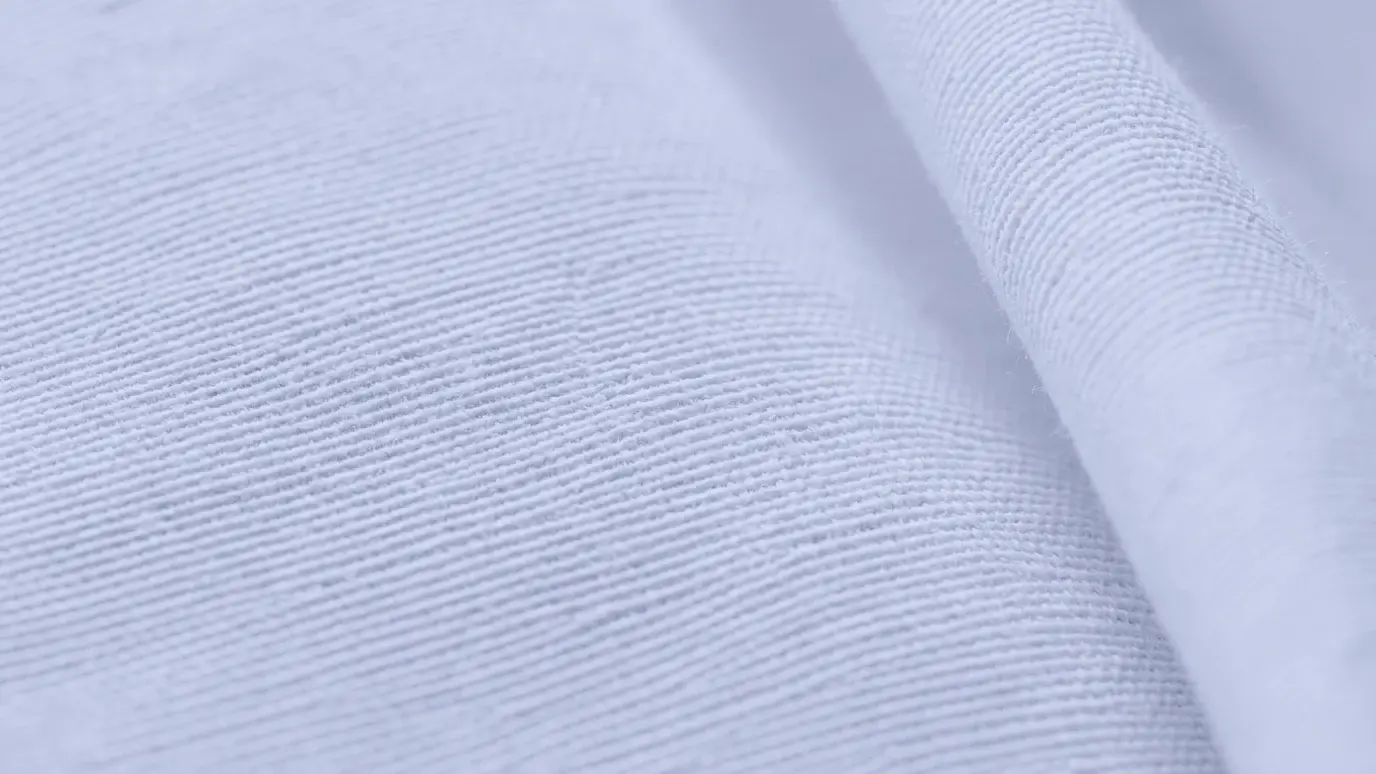
Poplin is a strong plain-weave fabric with a fine, closely spaced crosswise rib on its surface, woven mostly from cotton. It is used for shirts, blouses and dresses.
- Published:
- Updated:
- Fact-checked by:
- Gizem Polat
Key facts
- Poplin is a strong plain-weave fabric with a fine rib look, woven mostly from cotton.
- The fine ribs come from a thicker weft yarn; the weft runs across the fabric width, so the ribs show crosswise.
- Poplin is the name of a structure, not a fiber; cotton, polyester-cotton and stretch versions exist.
- There is no standard weight range; one shirt brand gives an average poplin weight of 110–140 g/m².
- Poplin is a 1/1 plain weave; oxford is a plain-weave derivative with two warp yarns woven as one; twill shows a diagonal line on the face.
Properties
- Fiber content
- Mostly cotton; rayon, silk, wool and linen versions, and blends with polyester and elastane, also exist
- Structure
- Plain weave (1/1); the weft yarn is thicker, which gives a fine crosswise rib look
- Weight range
- No standard range. One shirt brand gives an average poplin weight of 110–140 g/m² (3.2–4.1 oz/yd²) (Première Manche); it varies with composition and yarn fineness
- Stretch
- Plain-weave fabric does not stretch unless it contains elastic yarn; stretch poplin contains elastic yarn such as elastane
- Uses
- Shirts, blouses, dresses, skirts and children’s clothing; home textiles such as curtains and pillowcases
- Care
- Care instructions depend on fiber content and finishing. Some poplins get a finish that makes ironing easier. Dimensional change after washing is measured by ISO 5077, using ISO 6330 procedures.
Poplin is a strong plain-weave fabric with a fine, dense rib look on its surface. The Collins dictionary defines poplin as a plain-weave fabric with fine ribs, mostly made of cotton; the TDK (Turkish Language Association) dictionary calls it a thin type of fabric woven densely from cotton, linen or silk (our translation). Poplin is the name of a structure, not a fiber: it is made in different compositions such as cotton poplin, polyester-cotton poplin and stretch poplin. It is used in garments such as shirts, blouses and dresses.
Poplin structure: where does the rib come from?
In a plain weave each warp yarn passes over one weft yarn and under the next (CottonWorks). In poplin the fine ribs arise because the two sets of yarn differ: TRC Needles attributes the ribbed look to a thicker weft yarn. Because the weft runs across the width of the fabric (CottonWorks), the ribs show crosswise.
In traditional poplin the warp was silk and the thicker weft was wool; today most poplin is made of cotton (TRC Needles).
Properties
- Surface: One shirt brand says poplin has no pronounced micro-texture like oxford or twill; it looks smooth and plain (Première Manche).
- Stiffness: Plain-weave fabrics are stiffer and drape less because they have many interlacing points (CottonWorks).
- Weight: There is no standard range. The same brand gives an average poplin weight of 110–140 g/m² (3.2–4.1 oz/yd²) and adds that very thin poplins crease more easily and carry a risk of tearing (Première Manche). This is a manufacturer’s claim.
- Creasing: According to the same source, poplin woven from finer, higher-count yarn creases more easily; some poplins get a finish that eases ironing and reduces creasing (Première Manche).
- Stretch: Plain-weave fabric does not stretch unless elastic yarn is added (Pratt Institute). A supplier guide says poplin can be blended with polyester, elastane (spandex) or rayon (Fabric Sight, 2024).
How poplin differs from similar fabrics
| Fabric | Weave | Distinguishing feature |
|---|---|---|
| Poplin | Plain weave (1/1) | Smooth surface and fine rib (Collins); the thicker weft gives the rib (TRC Needles) |
| Oxford | Plain-weave derivative (basket weave family) | Two warp yarns are woven as one; the weft yarn is often at least twice the thickness of the warp, while in pinpoint oxford the yarns are equal (CottonWorks) |
| Twill (e.g. gabardine, denim) | Twill | Diagonal line on the face (CottonWorks) |
| Satin | Satin | Long floats; smooth, lustrous face (CottonWorks) |
In short, poplin has a smooth, finely ribbed surface; in oxford the texture is more pronounced (Première Manche); twill has a diagonal line and satin a lustrous face.
Uses
Poplin is used in shirts (Première Manche); the Collins dictionary also lists dresses and children’s clothing. A supplier guide mentions home-textile uses such as curtains, pillowcases and tablecloths alongside blouses and skirts (Fabric Sight, 2024).
What to specify when sourcing poplin
- Write the structure and fiber next to the name: “poplin” describes a weave family. The fiber ratio, yarn count, warp and weft density (ISO 7211-2) and weight (ISO 3801 or EN 12127) should be stated separately.
- State your creasing expectation: say whether you want an easy-iron finish, and check the creasing behavior on the sample.
- If you need stretch, state the elastane percentage: without elastic yarn, poplin does not stretch (Pratt Institute).
- Ask for poplin's shrinkage figure: the change measured by ISO 5077 belongs to a sample washed and dried to ISO 6330.
For a general classification of fabrics see the fabric types guide; for poplin suppliers see the Poplin and Shirting Fabrics category.
Frequently asked questions
What fiber is poplin made of?
Poplin is the name of a structure. According to the Collins dictionary it is mostly cotton, and TDK lists cotton, linen and silk. Traditional poplin was woven with a silk warp and a wool weft (TRC Needles). The Random House dictionary lists cotton, rayon, silk and wool poplin; a supplier guide also mentions blends with polyester, elastane (spandex) and rayon (Fabric Sight, 2024).
Does poplin wrinkle?
According to a shirt brand, poplin woven from fine, high-count yarn creases more easily, and some poplins get a finish that eases ironing (Première Manche). State your creasing expectation and the finish in the quotation.
What is the difference between poplin and oxford?
Poplin is a 1/1 plain weave. Oxford is also a plain-weave derivative, but two warp yarns are woven as one and the weft is often at least twice as thick as the warp; in pinpoint oxford the warp and weft are the same thickness (CottonWorks). Up close, the texture of oxford is pronounced, while the surface of poplin is flat (Première Manche).
What is stretch poplin?
Poplin that contains an elastic yarn such as elastane. The stretch percentage should be stated in the fiber composition and in the test report.
Sources (14)
- Collins English Dictionary and Random House Unabridged Dictionary, entry “poplin” (via Dictionary.com, accessed October 9, 2026)
- TDK Güncel Türkçe Sözlük (Turkish Language Association dictionary), entry “poplin” (accessed October 9, 2026)
- Textile Research Centre Leiden, TRC Needles: Poplin (WV, March 23, 2022)
- CottonWorks (Cotton Incorporated): Learning Hub, Weaving (warp and weft directions; accessed October 9, 2026)
- Pratt Institute Textile Research Lab: Wovens (accessed October 9, 2026)
- CottonWorks (Cotton Incorporated): Basic Woven Fabric Designs (accessed October 9, 2026)
- CottonWorks (Cotton Incorporated), Textile Encyclopedia: Oxford (accessed October 9, 2026)
- Première Manche, Poplin shirts (shirt brand product guide; accessed October 9, 2026)
- Martiniuc, R. (February 16, 2024). Exploring the Versatility and Sustainability of Poplin Fabrics. Fabric Sight (fabric supplier blog)
- ISO 3801:1977 Textiles: Woven fabrics: Determination of mass per unit length and mass per unit area (EVS record)
- ISO 7211-2:2024 Textiles: Methods for analysis of woven fabrics construction: Determination of number of threads per unit length (BSI record, published August 22, 2024)
- EN 12127:1997 Textiles. Fabrics. Determination of mass per unit area using small samples (BS EN 12127:1998 record; applies to woven and knitted fabrics)
- ISO 6330:2021 Textiles: Domestic washing and drying procedures for textile testing
- ISO 5077:2007 Textiles: Determination of dimensional change in washing and drying (confirmed in 2022)
Author and fact-checking
Written by
Fabrics and Fibers Editor
Elif Karaca is Tekstil Rehberi's fabrics and fibers editor. She writes guides and glossary entries on knitted, woven and nonwoven fabrics, fiber properties and choosing the right fabric for each product, and bases values such as GSM, width, shrinkage and color fastness on standards and mill technical data sheets.
Content by Elif KaracaFact-checked by: Gizem Polat
This content was prepared by the Tekstil Rehberi editorial team. Before publication, our verification editor checked its figures, dates and sources against primary sources.
Spotted an error? Email us at [email protected] How we work →
Articles on this topic
Breathable Fabrics for Summer: Linen, Cotton, Viscose and Modal
No fabric stops sweating, but some manage sweat better. What test data show for linen, cotton, viscose and modal, how construction and weight change the result, and which tests to ask a fabric supplier for.