What is Interlock?
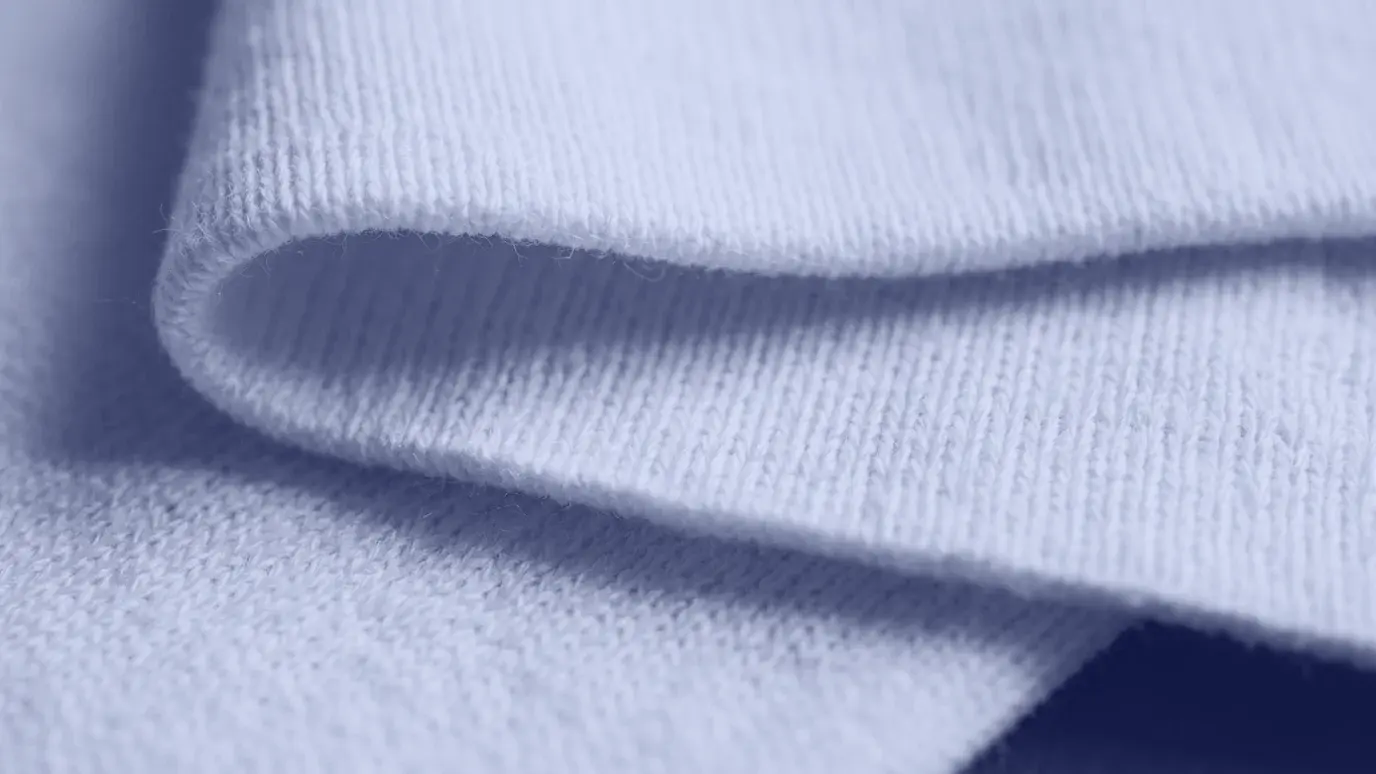
Interlock fabric is a stable, double-bed circular knit made by interlocking two 1x1 ribs, so both faces look flat, like the face of single jersey. With the same yarn it is thicker and more stable than single jersey, and its edges do not curl.
- Published:
- Updated:
- Fact-checked by:
- Gizem Polat
Properties
- Fiber content
- Cotton is common; also knitted from modal, viscose and polyester yarns; elastane versions exist
- Structure
- Double-bed circular knit (cylinder and dial; “çift plaka”, double plate, in Turkish trade usage); two 1x1 ribs knitted into each other; both faces look like the face of single jersey
- Weight range
- No standard range. One knitted-fabric manufacturer quotes 180–260 g/m² (5.3–7.7 oz/yd²), and ranges differ by source. Wet-relaxed research samples in Ne 30/1 yarn on a 20-gauge machine measured 245–271 g/m² (7.2–8.0 oz/yd²); weight varies with yarn count, machine gauge, stitch length and elastane content
- Stretch
- Stable: low stretch both crosswise and lengthwise, limited compared with rib. Elastane versions are made for close-fitting products
- Uses
- T-shirts, baby clothing, dresses, pajamas and loungewear, close-fitting garments
- Care
- Care instructions depend on fiber content and finishing. Dimensional change after washing is measured by ISO 5077, using ISO 6330 washing and drying procedures.
Interlock fabric is a double-bed circular knit made by interlocking two 1x1 ribs. Both faces look flat, like the face of single jersey. With the same yarn it is thicker and more stable than single jersey, and its edges do not curl. It is used in T-shirts, baby clothing and close-fitting garments. Turkish suppliers call it interlok. Note that in the sewing industry “interlock” is also a machine name (see below).
Interlock fabric structure
The name comes from two 1x1 ribs “locking” into each other to form one fabric (CottonWorks). The wales on the two faces sit directly opposite each other and are locked together, so even when the fabric is stretched, the purl loops behind are not visible (Jamshaid et al., 2021). The result is a balanced, flat-lying structure: edges do not curl and, unlike single jersey, stitches do not run (Jamshaid et al., 2021; CottonWorks). Because the wales of one bed sit between those of the other, the tendency to narrow crosswise is half that of 1x1 rib, and stretch is low both crosswise and lengthwise (Gülsevin, 2005, cited in Dönmez, 2008).
Double-bed fabrics bond two fabrics during knitting, so they are heavier, more stable and curl less (CottonWorks). With the same yarn and stitch length, the three basic structures rank as follows (NPTEL):
| Property | Ranking |
|---|---|
| Thickness | Interlock > rib > single jersey |
| Weight per unit area (GSM) | Interlock > rib > single jersey |
| Fabric width | Single jersey > interlock > rib |
How interlock is knitted
Interlock is knitted on circular machines with two needle beds, cylinder and dial, which in Turkish are also called “çift plakalı” (double plate) (Erkoç, 2006, cited in Dönmez, 2008). The needles are set opposite each other, but opposite needles do not knit at the same time; one visible course needs two feeds (CottonWorks). The first feed forms loops on odd-numbered needles and the second on even-numbered needles, so the second rib fills the gaps of the first (Dönmez, 2008). Because the structure is two ribs knitted into each other, a much finer yarn is chosen than if a single rib were being knitted (NPTEL, Module 5).
Types and variants
- By fiber: Interlock fabrics knitted from modal, viscose and polyester yarns have been studied alongside cotton (Jamshaid et al., 2021).
- Different yarn on each face: Feeding different yarns to the odd and even courses can give cotton on one face and another fiber on the other (NPTEL, Module 2).
- Elastane interlock: Full-elastane, half-elastane and elastane-free interlock fabrics exist (Ertekin, Oğlakçıoğlu and Marmaralı, 2018, cited in Cingü, 2022).
Penye and other names not to mix up
Penye is a Turkish yarn term for combed cotton, not a knit structure, although it is also used loosely as a fabric name (see Single Jersey). Interlock knitted from combed cotton yarn can be very soft (CottonWorks). Write structure and yarn separately: “interlock, Ne 30/1 combed cotton”.
- Interlock sewing machine: In the sewing industry “interlock” also appears as a machine name. For example, Pegasus presents its W3500P series, developed for sewing knitted garments, as a “flatbed interlock sewing machine” (Apparel Resources, 2014). That is a sewing machine name, not a fabric structure.
- Double jersey and double face: Dönmez (2008) uses “double jersey” for rib knit, and Cingü (2022) treats “double face” knit as a structure separate from interlock. Do not use these names as synonyms of interlock.
Interlock weight (GSM)
There is no standard weight range; weight varies with yarn count, machine gauge and stitch length. One raw knitted-fabric manufacturer gives 180–260 g/m² (5.3–7.7 oz/yd²) for interlock (Karcem, September 2026), and ranges differ by source. A measured example: samples in Ne 30/1 yarn, knitted on a 26-inch, 20-gauge interlock machine and wet-relaxed, weighed 245–271 g/m² (7.2–8.0 oz/yd²), and the all-cotton sample 260 g/m² (7.7 oz/yd²) (Jamshaid et al., 2021). Because interlock is knitted with finer yarn, do not compare single jersey and interlock by GSM alone. 1 oz/yd² ≈ 33.9 g/m².
Uses
Interlock is used in T-shirts, dresses and baby clothing, in pajamas and loungewear (Pratt Institute), and in close-fitting garments such as turtleneck tops (CottonWorks). Makers of pajamas and loungewear are listed in the Pajamas and Loungewear category.
What to check when sourcing interlock
- Do not compare with single jersey by GSM alone: ask for yarn count, machine gauge and stitch length too.
- Factor in cost: with the same yarn and stitch length, interlock contains more yarn per square meter than single jersey (NPTEL); it is also knitted with finer yarn, and finer yarn generally costs more (Cotton Incorporated, ISP 1009).
- Check stretch: interlock stretches less than rib (NPTEL). For close-fitting products, ask for the elastane version and recovery values.
- Compare samples for hot-climate products: in one study of cotton and polyester fabrics, interlock and 1x1 rib had higher thermal resistance, and single jersey higher water vapor permeability (Oğlakcıoğlu and Marmaralı, 2007). This is one study under specific conditions, not a general rule; test with your own yarn and weight.
- Ask for the interlock shrinkage result: width and length change is measured to ISO 5077, and washing and drying follow ISO 6330 procedures.
- If you need a more stretchy band, consider rib; if you need a lighter, thinner fabric, consider single jersey.
Sources (13)
- CottonWorks (Cotton Incorporated): Single Knits and Double Knits (accessed October 8, 2026)
- NPTEL, Knitting Technology, Module 2 FAQ
- NPTEL, Knitting Technology, Module 5 FAQ
- Dönmez, E. T. (2008). Yuvarlak örme kumaşlarda kumaş gramajına etki eden faktörler üzerine bir araştırma (A study on the factors affecting fabric weight in circular knitted fabrics; in Turkish). Dokuz Eylül University Graduate School of Natural and Applied Sciences, master’s thesis
- Jamshaid, H., Rajput, A. W., Zahid, B., Hussain, S. (2021). Characterisation of Interlock Knitted Fabric with Different Feed Patterns to Improve Thermal and Sensorial Comfort. Fibres & Textiles in Eastern Europe, 29(3), 80-85. DOI: 10.5604/01.3001.0014.7791
- Oğlakcıoğlu, N. and Marmaralı, A. (2007). Thermal comfort properties of some knitted structures. Fibres & Textiles in Eastern Europe, 15(5)
- Cingü, N. (2022). Elastanlı örme kumaşların kalıcı uzama ve konfor özelliklerinin incelenmesi (Investigation of permanent elongation and comfort properties of elastane knitted fabrics; in Turkish). Bursa Uludağ University Graduate School of Natural and Applied Sciences, master’s thesis
- Cotton Incorporated, A Guide to Improved Shrinkage Performance of Cotton Fabrics (ISP 1009), 2004
- Pratt Institute Textile Research Lab: Knits (accessed October 8, 2026)
- Apparel Resources: Pegasus launches the new W3500P flatbed interlock sewing machine (August 1, 2014; accessed October 8, 2026)
- Karcem Tekstil (raw knitted fabric manufacturer): Örme Kumaş: Çeşitleri, Gramaj Tablosu ve Üretimi (knitted fabric: types, weight table and production; Turkish; last updated September 26, 2026; accessed October 8, 2026)
- ISO 6330:2021 Textiles: Domestic washing and drying procedures for textile testing
- ISO 5077:2007 Textiles: Determination of dimensional change in washing and drying (confirmed in 2022)
Author and fact-checking
Written by
Fabrics and Fibers Editor
Elif Karaca is Tekstil Rehberi's fabrics and fibers editor. She writes guides and glossary entries on knitted, woven and nonwoven fabrics, fiber properties and choosing the right fabric for each product, and bases values such as GSM, width, shrinkage and color fastness on standards and mill technical data sheets.
Content by Elif KaracaFact-checked by: Gizem Polat
This content was prepared by the Tekstil Rehberi editorial team. Before publication, our verification editor checked its figures, dates and sources against primary sources.
Spotted an error? Email us at [email protected] How we work →
Articles on this topic
T-Shirt Fabric Types: A Buyer’s Guide to Jersey, Piqué, Interlock and Rib
How single jersey, piqué, interlock and rib behave in a T-shirt, how to write the fabric spec for your supplier, and what Turkish terms such as süprem and penye mean.