Knit vs Woven Fabric: How to Tell Them Apart
How knit and woven fabrics differ, five checks to tell them apart, the cases that mislead, how to choose by product, and what changes in production, testing and customs classification.
- Published:
- Fact-checked by:
- Gizem Polat
Key facts
- In a knit, yarn forms interlocking chains of loops; in a woven fabric, lengthwise warp and crosswise weft yarns cross at right angles.
- Three checks tell most fabrics apart: the yarn layout under a magnifier, stretch and recovery, and how the cut edge behaves.
- Stretch woven can stretch, stable knits such as raschel barely stretch, and interlock looks the same on both faces and does not curl, so never rely on one check.
- Cotton knits are more prone to dimensional change than cotton wovens; fabric need is usually calculated in kilograms for knits and in meters for wovens.
- In the Harmonized System, Chapter 60 covers knitted fabrics, Chapter 61 knitted garments and Chapter 62 garments that are not knitted.
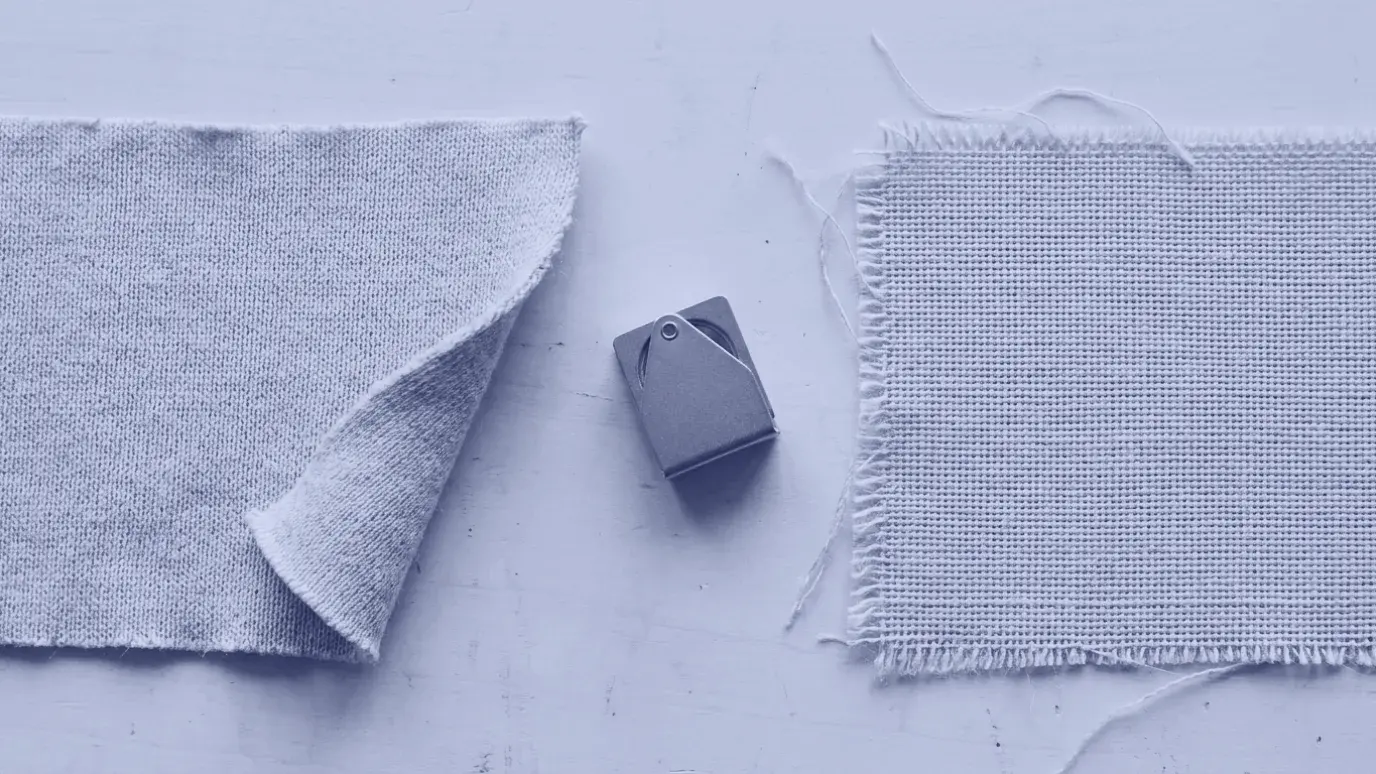
The difference between knit and woven fabric is the yarn layout: in a knit, yarn is formed into loops that interlock with their neighbors; in a woven fabric, lengthwise warp yarns and crosswise weft yarns cross at right angles. Three checks tell most fabrics apart: look at the yarn layout with a magnifier, test stretch and recovery, and watch how the cut edge behaves. Stretch woven and stable knits can blur these rules, so run the checks together.
Below you will find how the structure shows up in fabric behavior, a five-step method for telling knits from wovens, the cases that mislead, a starting point for choosing by product, and what changes in production, testing and customs classification. It also explains Turkish trade words you may meet on a quotation, such as penye. For a general classification of fabrics, see our fabric types guide.
Knit vs woven fabric: from structure to behavior
A woven fabric uses two sets of yarn at right angles, so it is more stable than a knit and its stretch is limited by yarn properties and weave structure. In a knit, the curved shape of the loops gives the fabric stretch of its own; that stretch also depends on the yarn and the knit structure (Dönmez, 2008). The table summarizes the everyday consequences.
| Knit | Woven | |
|---|---|---|
| Structure | Yarn becomes loops; each loop is connected to neighboring loops (Dönmez, 2008) | Warp and weft cross at right angles (Dönmez, 2008; Kentucky, Grain; CottonWorks, Weaving Basics) |
| Stretch | Stretches by itself; in a weft knit usually more across the width, but not in every fabric (Dönmez, 2008; Kentucky, Grain) | Without elastic yarn, plain weave does not stretch (Pratt); it gives on the diagonal (bias), most at 45° (Kentucky, Grain) |
| Stability and fit | Conforms to the body easily (CottonWorks, Knit Basics); wrinkles little (Dönmez, 2008; Kentucky, Knit) | Cotton wovens are far more stable than knits (ISP 1009); plain weave resists stretching better in the main directions (NPTEL) |
| The two faces | The two faces of a single-bed knit differ (Kentucky, Knit); interlock and 1×1 rib look the same on both (CottonWorks, Single & Double Knits) | Plain weave looks similar on both faces (NPTEL) |
| Cut edge | A single-bed weft knit (such as single jersey) curls, runs and unravels; interlock does not curl; a warp knit cut horizontally neither curls nor frays (CottonWorks, Knit Basics and Single & Double Knits) | Can fray; Pratt notes that a basket weave frays more easily than plain weave. Has a firm lengthwise edge, the selvage (Kentucky, Grain) |
| Size change in washing | Cotton fabrics are prone to dimensional instability, knits especially (ISP 1009); washable knits shrink more often and more than wovens (Kentucky, Knit) | More stable; but because very low shrinkage is expected of wovens, processing tensions matter for them too (ISP 1009) |
Source key: Kentucky, Grain = Understanding Fabric Grain (2006); Kentucky, Knit = Sewing with Knit Fabric (2006); ISP 1009 = Cotton Incorporated, 2004; Pratt = Pratt Institute Textile Research Lab, Wovens. The table shows general tendencies; fiber, yarn, density and finishing change the behavior. This guide does not rank knit and woven by price or durability: both depend on fiber, yarn, density and finishing more than on structure.
How to tell knit from woven fabric: five checks
You can run the checks on a roll end, a swatch or the fabric inside a garment. The first three are enough for most fabrics; the fourth is supporting and the fifth is for laboratory confirmation. Do not trust a single result; look for at least three checks that point the same way.
- Look at the yarn layout with a magnifier. In a woven fabric two sets of yarn run at right angles and pass over and under each other. In a knit, the yarn forms chains of loops; in a single-bed knit (such as single jersey) the front shows lengthwise columns of loops (wales) and the back shows crosswise rows of loops (courses) (Kentucky, Knit).
- Pull lengthwise, crosswise and on the diagonal. A knit stretches by itself; in a weft knit the stretch is usually greater across the width, but not in every fabric, so test it before you buy (Kentucky, Grain). Without elastic yarn, a plain weave does not stretch in the main directions (Pratt); it gives on the diagonal (bias), most at 45° (Kentucky, Grain). Also see whether the fabric returns to its size when you let go: according to the Kentucky sewing guide, a knit that stays distorted after stretching will probably lose its shape in use (Kentucky, Knit).
- Check the cut edge and the selvage. A woven fabric has a firm lengthwise edge, the selvage, running parallel to the warp (Kentucky, Grain). A single-bed weft knit (such as single jersey) curls at the cut end, runs and unravels (CottonWorks, Single & Double Knits); pulling the yarn of the last knitted row can unravel the fabric across its width (Dönmez, 2008). A circular knitting machine delivers fabric in tubular form (Dönmez, 2008; CottonWorks, Knit Basics).
- Compare the two faces. In a single-bed knit the faces differ, while in plain weave they look alike (NPTEL). But interlock and 1×1 rib are knits that look the same on both faces, and interlock is also very stable and does not curl (CottonWorks, Single & Double Knits). “Both faces alike” is therefore not proof of a woven on its own.
- If in doubt, count the density. Courses and wales per centimeter are determined by EN 14971 for knits, and the number of threads per unit length by ISO 7211-2 for wovens. If doubt remains, or you need density values for a specification, have a laboratory analyze the fabric.
Decision table by observation
| What you see | Most likely |
|---|---|
| Loop chains; clear crosswise stretch; cut end curls and stitches run | Weft knit (for example single jersey) |
| Loop chains; stretch mostly lengthwise; a horizontal cut does not curl or fray | Warp knit (for example tricot) |
| Loop chains; the same on both faces; cut edge does not curl | Double-bed knit (for example interlock, 1×1 rib) |
| Loop chains; very little stretch; behaves like a woven | Stable knit (for example raschel) |
| Yarns crossing at right angles; no stretch, or stretch only on the bias; firm lengthwise selvage | Woven |
| Yarns crossing at right angles, but stretch lengthwise or crosswise | Stretch woven (with elastic yarn) |
The table gives probabilities, not verdicts. In a warp knit the stretch is expected to be greater in the direction of the wales (NPTEL; CottonWorks, Knit Basics). Double-bed knits are usually the same on both faces and their cut edge does not curl, but that does not mean they stretch little: the Kentucky guide counts interlock among medium-stretch knits, and rib can stretch up to 100% across the width (Kentucky, Knit).
What makes the call harder
- Stretch woven. According to the Pratt Institute, a plain-weave fabric does not stretch without elastic yarn; when elastic yarn is added it can stretch. The scope of EN ISO 13934-1 also mentions stretch wovens containing elastomeric fiber. Stretch alone therefore does not mean “knit”; the magnifier and the edge check decide.
- Stable knits. The University of Kentucky sewing guide treats “firm, stable knits” (double knit, sweatshirt knit, boiled wool, raschel) as a separate class: they stretch very little and are handled like woven fabrics. The same guide places interlock among medium-stretch knits. According to the guide’s indicative values, a stable knit stretches up to about 10%, a medium-stretch knit about 25–35%, a two-way stretch knit up to 50–75% and a super-stretch knit 100% or more; these are sewing-guide classes, not standards (Kentucky, Knit). The conclusion “if it does not stretch, it is woven” can therefore be wrong.
- Warp knits. Tricot and raschel are common warp knits (Kentucky, Knit); cut horizontally, they neither curl nor fray (CottonWorks, Knit Basics). An edge that does not curl does not mean the fabric is woven.
- Brushed surfaces. Flannel is a woven fabric that is brushed after weaving to raise the surface fibers (CottonWorks, Flannel). Fleece is a knit made with two or three yarns whose back loops are brushed; brushing changes the surface, not the knit structure (CottonWorks, Single & Double Knits). Brushing gives the surface cover and softness (CottonWorks, Flannel); because the nap can hide the yarn layout, look at an unbrushed face and at the cut edge.
- The name “penye” says nothing about structure. Penye is a Turkish trade word for a yarn type spun from combed cotton, not a fabric structure. Cotton Incorporated’s yarn bulletin for “knit and woven fabrics” classifies cotton yarns by spinning system (ring carded, ring combed, open-end and so on), so the yarn type does not determine the fabric structure (ISP 1006). The Turkish Language Association dictionary (TDK) defines penye as “a kind of fine fabric finished with a special tool in weaving”, while “penye products” are listed among knitted products (Marmaralı, 2004, cited in Dönmez, 2008). On a quotation, write the structure and the yarn separately; for T-shirt fabrics see T-shirt fabric types.
Which fabric for which product?
The table is a starting point based on the end uses named in the sources; the final decision is made on a sample and a pattern.
| Need | General direction | Basis |
|---|---|---|
| T-shirts, joggers, sweatshirts, underwear | Weft knit | Marmaralı (2004), cited in Dönmez (2008) |
| Collars, cuffs, waistbands | Rib knit | Kentucky, Knit; CottonWorks, Single & Double Knits |
| Swimwear, activewear, close-fitting garments | Two-way stretch knit (warp knits included) | CottonWorks, Knit Basics; Kentucky, Knit |
| Shirts, and chinos, jeans or gabardine-type bottoms that keep their shape | Woven (plain weave, twill) | CottonWorks, Basic Woven Fabric Designs |
| Both shape and slight stretch | Stretch woven or stable knit | Pratt; Kentucky, Knit |
Four questions help you decide. Should the garment conform to the body or keep its pattern shape? Will the stretch come from the structure or from elastic yarn? How will the cut edge be finished? Will fabric need be calculated in kilograms or in meters? For summer garments the choice between knit and woven depends on more than structure; the combined effect of fiber, structure and weight is covered in breathable fabrics for summer.
Company directory
Looking for manufacturers in this field?
Browse companies in the related categories or get quotes from several companies with one form.
Do you manufacture or offer services in this field?
What changes in production
Cutting and direction. A garment that is not cut and sewn in line with the fabric’s direction stretches in unwanted places and the hem sags; in woven fabric this direction is called grain, in a knit simply “direction” (Kentucky, Grain). Do not stretch a knit on the cutting table or let it hang off the table; its weight distorts it. The fabric is placed so that the greatest stretch runs around the body (Kentucky, Knit).
Shrinkage. According to Cotton Incorporated, because of processing tensions the delivered dimensions of greige fabric do not hold in later stages; the reference state is the relaxed dimension (ISP 1009). To find the shrinkage allowance, measure a swatch before and after washing; the shrinkage calculator does the arithmetic. State which condition a weight or width refers to; typical weights by product are in fabric weight for T-shirts, hoodies and joggers.
Sewing. In a knit the seam must stretch with the fabric or it will break. The Kentucky sewing guide names overlock (serger) and cover stitch machines, ball-point needles and differential feed, which prevents wavy seams. Because a knit does not fray like a woven, finishing the seam edge is optional; if the edge curls, it is finished with an overlock or two rows of stitching (Kentucky, Knit).
Ordering. Fabric need per garment is calculated in kilograms for knits and in meters for wovens (Sarkar, 2020); for a knit, state whether the width is open or tubular. Use the fabric consumption calculator for the need per garment and order, the meter-to-kg tool to convert between kilograms and meters, and the GSM calculator for weight, which also converts between g/m² and oz/yd².
In specifications and testing
The methods used for the same property differ partly between knits and wovens. The table follows EVS and BSI standard records as of this article’s date (October 2026); confirm the current edition with ISO, CEN or your national standards body before you write it into a contract.
| Property | Knit | Woven |
|---|---|---|
| Weight (mass per unit area) | EN 12127 (small specimens; woven and knitted) | ISO 3801 (woven only; also covers mass per unit length) or EN 12127 |
| Density | EN 14971: courses and wales per centimeter | ISO 7211-2: threads per unit length |
| Breaking and bursting | EN ISO 13938-2 (bursting; knitted, woven, nonwoven) | EN ISO 13934-1 (strip method; mainly woven) |
| Elasticity | EN ISO 20932-1 (strip method; narrow fabrics excluded) | EN ISO 20932-1 |
| Size change in washing | EN ISO 6330 (washing and drying) and EN ISO 5077 (dimensional change) | EN ISO 6330 and EN ISO 5077 |
On a quotation or in the tech pack, give the following.
- Knit: the knit type (weft or warp) and the fabric name, the fiber percentages, the yarn, the weight (and the state in which it was measured) and the width (open or tubular).
- Woven: the weave, the fiber percentages, the yarn, the warp and weft density, the weight and the width.
A single fabric name such as “poplin” or “penye” is not enough.
Customs treats them differently too. The first six digits of Turkey’s 12-digit customs tariff statistics position (GTİP) are the Harmonized System (HS) code (Republic of Turkey Ministry of Trade, Tariff FAQ). In the HS, Chapter 60 covers knitted or crocheted fabrics, Chapter 61 articles of apparel and clothing accessories, knitted or crocheted, and Chapter 62 articles of apparel and clothing accessories, not knitted or crocheted (Japan Customs, HS-based tariff, August 8, 2026 edition). So the same garment style falls in a different chapter depending on whether it is knit or woven. This is the position as of this article’s date; confirm the exact heading and duty for your market with your customs broker. If a classification is uncertain, binding tariff information (BTB) can be requested in Turkey; it is issued free of charge, although any analysis or expert costs are borne by the applicant (Ministry of Trade, Tariff FAQ).
Summary rule
Look at the yarn layout first, then at stretch and the cut edge; if all three point the same way, the result is very likely right. A knit is a good starting point for garments that conform to the body and wrinkle little, and a woven for garments that keep their shape, but stretch woven and stable knits blur the line. If you are looking for a fabric supplier, browse the knitted fabric and woven fabric categories in our company directory, and see fabric suppliers in Turkey for how to compare and order.
Frequently asked questions
What is the difference between knit and woven fabric?
In a knit, yarn is formed into loops and the loops interlock with their neighbors; in a woven fabric, lengthwise warp and crosswise weft yarns cross at right angles. The loop structure gives a knit stretch of its own, while a woven fabric is more stable and its stretch is limited by yarn properties and weave structure (Dönmez, 2008). T-shirts, joggers and underwear are made from knits; Oxford shirting and bottom-weight fabrics such as denim and gabardine are made from wovens (Marmaralı, 2004, cited in Dönmez, 2008; CottonWorks).
How can you tell if a fabric is knit or woven?
Use three checks. Look through a magnifier: a knit shows chains of loops, a woven shows yarns crossing at right angles. Stretch it: a knit stretches by itself, a plain weave does not. Look at the cut edge: a single-bed weft knit curls and unravels, while a woven has a firm lengthwise edge (selvage). Because stretch woven, stable knits and fabrics that look the same on both faces, such as interlock, can mislead, look for at least three checks that agree. If doubt remains, have a laboratory analyze the fabric; density is measured by EN 14971 for knits and ISO 7211-2 for wovens.
Is stretch fabric always knit?
No. According to the Pratt Institute, a plain-weave woven does not stretch without elastic yarn; add elastic yarn and a woven stretches too. In a knit the stretch comes from the loop structure, and according to the University of Kentucky sewing guide it varies widely, from stable knits to super-stretch knits. Check the structure of a stretch fabric with a magnifier and the cut edge.
Is penye fabric knit or woven?
The word does not tell you. “Penye” is a Turkish trade term for a yarn type spun from combed cotton, not a fabric structure. “Penye products” (T-shirts, tracksuits, sweatshirts) are listed among knitted products (Marmaralı, 2004, cited in Dönmez, 2008), while the TDK dictionary defines penye as “a kind of fine fabric finished with a special tool in weaving”. On a quotation, write the structure (single jersey, poplin and so on) and the yarn separately.
Does knit fabric shrink more than woven fabric?
As a general tendency, yes. The University of Kentucky guide says washable knits tend to shrink more often and more than wovens, and Cotton Incorporated says cotton fabrics, knits in particular, are prone to dimensional instability while wovens are far more stable (ISP 1009, 2004). The actual value depends on fiber, yarn and finishing; have dimensional change measured to EN ISO 5077 and EN ISO 6330.
Are single jersey, rib, poplin and denim knit or woven?
Single jersey (Turkish: süprem), rib (ribana), interlock and piqué are knits (CottonWorks, Single & Double Knits). Poplin is a plain weave, denim and gabardine are twills, and satin or sateen (Turkish: saten) is a satin weave (Collins dictionary; CottonWorks, Basic Woven Fabric Designs). A fabric name mostly describes construction, not fiber, so write the fiber and the structure separately on a quotation.
Sources (28)
- Dönmez, E. T. (2008). Yuvarlak örme kumaşlarda kumaş gramajına etki eden faktörler üzerine bir araştırma (A study on the factors affecting fabric weight in circular knitted fabrics; in Turkish). Dokuz Eylül University Graduate School of Natural and Applied Sciences, master’s thesis (pp. 1-5; includes Marmaralı, 2004 and Çeken, 2008 as cited there)
- Understanding Fabric Grain (CT-MMB.210). University of Kentucky Cooperative Extension Service (N. Hackler; adapted by L. M. Heaton, 2002; revised by M. M. Baker, January 2006; pp. 1-2)
- Sewing with Knit Fabric (CT-MMB.165). University of Kentucky Cooperative Extension Service (original text R. M. Tondl; revised by L. Heaton and M. M. Baker, March 2006; pp. 1-5, 8)
- NPTEL, Knitting Technology, Module 1 FAQ (IIT Delhi)
- CottonWorks (Cotton Incorporated), Learning Hub: Knit Basics (accessed October 11, 2026)
- CottonWorks (Cotton Incorporated), Learning Hub: Single & Double Knits (accessed October 11, 2026)
- CottonWorks (Cotton Incorporated), Learning Hub: Weaving Basics (accessed October 11, 2026)
- CottonWorks (Cotton Incorporated), Learning Hub: Basic Woven Fabric Designs (accessed October 11, 2026)
- CottonWorks (Cotton Incorporated), Textile Encyclopedia: Flannel (accessed October 11, 2026)
- Pratt Institute Textile Research Lab: Wovens (accessed October 11, 2026)
- Cotton Incorporated, A Guide to Improved Shrinkage Performance of Cotton Fabrics (ISP 1009), 2004 (pp. 1-3)
- Cotton Incorporated, Cotton Spun Yarns for Knit and Woven Fabrics (ISP 1006), 2003 (pp. 1, 3-4)
- TDK Güncel Türkçe Sözlük (Turkish Language Association dictionary), entry “penye” (in Turkish; accessed October 11, 2026)
- Collins English Dictionary and Random House Unabridged Dictionary, entry “poplin” (via Dictionary.com, accessed October 11, 2026)
- Sarkar, P. (April 4, 2020). How Do We Calculate Fabric Consumption for Garments. Online Clothing Study (industry education site; accessed October 11, 2026)
- EN 12127:1997 Textiles - Fabrics - Determination of mass per unit area using small samples (EVS-EN 12127:2000 record)
- ISO 3801:1977 Textiles - Woven fabrics - Determination of mass per unit length and mass per unit area (EVS record)
- EN 14971:2006 Textiles - Knitted fabrics - Determination of number of stitches per unit length and unit area (EVS record)
- ISO 7211-2:2024 Textiles - Methods for analysis of woven fabrics construction - Determination of number of threads per unit length (BSI record, published August 22, 2024)
- EN ISO 13934-1:2013 Textiles - Tensile properties of fabrics - Part 1: Determination of maximum force and elongation at maximum force using the strip method (EVS record)
- EN ISO 13938-2:2019 Textiles - Bursting properties of fabrics - Part 2: Pneumatic method for determination of bursting strength and bursting distension (EVS record)
- EN ISO 20932-1:2020 Textiles - Determination of the elasticity of fabrics - Part 1: Strip tests (with amendment A1:2021; EVS record)
- EN ISO 5077:2008 Textiles - Determination of dimensional change in washing and drying (EVS record)
- EN ISO 6330:2021 Textiles - Domestic washing and drying procedures for textile testing (EVS record)
- Republic of Turkey Ministry of Trade, Customs Procedures, Frequently Asked Questions: Tariff (GTİP and Binding Tariff Information; in Turkish; accessed October 11, 2026)
- Japan Customs, Customs Tariff Schedule (Harmonized System based), Chapter 60: Knitted or crocheted fabrics (August 8, 2026 edition; accessed October 11, 2026)
- Japan Customs, Customs Tariff Schedule (Harmonized System based), Chapter 61: Articles of apparel and clothing accessories, knitted or crocheted (August 8, 2026 edition; accessed October 11, 2026)
- Japan Customs, Customs Tariff Schedule (Harmonized System based), Chapter 62: Articles of apparel and clothing accessories, not knitted or crocheted (August 8, 2026 edition; accessed October 11, 2026)
Author and fact-checking
Written by
Fabrics and Fibers Editor
Elif Karaca is Tekstil Rehberi's fabrics and fibers editor. She writes guides and glossary entries on knitted, woven and nonwoven fabrics, fiber properties and choosing the right fabric for each product, and bases values such as GSM, width, shrinkage and color fastness on standards and mill technical data sheets.
Content by Elif KaracaFact-checked by: Gizem Polat
This content was prepared by the Tekstil Rehberi editorial team. Before publication, our verification editor checked its figures, dates and sources against primary sources.
Spotted an error? Email us at [email protected] How we work →
Related articles
Fabric Types and Properties: A Buyer’s Guide to Knit, Woven and Nonwoven Fabrics
How fabrics are classified by construction, fibre, yarn and finish; the main knit, woven and nonwoven types and their properties; the test methods behind them; and a checklist for ordering fabric.
Breathable Fabrics for Summer: Linen, Cotton, Viscose and Modal
No fabric stops sweating, but some manage sweat better. What test data show for linen, cotton, viscose and modal, how construction and weight change the result, and which tests to ask a fabric supplier for.
How to Source Fabric from Turkey: Find, Verify, Compare and Order
What Turkish fabric mills make and who they sell to, where to find them, what to plan for on MOQ and lead time, which tests to request, how EU, UK and US duty rules differ and how to verify a supplier.