What is Piqué?
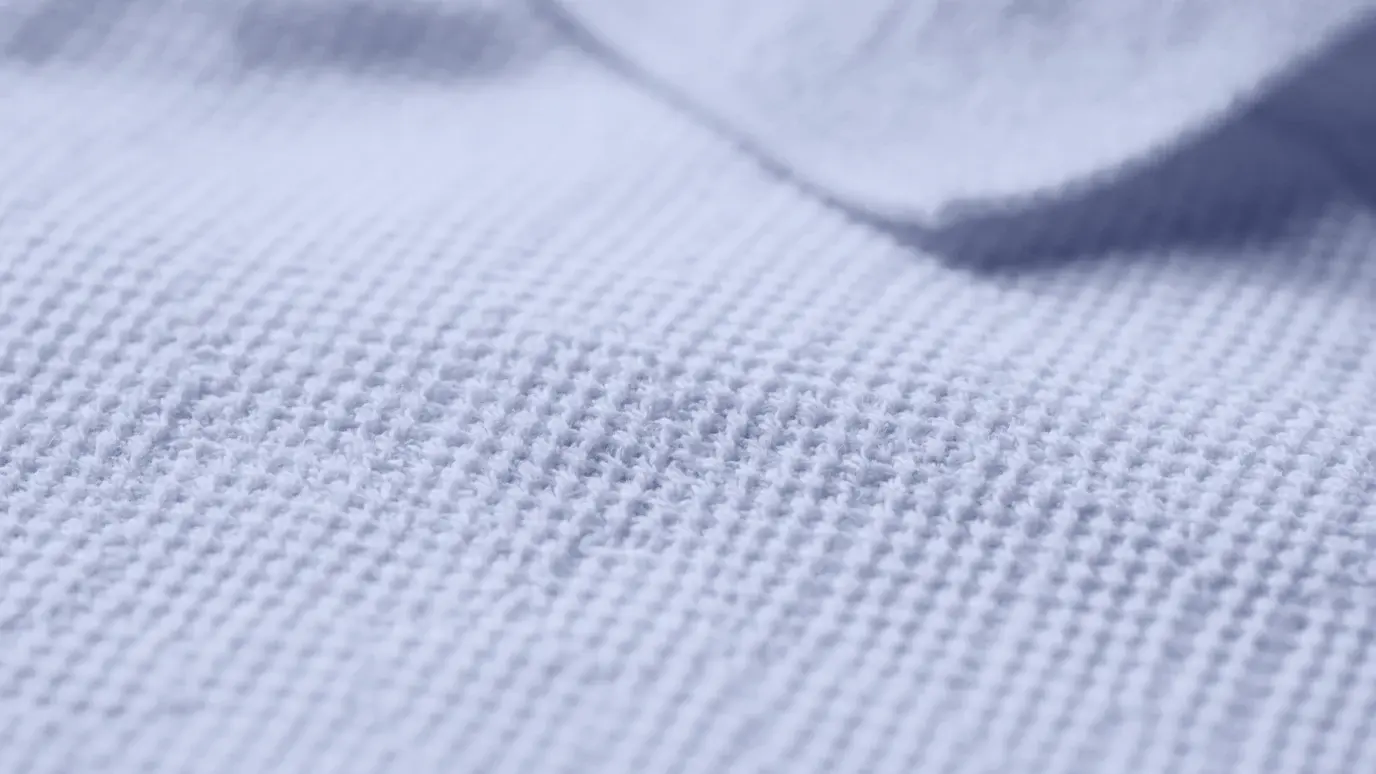
Piqué is a single-bed knitted fabric in which tuck stitches are knitted alongside plain knit stitches, giving the surface a honeycomb-like texture with a visible micro-mesh look. It is common in polo shirts, sportswear and corporate wear; Turkish suppliers call it pike or lakost.
- Published:
- Fact-checked by:
- Gizem Polat
Key facts
- Piqué is a single-bed knit in which tuck stitches are combined with plain knit stitches, giving a honeycomb-textured surface.
- Turkish suppliers also call piqué lakost; Lacoste is a brand name, while the fabric is called piqué.
- Single, double and six-feed piqué exist; double piqué is thicker than single piqué.
- Two suppliers’ weight claims for polo and corporate wear fall within 180–240 g/m²; there is no standard range.
Properties
- Fiber content
- Knitted from cotton, cotton-polyester and polyester yarns; elastane versions exist
- Structure
- Single-bed circular knit (“tek plaka”, single plate, in Turkish trade usage); plain knit and tuck stitches; single piqué (four-feed repeat), double piqué, six-feed piqué
- Weight range
- No standard range. For cotton-polyester piqué one manufacturer quotes 180–240 g/m² (5.3–7.1 oz/yd²), and for polyester piqué another quotes 150–280 g/m² (4.4–8.3 oz/yd²), depending on the source. In research samples of Ne 30/1 cotton ring-spun yarn knitted on a 28-gauge machine, dry-relaxed greige weight was about 170–197 g/m² (5.0–5.8 oz/yd²) for single piqué and about 190–218 g/m² (5.6–6.4 oz/yd²) for double piqué
- Stretch
- Tuck stitches increase fabric width and crosswise stretch and reduce length and lengthwise stretch (Dias, 2003, cited in Dönmez, 2008); in one study single piqué was more dimensionally stable than double piqué
- Uses
- Polo shirts, sportswear, corporate wear and uniforms
- Care
- Care instructions depend on fiber content and finishing. Dimensional change after washing is measured by ISO 5077, using ISO 6330 washing and drying procedures.
Piqué is a knitted fabric in which plain knit stitches and tuck stitches are knitted together, giving the surface a honeycomb-like texture with small holes. According to CottonWorks, piqués are common in knit polo shirts and are a favored structure in activewear. Like single jersey it is a single-bed knit, but its surface is textured rather than smooth. Turkish suppliers call it pike or lakost.
Piqué fabric structure
Piqué is a structure that combines plain and tuck stitches (CottonWorks, Textile Encyclopedia). In a tuck the needle takes a new yarn without dropping the old loop (Dönmez, 2008). A structure made of tuck stitches alone is both wider and thicker than one without tucks (NPTEL, Module 2). Tucks widen the fabric and increase crosswise stretch, while shortening it and reducing lengthwise stretch (Dias, 2003, cited in Dönmez, 2008). The look that distinguishes piqué, a “visible micro-mesh structure” (CottonWorks), comes from honeycomb-like cells that the loop and tuck movements open on the surface (Fersan; Karcem). CottonWorks lists piqué among single-bed fabrics.
Single, double and six-feed piqué
- Single piqué: One repeat needs four feeds. It is the most productive piqué to knit, so it makes up the majority of piqués on the market (CottonWorks).
- Double piqué: Also four feeds, but the needles take yarn on two feeds before releasing their loops, and the held yarns make the fabric thicker than single piqué. With no plain-knit feed at all, it is the slowest piqué to knit (CottonWorks).
- Six-feed piqué: One repeat needs six feeds; the tuck stitches are stacked to form more pronounced piqué cells. It is more textured and more stable than double piqué (CottonWorks).
Turkish academic texts use the names tek toplama pike and çift toplama pike. Candan, İridağ and Nergis (2001) compared these two structures and found the tek toplama (single) one more dimensionally stable than the çift toplama (double) one (Candan et al., 2001; Dönmez, 2008). Their English abstract calls the structures single piqué and double piqué; however, the sources do not show that their knitting reports are identical to CottonWorks’ single and double piqué. Confirm the structure on a sample when ordering.
Piqué, lakost and Lacoste
In Turkey, piqué is also called lakost: one supplier uses “lakost” and “polyester lakost” for polo and corporate wear (Altunkaya), and another names its fabric line “Pike / Lacoste” (Karcem). Turkish academic writing also uses “lacoste type structures” (Candan et al., 2001) and “lakost kumaş” (Dönmez, 2008). Lacoste itself is a brand: René Lacoste founded it with André Gillier in 1933, and according to the brand’s corporate site the polo shirt it put on the courts that year was made of “petit piqué” cotton. The name of the fabric is piqué. In an order, write the structure (single or double piqué), the fiber composition and the weight instead of a brand name or a trade nickname.
Piqué weight (GSM)
There is no standard weight range for piqué. Karcem quotes 180–240 g/m² for cotton-polyester piqué and Altunkaya 190–240 g/m² for polo and corporate wear; for polyester piqué Fersan declares 150–280 g/m² (160–290 g/m² for the elastane type). A measured comparison:
| Structure (Ne 30/1 cotton ring-spun yarn, 28-gauge, 30-inch; dry-relaxed greige) | Weight (g/m²) |
|---|---|
| Single jersey | about 129–144 |
| Single piqué (tek toplama pike) | about 170–197 |
| Double piqué (çift toplama pike) | about 190–218 |
The ranges vary with the yarn feed amount and the yarn twist factor (Candan, İridağ and Nergis, 2001; cited in Dönmez, 2008, Table 1.2). In the same study single piqué came out lighter than double piqué regardless of yarn type. For conversion, 1 oz/yd² ≈ 33.9 g/m².
Uses
Piqué is used in polo shirts and corporate wear (Karcem), and also in sportswear, promotional products and uniforms (Fersan). CottonWorks presents the micro-mesh structure as what makes piqué a good fabrication for warm climates. The choice among single jersey, piqué, interlock and rib for T-shirts is covered in T-shirt fabric types.
Not to be confused with
- Piqué in Turkish home textiles: The Turkish Language Association (TDK) dictionary defines pike as an embossed cotton fabric and the bedspread made from it. This entry covers the knitted piqué; a bedspread is a separate product.
- Lakost and Lacoste: Lakost is a Turkish trade name; Lacoste is a brand name.
- Single jersey: Single jersey is a plain knit; one face shows V-shaped loops and the other shows loop rows (Dönmez, 2008). Piqué has a surface texture formed by tuck stitches; in the Candan et al. study, piqué samples knitted from the same yarn came out heavier than single jersey (table above).
What to specify when sourcing piqué
- State the structure: single or double piqué, the fiber composition (as a percentage), the yarn and the weight.
- Check dimensional stability: in one study single piqué was more stable than double piqué (Candan et al., 2001); still, have the dimensional change after washing measured for each fabric by ISO 5077 (to ISO 6330 procedures).
- Ask for the weight with its condition: greige, finished or relaxed.
- Ask for a sample: the name “lakost” can cover different structures from one supplier to another; check the texture and thickness by hand.
Sources (12)
- CottonWorks (Cotton Incorporated): Single Knits and Double Knits (accessed October 9, 2026)
- CottonWorks (Cotton Incorporated), Textile Encyclopedia: Piqué (accessed October 9, 2026)
- Dönmez, E. T. (2008). Yuvarlak örme kumaşlarda kumaş gramajına etki eden faktörler üzerine bir araştırma (A study on the factors affecting fabric weight in circular knitted fabrics; in Turkish). Dokuz Eylül University Graduate School of Natural and Applied Sciences, master’s thesis (pp. 17-18: tuck and float; pp. 29-32: Candan et al. 2001 as cited, Tables 1.1-1.2)
- Candan, C., Iridag, Y., Nergis, U. B. (2001). A comparative study of the properties of lacoste type structures. Melliand Textilberichte, 82(9), E168-E170, 690-692 (Istanbul Technical University research record, abstract)
- NPTEL, Knitting Technology, Module 2 FAQ (Q1: effect of tuck and float stitches on fabric dimensions)
- TDK Güncel Türkçe Sözlük (Turkish Language Association dictionary), entry “pike” (accessed October 9, 2026)
- Karcem Tekstil (raw knitted fabric manufacturer): Örme Kumaş: Çeşitleri, Gramaj Tablosu ve Üretimi (knitted fabric: types, weight table and production; Turkish; last updated September 26, 2026; accessed October 9, 2026)
- Fersan Tekstil (polyester knitted fabric manufacturer): Pike Kumaş (piqué fabric; Turkish; updated October 3, 2026; accessed October 9, 2026)
- Altunkaya Tekstil: Kumaş GSM (Gramaj) Nedir? (What is fabric GSM (weight)?; Turkish; June 30, 2026; accessed October 9, 2026)
- Lacoste (corporate site): Our History (accessed October 9, 2026)
- ISO 6330:2021 Textiles: Domestic washing and drying procedures for textile testing
- ISO 5077:2007 Textiles: Determination of dimensional change in washing and drying (confirmed in 2022)
Author and fact-checking
Written by
Fabrics and Fibers Editor
Elif Karaca is Tekstil Rehberi's fabrics and fibers editor. She writes guides and glossary entries on knitted, woven and nonwoven fabrics, fiber properties and choosing the right fabric for each product, and bases values such as GSM, width, shrinkage and color fastness on standards and mill technical data sheets.
Content by Elif KaracaFact-checked by: Gizem Polat
This content was prepared by the Tekstil Rehberi editorial team. Before publication, our verification editor checked its figures, dates and sources against primary sources.
Spotted an error? Email us at [email protected] How we work →
Articles on this topic

T-Shirt Fabric Types: A Buyer’s Guide to Jersey, Piqué, Interlock and Rib
How single jersey, piqué, interlock and rib behave in a T-shirt, how to write the fabric spec for your supplier, and what Turkish terms such as süprem and penye mean.