What is Jacquard?
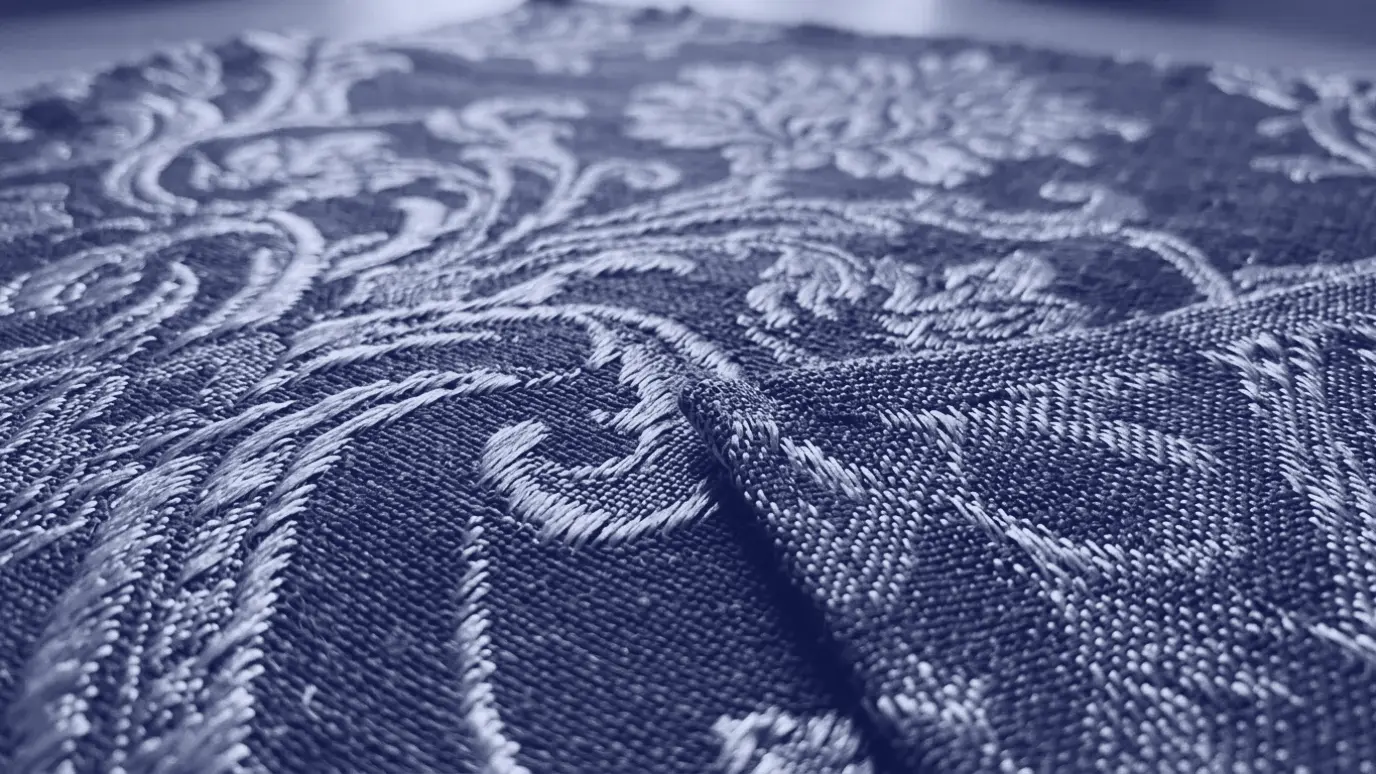
Jacquard is a weaving method that builds the pattern into the fabric structure on a loom that can control each warp yarn individually, instead of adding it later by printing or dyeing. The patterned fabric woven this way is also called jacquard, and some patterned knits carry the name too. Turkish suppliers say jakar.
- Published:
- Updated:
- Fact-checked by:
- Gizem Polat
Key facts
- Jacquard names both the loom that controls each warp yarn individually and the complex patterned fabric woven on it (TDK).
- In jacquard fabric the pattern is in the weave itself, not in print or dye; Getty AAT defines jacquard as a patterned woven textile made on a jacquard loom.
- According to CottonWorks, the jacquard head can control up to 12,000 warp ends, while dobby designs are generally small and geometric because of the limited frame count.
- Jacquard fabrics are normally more expensive because of their complexity and slower weaving speed (CottonWorks).
- Knitting has jacquard structures too; in single-bed jacquard the unused color yarn floats at the back, so natural stretch is very low.
Properties
- Fiber content
- Not specified; jacquard is a method name. State the fiber and its percentage separately
- Structure
- In weaving, the jacquard head controls each warp yarn individually; CottonWorks says up to 12,000 warp ends can be controlled. Jacquard designs include at least two basic weaves, such as satin and plain. Knitting has single-bed and double-bed jacquard structures
- Weight range
- No standard range; it varies with fiber, yarn count and structure. Ask for weight in g/m² with the test method (for example EN 12127); 1 oz/yd² ≈ 33.9 g/m²
- Stretch
- No measured value for woven jacquard. In single-bed jacquard knits the unused color yarn floats at the back, so natural stretch is very low (CottonWorks)
- Care
- Care instructions depend on fiber content and finishing; follow the label. Dimensional change after washing is measured by ISO 5077, using ISO 6330 washing and drying procedures.
Jacquard is a weaving method that builds the pattern into the structure of the fabric instead of adding it afterwards by printing or dyeing. The Turkish Language Association dictionary (TDK) gives jakar two meanings: a mechanical loom on which each warp yarn moves on its own, and a complex patterned fabric woven on that loom. The Getty Art & Architecture Thesaurus defines jacquard as any patterned woven textile produced on a jacquard loom. The name comes from the French inventor Joseph Marie Jacquard (TDK; Dictionary.com).
How does a jacquard loom work?
Weaving uses three methods to raise the warp: cam, dobby and jacquard. On a jacquard loom, a jacquard head mounted above the loom controls each warp yarn individually; the yarns are managed by lifting cords that hang from the head instead of by frames. The more hooks the head has, the larger the pattern repeat; CottonWorks says up to 12,000 warp ends can be controlled.
| Method | Control | Pattern |
|---|---|---|
| Cam | Typically 6–8 frames, sometimes up to 12 | Narrower design range than dobby |
| Dobby | 12–32 frames | Generally small, geometric designs; also complex twill, satin and stripe patterns |
| Jacquard | Lifting cords instead of frames; each warp yarn individually | Large repeats, detailed designs; includes at least two basic weaves |
Source: CottonWorks. Fabrics made on jacquard looms are normally more expensive because of their complexity and slower weaving speed (CottonWorks).
Jacquard knits
The name jacquard is also used in knitting. CottonWorks distinguishes single-bed and double-bed jacquard knits; in knitting the pattern is determined by needle and yarn selection.
| Type | Structure | Note |
|---|---|---|
| Single-bed jacquard | The color yarn that does not show on the face stays as a float at the back; in the source’s two-color example the pattern needs two feeds | Natural stretch is very low because of the floats at the back |
| Double-bed jacquard | Separate knit patterns on the face and the back; in the source’s three-color example, three feeds are needed for one visible row | Heavier depending on yarn size, and uses more yarn than single-bed jacquard |
Source: CottonWorks.
Telling jacquard apart from similar terms
| Term | Difference |
|---|---|
| Dobby | Works with a limited number of frames; designs are generally small and geometric (CottonWorks) |
| Printed fabric | In jacquard the pattern is part of the weave; it is not added later by printing or dyeing (Collins) |
| Jacquard loom and jacquard fabric | TDK gives the two meanings separately; if you mean the fabric in an order, also state the structure and fiber |
What to check when buying jacquard fabric
- State the structure: woven or knitted; for knits, single-bed or double-bed. Jacquard does not specify a fiber, so add the fiber with its percentage too.
- Ask about the pattern repeat and its direction: according to the MEGEP Spreading module, pattern direction matters in patterned fabrics, so the marker is laid one-way; this can affect fabric consumption. For the calculation, use the fabric consumption calculator.
- Get the weight with its test method. The figure should be in g/m²; EN 12127 is the small-sample method for mass per unit area, and in woven fabric warp and weft density is determined by ISO 7211-2. To calculate weight from a sample, use the fabric GSM calculator.
- Ask about post-wash size on jacquard: values should come from ISO 5077 on samples washed and dried to ISO 6330. The shrinkage calculator can then add the figure to the cut size.
- Evaluate the price separately: have the jacquard structure written out in the quotation; the slow weaving speed may be reflected in the price.
To compare woven and knitted fabric families, use the fabric types guide; suppliers are listed under woven fabric and knitted fabric.
Frequently asked questions
Is jacquard fabric printed?
No. According to the Collins dictionary, the pattern in jacquard is part of the weave; it is not added later by printing or dyeing. Random House likewise defines jacquard as a fabric with an intricate pattern woven on a jacquard loom.
Is jacquard breathable?
Jacquard names a patterning method rather than a fiber; the cloth can be woven from different fibers and weights, so how it handles sweat varies with the fiber, the structure and the weight. No fabric eliminates sweating. A seller’s “breathable” claim is not enough: ask for EN ISO 9237 air-permeability and EN ISO 11092 water-vapor-resistance results. The general framework is in breathable fabrics.
Is jacquard the same as dobby?
No. Dobby works with a limited number of frames, and according to CottonWorks its designs are generally small and geometric. Jacquard can control each warp yarn individually, so it allows large, detailed designs.
Sources (15)
- TDK Güncel Türkçe Sözlük (Turkish Language Association dictionary), entry “jakar” (jacquard; accessed October 11, 2026)
- TDK Güncel Türkçe Sözlük (Turkish Language Association dictionary), entry “jakarlı” (jacquard-patterned; accessed October 11, 2026)
- Getty Research Institute, Art & Architecture Thesaurus: jacquard (AAT 300256616; accessed October 11, 2026)
- Dictionary.com, entry “jacquard” (Random House Unabridged Dictionary; Collins English Dictionary; accessed October 11, 2026)
- CottonWorks (Cotton Incorporated), Textile Encyclopedia: Jacquard Head (accessed October 11, 2026)
- CottonWorks (Cotton Incorporated), Learning Hub: Weaving Basics (cam, dobby and jacquard shedding; accessed October 11, 2026)
- CottonWorks (Cotton Incorporated), Learning Hub: Complex Woven Fabric Designs (accessed October 11, 2026)
- CottonWorks (Cotton Incorporated), Learning Hub: Single & Double Knits (accessed October 11, 2026)
- MEB MEGEP (Republic of Türkiye Ministry of National Education), Serim (Spreading) module, section 1.3.1.6 Desen Özellikli Serim (Spreading of pattern fabrics; Turkish; p. 14; accessed October 11, 2026)
- EN 12127:1997 Textiles. Fabrics. Determination of mass per unit area using small samples (BS EN 12127:1998 record; applies to woven and knitted fabrics)
- ISO 7211-2:2024 Textiles: Methods for analysis of woven fabrics construction: Determination of number of threads per unit length (BSI record, published August 22, 2024)
- ISO 5077:2007 Textiles: Determination of dimensional change in washing and drying (confirmed in 2022)
- ISO 6330:2021 Textiles: Domestic washing and drying procedures for textile testing
- EN ISO 9237:1995 Textiles: Determination of permeability of fabrics to air (EVS-EN ISO 9237:2000 record)
- EN ISO 11092:2026 Textiles: Physiological effects, measurement of thermal and water-vapour resistance under steady-state conditions (sweating guarded-hotplate test) (EVS record; valid from June 15, 2026)
Author and fact-checking
Written by
Fabrics and Fibers Editor
Elif Karaca is Tekstil Rehberi's fabrics and fibers editor. She writes guides and glossary entries on knitted, woven and nonwoven fabrics, fiber properties and choosing the right fabric for each product, and bases values such as GSM, width, shrinkage and color fastness on standards and mill technical data sheets.
Content by Elif KaracaFact-checked by: Gizem Polat
This content was prepared by the Tekstil Rehberi editorial team. Before publication, our verification editor checked its figures, dates and sources against primary sources.
Spotted an error? Email us at [email protected] How we work →
Articles on this topic
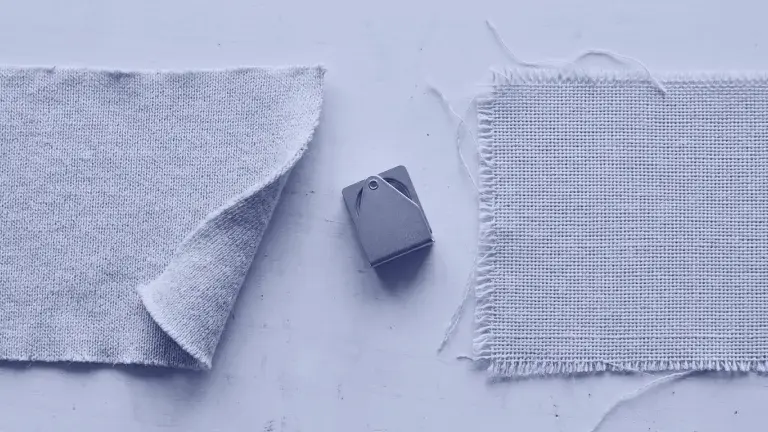
Knit vs Woven Fabric: How to Tell Them Apart
How knit and woven fabrics differ, five checks to tell them apart, the cases that mislead, how to choose by product, and what changes in production, testing and customs classification.
How to Source Fabric from Turkey: Find, Verify, Compare and Order
What Turkish fabric mills make and who they sell to, where to find them, what to plan for on MOQ and lead time, which tests to request, how EU, UK and US duty rules differ and how to verify a supplier.
Bed Linen Fabric Types: Percale, Sateen and Thread Count
Percale, sateen, ranforce and flannel compared: what thread count means per inch and as the Turkish per-centimeter “tel”, why “600 thread count” can mislead, and a checklist for writing a spec.