T-Shirt Production Cost: How to Calculate It, with a Worked Example
How to calculate T-shirt production cost: the cost lines, kilogram-based fabric use, waste, sewing and print costs, and a hypothetical worked example you can rerun with your own numbers.
- Published:
- Updated:
- Fact-checked by:
- Gizem Polat
Key facts
- T-shirt production cost is the per-piece total of fabric, rib, trims, cutting, sewing, print, packing, freight and waste, plus one-off costs spread over the order quantity.
- Knit fabric use is calculated in kilograms: fabric area per piece taken from the marker (m²) × GSM (g/m²) ÷ 1,000.
- CBI's cost study suggests adding an average of 3–6% waste for fabric and about 2% for trims and packing; treat these as starting points and adjust with your own batch records.
- The abstract of a study on knitwear cites fabric as close to 50% of garment cost or more; the real share depends on the product and the labor involved.
- Fixed costs such as samples, patterns and print setup are divided by the order quantity: in a hypothetical example, TL 7,500 adds TL 1.50 per piece at 5,000 pieces but TL 15.00 at 500.
T-shirt production cost is the total spent per piece from fabric to carton: fabric including waste, rib and trims, cutting, sewing labor, any print or embroidery, packing, freight and a quality-loss allowance. One-off costs such as samples and patterns are divided by the order quantity and added to this total. Overhead and profit are added on top of the production cost to reach a selling price.
This guide shows how to calculate each line: kilogram-based fabric consumption for knits, the waste allowance, the sewing charge and fixed costs spread over the order. It ends with a hypothetical worked example in which you can replace every input with your own numbers, and a scenario table showing how much each input moves the result. None of the TL figures in the example is a market price or a recommendation. The example is in Turkish lira (TL), the currency of its minimum-wage-based labor input; if your quote is in USD or EUR the formulas are the same, so record the exchange rate and its date.
What does T-shirt production cost consist of?
A cost calculation starts from the materials and operations list in the T-shirt's tech pack. Our recommendation at Tekstil Rehberi: leave no line to assumption if it is not in the tech pack. A line that is not on the list is not in the calculation, and it later shows up as an extra cost. The CBI cost study, written for manufacturers selling to European buyers, builds its calculation on the same logic: a minute cost from labor and overhead, fabric, trims and packing lines with waste allowances, and the factory's profit on top.
| Line | How it is calculated | Where the data comes from |
|---|---|---|
| Body fabric | Consumption (kg per piece) × price per kg × (1 + extra waste) | Marker, GSM, fabric quote |
| Rib (collar band) | Consumption (kg per piece) × price per kg × (1 + extra waste) | Rib quote, sample weighing |
| Trims | Cost per piece × (1 + about 2% waste) | Sewing thread, shoulder tape (Turkish: ekstrafor, a tape that supports the shoulder seam), main and care labels; the tech pack's materials list |
| Cutting | Charge for spreading, cutting, numbering and sorting | Cutting workshop quote, or a sewing quote that includes cutting |
| Sewing labor | SMV × minute cost ÷ efficiency + overhead + profit | Contract workshop quote, or your own workshop calculation |
| Print and embroidery | Quote by method, number of colors, quantity and placement | Print and embroidery workshop quote |
| Packing | Polybag, carton and hanger materials × (1 + about 2% waste) | Packaging quote |
| Freight | Fabric to the workshop, product to the warehouse | Carrier quote |
| Quality loss | Percentage of the subtotal: rework, second quality | Your own past batch records |
| Fixed costs | (Sample + pattern and grading + print setup) ÷ order quantity | Sample and pattern invoices |
Who pays for which line?
You can receive quotes for the same T-shirt under three different production models, explained in the contract manufacturing guide. Quotes cannot be compared until the scope is equal.
| Line | Sewing only | Cut and sew (CMT) | Full package |
|---|---|---|---|
| Fabric and rib | The party placing the order | The party placing the order | The manufacturer |
| Trims and labels | Mostly the party placing the order; depends on what the quote states | Mostly the party placing the order; depends on what the quote states | The manufacturer |
| Cutting | The party placing the order (cut pieces arrive at the workshop) | The workshop | The manufacturer |
| Sewing | The workshop | The workshop | The manufacturer |
| Print, pressing and packing, freight | Depends on what the quote states | Depends on what the quote states | Depends on what the quote states |
The CBI study likewise separates the CM (cut and make) model, which focuses on labor only, from the FOB model, where the factory also sources the materials; in the trade, full package is often called FOB. To ask line by line what a sewing quote includes, see our guide to contract T-shirt sewing prices, which has an include/exclude table.
How to calculate T-shirt production cost, step by step
1. Fabric consumption: kg per piece
Knit fabric consumption is calculated in kilograms, woven fabric consumption in meters or yards (Sarkar, 2020). The method starts from the marker, the layout plan of the pattern pieces on the fabric. Find the area the marker covers and include the unused gaps in that area. Divide the area by the number of T-shirts in the marker and multiply by the GSM (fabric weight):
Marker area (m²) = marker length (m) × fabric width used (m)
Area per piece (m²) = marker area ÷ number of T-shirts in the marker
Consumption (kg per piece) = area per piece (m²) × GSM (g/m²) ÷ 1,000
Example (assumption): If the marker is 30.00 m long, the fabric width used is 1.80 m and the marker holds 54 T-shirts, the area is 54 m² and the area per piece is 1.00 m². At 180 g/m², consumption is 1.00 × 180 ÷ 1,000 = 0.180 kg.
Three details change the result:
- Size distribution. A marker built with the size distribution of the order, not with a single size, gives the average consumption. Sarkar also explains, in a woven garment example, that the sample marker consists of different sizes and that the result is the average consumption for all sizes; the logic is the same for knits.
- The state in which GSM is measured. In Cotton Incorporated's bulletin ISP 1009, the same raw single jersey measured 135 g/m² as delivered off the machine and 176 g/m² after relaxing, a difference of about 30%. State the measurement state in the tech pack and in the fabric quote. Details are in the guide to fabric weight by product.
- A rough estimate is not enough. Sarkar does not recommend using his T-shirt consumption calculator, which works from garment measurements, in bulk production; he asks for CAD- or marker-based consumption (2021). For converting between meters and kilograms, see how many meters of fabric a product takes or the fabric meter to kg calculator.
2. Fabric cost and waste
Fabric cost (TL per piece) = consumption (kg per piece) × fabric price (TL per kg) × (1 + extra waste)
Waste appears in two places. Marker waste is the gap left between pattern pieces, and it is already inside the area calculation above. Extra waste covers losses outside the marker, such as fabric defects, losses at the start and end of a roll, and cutting errors. Counting both on top of each other, or adding no extra waste at all, spoils the calculation. In CBI's example calculation, too, the fabric line is shown including waste.
CBI's study suggests adding an average of 3–6% waste for fabric and about 2% for trims and packing. These rates are a starting point; replace them with your own batch records.
Marker efficiency is not fixed either. Bilgiç and Duru Baykal (2017) prepared markers for six knitted upper-garment models with three fabric widths and four fabric types, and studied model type, fabric width and fabric type (represented by its shrinkage value) as parameters that affect marker efficiency and therefore raw material and second-quality cost. The abstract of the study also states that fabric cost is close to 50% of total garment cost or more. Asking for marker trials with different fabric widths before an order is therefore sensible.
A fabric quote should state: whether VAT is excluded or included, the price per kg, GSM and the state in which it was measured, open width, raw or dyed, any shrinkage-resistance treatment, minimum lot, payment terms and currency.
3. Rib and trims
Rib (an elastic knit fabric used for collar bands; Turkish: ribana) is a separate fabric: it appears in the quote with its own consumption and its own price per kg. Write the fiber and color of the collar rib into the specification so that it matches the body fabric. For fabric choices, see T-shirt fabric types.
Trims come from the tech pack's materials list: sewing thread, shoulder tape, main label, care and size labels, and a hang tag if wanted. Add about 2% waste to each line, as CBI suggests. Types of trims and how to specify them are covered in the guide to garment trims and accessories.
4. Cutting
The cutting line covers more than cutting; it covers the work of the cutting room. According to MEB's cutting-room module, a label showing the order, size, color and ply number is attached to each cut ply (numbering), and the pieces are checked and bundled (sorting; Turkish: tasnif). If you get a sewing quote that includes cutting, this line is merged with the sewing charge; if you give cutting to a separate workshop, it is priced separately. For workshops that offer cutting, see fabric cutting services in Turkey. The cutting-room stages in the production flow are explained in garment manufacturing process.
5. Sewing labor
The detailed calculation of the sewing charge is in our guide to contract T-shirt sewing prices. In short, the formula is:
Sewing charge = (SMV × minute cost ÷ efficiency) + overhead + profit
SMV (standard minute value) is the time needed to do a job at a standard pace. Efficiency is the ratio that accounts for losses on the line (breakdowns, waiting for material, model changes, rework). In CBI's example, SAM (standard allowed minutes, a standard time used in the trade for a similar purpose as SMV) is multiplied by a 25% efficiency-loss factor; the study says that even in an efficient factory about 25% of working time is lost.
If you produce in your own workshop, you can also build the minute cost with CBI's formula: minute cost = (direct labor + indirect labor + overhead) ÷ total production minutes per year. If you use a contract workshop, enter the workshop's quote on this line and confirm its scope (pressing, thread trimming, quality control, VAT status) in writing.
6. Print and embroidery
Print and embroidery are mostly done in a separate workshop at a separate price. The price depends on the method, the number of colors, the quantity, the placement and the setup items (screen, film, sample print). In screen printing the setup is done once, so the unit cost falls as quantity rises and rises on small runs. This guide gives no TL value for printing. For a comparison of methods, see textile printing methods; for workshops, see the textile printing services and embroidery categories.
7. Quality loss, packing and freight
A faulty T-shirt is reworked, sold as second quality or scrapped, and this loss shows up in the product cost. The study by Bilgiç and Duru Baykal treats second-quality cost together with marker efficiency. Use the rate from your own past batches as the allowance. If you are working with a new manufacturer, write the scope of quality control and the responsibility for faulty product in advance (AQL inspection).
Packing materials (polybag, carton, hanger) and freight go in per piece as separate lines. Freight runs in two directions: fabric to the workshop and product to the warehouse.
8. Fixed costs: samples, patterns, grading
Costs that are incurred once and do not depend on the order quantity are divided by the number of pieces:
Fixed cost per piece = (sample + pattern and grading + print setup + testing) ÷ order quantity
For example (assumption), fixed costs of TL 7,500 are TL 1.50 per piece on 5,000 pieces, TL 15.00 on 500 pieces and TL 75.00 on 100 pieces. The same model therefore becomes noticeably more expensive in a smaller batch. The CBI study also notes that large-volume orders are more efficient to produce than small ones. For sample stages and approval rounds, see types of garment samples.
CBI also recommends tracking buyer-specific items that arise with some buyers separately from overheads: payment terms (interest), payment discount, chemical tests, sales samples, courier shipments, fit samples, financing cost and fabric stock holding.
Worked example (hypothetical)
Warning: All the figures below are assumptions; they are not a market price or a real quote from any supplier. They are numbers chosen only to show how the calculation is built. Write your own numbers in the “Your value” column and rerun the calculation. All amounts are in TL and exclude VAT; the date of this guide is October 9, 2026.
Product: Plain-color, short-sleeve, 100% cotton single jersey T-shirt with a crew-neck rib collar. No print. The brand buys the fabric and trims itself and gives cutting and sewing to a contract workshop.
| Input | Example value (assumption) | Your value | Note |
|---|---|---|---|
| Order | 5,000 pieces, mixed sizes | ||
| Marker | Length 30.00 m, width 1.80 m, 54 T-shirts | 1.00 m² per piece | |
| GSM | 180 g/m² (finished, relaxed state) | Consumption 0.180 kg per piece | |
| Body fabric price | TL 280/kg | An assumption; enter your own quote | |
| Rib | 0.010 kg per piece, TL 300/kg | Assumption | |
| Extra waste (fabric and rib) | 4% | Chosen within CBI's 3–6% range | |
| Sewing thread and shoulder tape | TL 2.50 per piece | Assumption | |
| Labels (main and care) | TL 3.00 per piece | Assumption | |
| Waste on trims and packing | 2% | CBI | |
| Cutting | TL 4.00 per piece | Assumption | |
| Sewing labor | TL 72.31 per piece | See below | |
| Packing materials | TL 2.50 per piece | Assumption | |
| Freight | TL 2.00 per piece | Assumption | |
| Quality and rework allowance | 2% of the subtotal | Assumption | |
| Fixed costs | TL 7,500 (sample, pattern, grading) | Assumption |
The sewing line: The TL 72.31 comes from the same inputs as the hypothetical calculation in our guide to contract T-shirt sewing prices: SMV 8.00 minutes, efficiency 60%, an employer cost of TL 40,874.63 per month for an operator (table of the Turkish Ministry of Labor and Social Security for 2026, without the social security premium discount; as of the date of this guide), overhead 35% and profit 15%. Pressing, thread trimming and the final check are assumed to be inside the SMV. This figure is not a price reference either. In a real cost sheet, replace it with the sewing charge from your own factory quote.
Calculation steps (intermediate values rounded to the kuruş, TL 0.01)
| Line | Calculation | TL per piece | Your result |
|---|---|---|---|
| Body fabric | 0.180 kg × TL 280/kg × 1.04 | 52.42 | |
| Rib | 0.010 kg × TL 300/kg × 1.04 | 3.12 | |
| Thread, shoulder tape, labels | (2.50 + 3.00) × 1.02 | 5.61 | |
| Cutting | 4.00 | ||
| Sewing labor | 72.31 | ||
| Packing materials | 2.50 × 1.02 | 2.55 | |
| Freight | 2.00 | ||
| Subtotal | 142.01 | ||
| Quality and rework allowance | 142.01 × 0.02 | 2.84 | |
| Fixed costs | 7,500 ÷ 5,000 | 1.50 | |
| Production cost per piece (example) | 146.35 |
With these assumptions, the total cost of the 5,000-piece order is TL 146.35 × 5,000 = TL 731,750. The result is not a market price, an average or a recommended price; it is only the output of the chosen inputs.
How does the cost split in the example?
In this example, fabric and rib make up about 38% of the total and sewing labor about 49%. The study abstract mentioned above, however, cites fabric as close to 50% of garment cost or more (a general statement, not a finding the study measured). The difference comes from the assumptions: an 8-minute SMV, 60% efficiency and labor built on the minimum wage make the sewing line large, and the fabric share rises as the price per kg or the GSM rises. Do not aim at someone else's percentage; calculate the share from your own inputs.
Which input moves the cost most?
The table below changes only the input named in each row; all other inputs stay the same as in the example above.
| Scenario | Changed input | Cost per piece (TL) | Difference |
|---|---|---|---|
| Example (baseline) | 146.35 | ||
| Fabric price rises 10% | Body fabric TL 308/kg, rib TL 330/kg | 152.01 | +TL 5.66 (+3.9%) |
| Extra waste rises from 4% to 8% | Fabric and rib | 148.52 | +TL 2.17 (+1.5%) |
| Consumption rises from 0.180 to 0.200 kg | Marker efficiency falls or GSM rises | 152.29 | +TL 5.94 (+4.1%) |
| GSM falls from 180 to 160 g/m² | Consumption 0.160 kg, same price per kg | 140.40 | −TL 5.95 (−4.1%) |
| Sewing efficiency falls from 60% to 50% | Sewing charge TL 86.79 | 161.12 | +TL 14.77 (+10.1%) |
| Order falls from 5,000 to 500 pieces | Fixed cost TL 15.00 per piece (this effect only) | 159.85 | +TL 13.50 (+9.2%) |
| One-color chest print added | Print +TL 10.00 (assumption) | 156.55 | +TL 10.20 (+7.0%) |
Three points follow from the table. A 10% rise in the fabric price raises the total by about 3.9%, because fabric is about 38% of the total. Less visible inputs such as efficiency and order quantity can move the total much more than that; CBI also states that production efficiency often has more influence on FOB prices than minimum wages or import duties. Lowering the GSM reduces consumption proportionally, but it also changes the fabric's handle, opacity and price per kg, so decide with a sample.
From production cost to selling price
Cost is the floor of the selling price. On top of it goes an allowance to cover your overheads (office, design, marketing, returns) and your profit margin. Two methods are often confused: markup is a percentage added on top of cost, while gross margin is a percentage of the selling price.
Selling price = cost × (1 + markup)
Selling price = cost ÷ (1 − gross margin)
Gross margin = markup ÷ (1 + markup)
| Target gross margin | Markup needed | Selling price excluding VAT at a cost of TL 146.35 |
|---|---|---|
| 30% | 42.9% | TL 209.07 |
| 40% | 66.7% | TL 243.92 |
| 50% | 100% | TL 292.70 |
The table shows the logic of the calculation; it is not a price recommendation. Adding 40% to cost gives TL 146.35 × 1.4 = TL 204.89, which means a gross margin of about 28.6%, not 40%. For exports the frame is wider: according to CBI, in Europe the retail price is on average four to eight times the FOB price, because customs duty, freight, rent, marketing, overhead, discounts and VAT are paid out of the retail price. The amounts in this guide exclude VAT; confirm the VAT treatment of your quote and invoices with your accountant.
Company directory
Looking for manufacturers in this field?
Browse companies in the related categories or get quotes from several companies with one form.
Do you manufacture or offer services in this field?
How do you compare a quote with your own cost sheet?
When a full-package or fabric-inclusive quote arrives, lay your line table over it:
- Scope: Which line holds fabric, rib, trims, cutting, sewing, pressing and packing, print and freight?
- Consumption and GSM: What is the kg per piece in the quote, and in which state was the GSM measured?
- Waste: Is it a separate line, or buried in the unit price?
- Trims: Who supplies labels, thread, shoulder tape, polybags and cartons?
- Fixed costs: Are sample, pattern and print setup charged? Are they deducted if the order is placed?
- Currency, exchange-rate date, payment terms, VAT: Is the quote exclusive or inclusive of VAT? If it is in a foreign currency, which exchange-rate date applies?
- Quality and lead time: What is the scope of quality control, who is responsible for faulty product, and what is the penalty for delay?
CBI's warning applies here too: the factory with the lowest FOB price for a product is not always the cheapest factory for the buyer, because delays and quality problems can close the gap. The CBI study also stresses that cost items such as labor, fabric, trims, machinery and energy can sometimes change quickly, so costs should be tracked often.
How to reduce T-shirt production cost
No measure suits every product; test the effect of each on quality with a sample.
- Raise marker efficiency. Try markers with different fabric widths; model, fabric width and fabric type affect efficiency (Bilgiç and Duru Baykal, 2017).
- Choose the GSM for the end use. Consumption changes in proportion to GSM; weigh its effect on handle and print first (see the fabric weight guide linked above for what GSM a T-shirt should be).
- Cut down cutting waste and use the offcuts; buy fabric out of season and keep stock low. All four are on CBI's cost-reduction list.
- Combine orders. Fixed costs are spread over more pieces.
- Simplify the model. Every extra operation (pocket, tape, slit) adds time to the SMV.
- Ask about line efficiency. Ask the contract workshop for its SMV assumption for the model and its efficiency expectation.
Next steps
Enter your own numbers in the tables above and rerun the scenarios; once you know which input moves your cost most, price negotiation becomes clearer. For companies making T-shirts, see T-shirt manufacturers in Turkey; for contract sewing workshops, CMT sewing workshops in Turkey; for fabric sourcing, knitted fabric manufacturers and suppliers in Turkey. The cost scenarios are indicative; for tax, invoicing and contract matters, consult your accountant or a lawyer.
Frequently asked questions
How do you calculate T-shirt production cost?
Add up, per piece: fabric (consumption in kg × price per kg × waste factor), rib, trims, cutting, sewing, print if there is any, packing and freight. Then add a quality-loss allowance and one-off costs such as samples and patterns divided by the order quantity. Overhead and profit are added on top of this cost when you set a selling price. The scope of each line, whether VAT is included and the currency should be written down.
What percentage of T-shirt cost is fabric?
There is no single valid share. The abstract of a 2017 study on knitwear (Bilgiç and Duru Baykal) states that fabric cost is close to 50% of total garment cost or more. The real share changes with the price per kg, GSM, marker efficiency, sewing labor and items such as print. In this guide's hypothetical example, fabric and rib come to about 38%.
How many kilograms of fabric does a T-shirt need?
There is no single sourced figure; it depends on size, model, GSM and marker efficiency. The method is fixed: divide the marker area (gaps included) by the number of T-shirts in the marker, multiply by GSM and divide by 1,000. For a reliable result, calculate from a marker made with the size distribution of your order.
How much waste should I add to T-shirt cost?
CBI's apparel cost study suggests adding an average of 3–6% waste for fabric and about 2% for trims and packing. These rates are a starting point. Decide whether marker waste is already inside your consumption figure, and replace the rates with your own batch data, which should reflect losses such as fabric defects and shrinkage.
Why are small T-shirt orders more expensive per piece?
Fixed costs such as samples, patterns, grading and print setup are divided over fewer pieces. In this guide's hypothetical example, fixed costs of TL 7,500 come to TL 1.50 per piece on 5,000 pieces and TL 15.00 on 500. CBI also notes that large-volume orders are more efficient to produce than small ones. Minimum order requirements of fabric suppliers and workshops can make a small batch more expensive too.
How do you get from production cost to a selling price?
First separate markup (a percentage added to cost) from gross margin (a percentage of the selling price). Selling price = cost ÷ (1 − gross margin), so for a 40% gross margin you divide the cost by 0.60. Adding 40% to cost gives only about a 28.6% gross margin. The margin you need depends on your overheads, sales-channel costs and discounts; this guide does not recommend a price.
Sources (7)
- CBI, How to calculate the cost price of an apparel item? (cost study for manufacturers selling to European buyers; last updated September 26, 2024; accessed October 9, 2026)
- Sarkar, P. (April 4, 2020). How Do We Calculate Fabric Consumption for Garments, Online Clothing Study (industry education site; accessed October 9, 2026)
- Sarkar, P. (September 15, 2021). T-shirt fabric consumption calculator, Online Clothing Study (accessed October 9, 2026)
- Bilgiç, H., Duru Baykal, P. (2017). Örme konfeksiyonda kumaş eni ile kumaş ve model türünün ikinci kalite maliyetine etkisi (The effect of fabric width, fabric type and model type on second-quality cost in knitted apparel). Tekstil ve Mühendis, 24(106), 78-87 (abstract record, accessed October 9, 2026)
- Cotton Incorporated, A Guide to Improved Shrinkage Performance of Cotton Fabrics (ISP 1009), 2004 (Table III)
- Turkish Ministry of National Education (MEB), MEGEP, Garment Production Technology: Final Operations in the Cutting Room (Kesimhanede Son İşlemler) (542TGD180), Ankara 2008 (in Turkish)
- Republic of Türkiye Ministry of Labor and Social Security (ÇSGB), General Directorate of Labor: Net Minimum Wage and Cost to the Employer (January 1 - December 31, 2026; table without the social security premium discount; accessed October 9, 2026; in Turkish)
Author and fact-checking
Written by
Garment Production Editor
Hakan Şahin is Tekstil Rehberi's garment production editor. He writes guides on production from the pattern room to shipment, patterns and marker making, quality control (AQL), sampling and costing, and compares process steps and quality criteria with the relevant standards and industry sources.
Content by Hakan ŞahinFact-checked by: Gizem Polat
This content was prepared by the Tekstil Rehberi editorial team. Before publication, our verification editor checked its figures, dates and sources against primary sources.
Spotted an error? Email us at [email protected] How we work →
Related articles
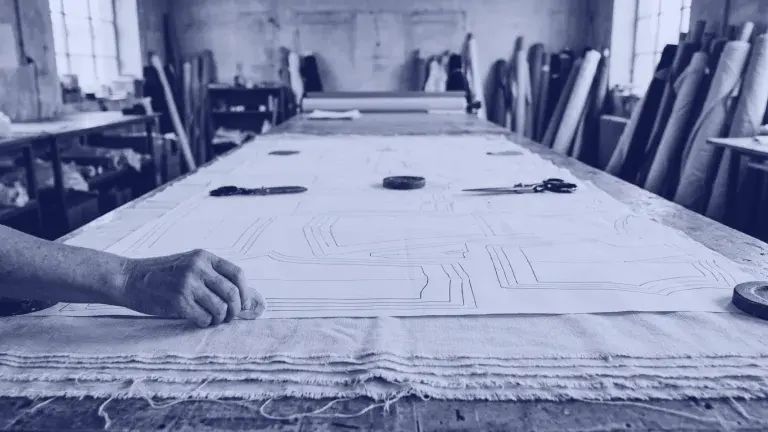
How to Calculate Fabric Consumption for Garments: Formula, Examples and Waste Allowances
How much fabric a garment needs depends on pattern area, fabric width and marker efficiency. The formula, T-shirt and shirt worked examples, shrinkage and waste allowances, and what to write into a CMT order.
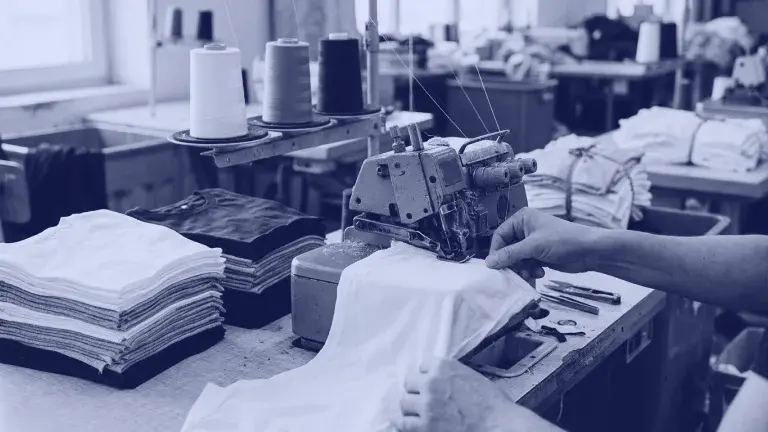
CMT Cost per T-Shirt in Turkey: How to Calculate and Compare Quotes
How a Turkish workshop prices CMT T-shirt sewing: the minute-cost formula, what a quote leaves out, a worked example in Turkish lira and a checklist for comparing quotes.

Types of Garment Samples: Proto, Fit, Size Set and PP Sample
The types of garment samples in the order they are made: proto, fit, size set and PP. What each sample is for, who sews and approves it, how many rounds to plan and how to put approval in writing.