Garment Manufacturing Process: Steps from Tech Pack to Shipment
The garment manufacturing process stage by stage: tech pack, pattern, sampling, cutting, sewing, pressing, packing and shipment, with each stage's output, control point and who does what at a contract factory.
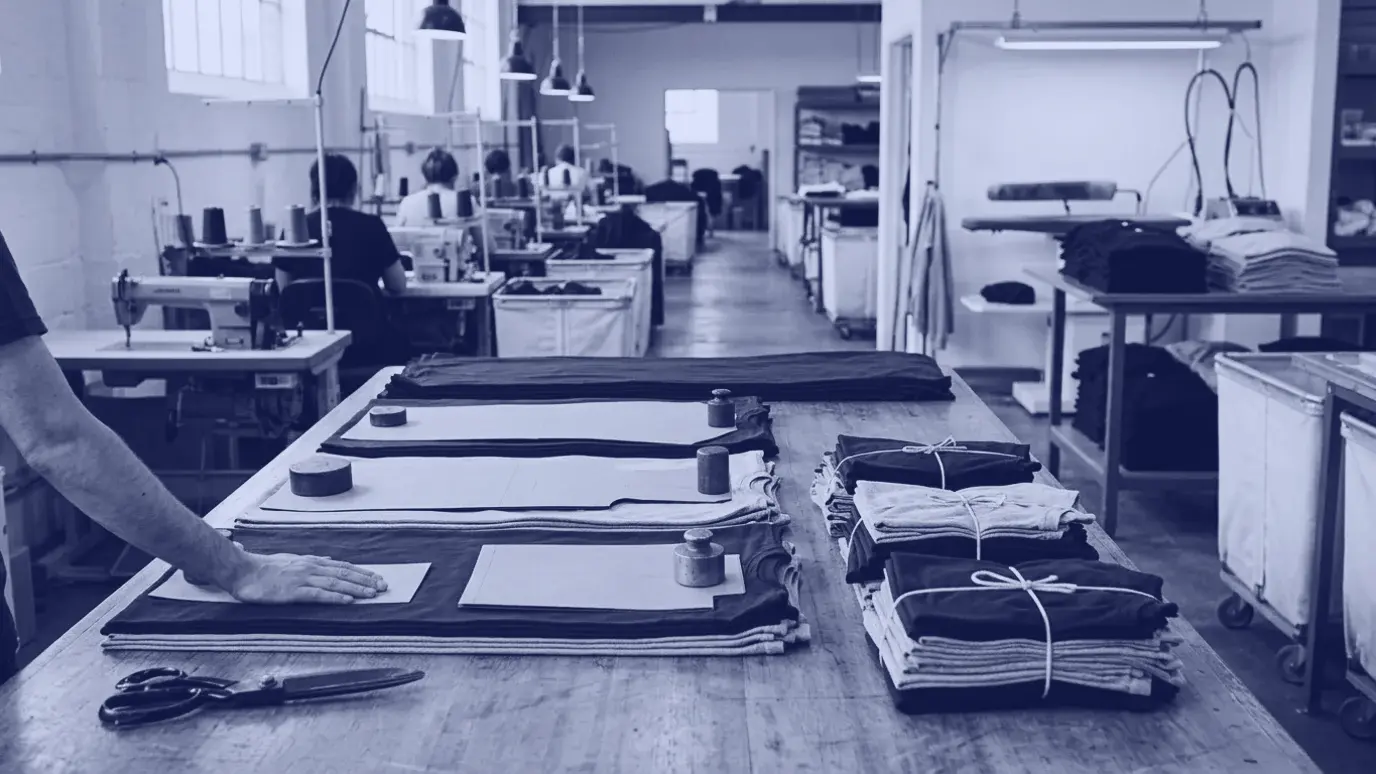
- Published:
- Updated:
- Fact-checked by:
- Gizem Polat
Key facts
- The usual order is tech pack, pattern, sampling and PP approval, material prep, marker and spreading, cutting, sewing, pressing and inspection, packing and shipment.
- According to Sarkar, mass production does not start until the buyer or buying office has approved the pre-production (PP) sample.
- According to MEB modules, knit and elastane fabrics are laid out without tension for about 24 hours before cutting.
- Sewing-line daily output = operators × actual working minutes per day × efficiency ÷ SMV (standard minute value).
- In the Turkish trade, fason usually means the party placing the order supplies fabric and trims (sewing only or CMT); a manufacturer that also sources them sells full package.
The garment manufacturing process runs in most factories in this order: tech pack, pattern making, sampling and pre-production approval, fabric and trims preparation, marker making and spreading, cutting, sewing, pressing and final inspection, packing and shipment. The order differs slightly from factory to factory. What does not change is that each stage hands a defined output to the next, and that output is checked before the work moves on.
This guide walks through the process stage by stage: the output of each stage, its control point and, when you work with a contract factory, who does what. It is written from the Turkish production context, so Turkish trade terms appear next to their English equivalents. That helps when you read a quotation, a tech pack or a stage list from a Turkish factory. Sampling, marker planning and AQL inspection each have their own guides; here you see the whole flow and how the stages connect.
Garment production stages at a glance
The table shows the logical order. In practice some jobs run in parallel, and the order depends on the factory, the buyer and the product.
| Stage | Turkish term | What happens | Output handed to the next stage |
|---|---|---|---|
| 1. Tech pack | model ve teknik föy | The product is defined in writing with drawings, measurements, materials and sewing details | Approved tech pack |
| 2. Pattern making and grading | kalıp ve serileme | Patterns for each part are made and graded (scaled up or down) across sizes | Graded pattern set |
| 3. Sampling and pre-production approval | numune ve üretim öncesi onay | Samples are sewn; measurements and fit are checked | Approved pre-production (PP) sample |
| 4. Material preparation | malzeme hazırlığı | Fabric and trims arrive and are inspected; the fabric is relaxed | Material ready for cutting |
| 5. Marker and spreading | pastal ve serim | Patterns are planned on the fabric width; fabric is laid out in plies | Spread fabric plies |
| 6. Cutting and cutting-room finishing | kesim ve kesimhane son işlemleri | Cut, numbered, fused, checked and bundled | Bundles of pieces ready for sewing |
| 7. Sewing | dikim | Pieces are joined in operation order | Sewn garments |
| 8. Pressing and final inspection | ütü ve son kontrol | Threads trimmed, pressed; appearance, measurements and materials checked | Garments ready to ship |
| 9. Packing and shipment | paketleme ve sevkiyat | Packed to the buyer's instructions and dispatched | Delivered goods |
Intermediate processes the model requires, such as printing, embroidery or garment washing, enter the flow at the point stated in the tech pack. When printing or embroidery is applied to cut pieces, pieces can get mixed up, so every ply that is cut must be numbered (MEB, Final Operations in the Cutting Room, 2008).
Before production: tech pack, pattern and sampling
The tech pack: model analysis and the model form
Production starts with a written definition of the product. The cutting module of MEB, Turkey's Ministry of National Education, describes this as model analysis (MEB's vocational-education modules are teaching material rather than industry standards, and they are cited throughout this guide): every detail of the model is examined and collected in a model definition form (Turkish: model föyü). The form holds the product name and season, front and back technical drawings, a written description of details a drawing cannot show, a parts list, samples of main and secondary materials, a size chart and, where needed, a measurement table. In the trade this is called a tech pack (Turkish: teknik föy).
The module wants the form prepared, with customer requirements and quality criteria in mind, no later than before the sample is sewn. Our recommendation at Tekstil Rehberi: do not leave any detail missing from the tech pack for the workshop to assume. Seam allowance, stitch type and packing method belong in it too.
Pattern making and grading
In pattern making (Turkish: kalıp or modelhane), patterns for each part are prepared from the measurements in the tech pack. MEB's pattern-preparation course lists this work as taking measurements, drafting the pattern, preparing templates, drawing the size series and calculating main and secondary materials. According to MEB's straight skirt pattern module, grading (Turkish: serileme; also called gradation) is enlarging and reducing a pattern prepared in one size, in steps, to produce the other sizes. Pattern making and grading can be done by hand or with computer-aided design (CAD) systems.
An error in the pattern is carried into every later stage, because every cut piece is a copy of that pattern. So the pattern is checked together with the measurement table and the first sample. For companies that offer this service, see the pattern making category.
Sampling and pre-production approval
The sample is where the tech pack and the pattern become a product for the first time. The sequence described by Prasanta Sarkar (2011) on the industry education site Online Clothing Study is this: first a proto sample that shows the structure of the design; once the proto is approved, a fit sample with real measurements; then a size set sample that checks consistency across sizes; and finally the pre-production (PP) sample. Once production has started, a top-of-production (TOP) sample taken from production and a shipment sample follow. The postgraduate course content e-PG Pathshala (INFLIBNET) in India gives proto/fit, size set, PP, production and shipment samples in a similar order. Names and the number of samples requested vary by buyer; Uphance's 2024 guide counts up to twelve sample types.
The gate to production is the PP sample. According to Sarkar, the buyer expects the PP sample to be sewn on the real production line, with real fabric and trims, by the line operators, and mass production does not start until the buyer or the buying office has approved it. For sample types and approval rounds, see the sampling process. For workshops that sew samples, there is the sampling category.
The cutting room: from fabric to sewing-ready pieces
Cutting is often a step that cannot be undone: the MEB cutting module notes that wrongly cut fabric may not be reusable. That is why most of the cutting room's work is done before the cut.
Fabric and trims inspection
Fabric and trims are inspected before cutting. The MEB cutting module groups fabric faults into three: weaving faults (weft and warp breaks, pattern shift), finishing faults (fold marks, colour faults, print faults) and handling-and-storage faults (stains, tears, holes, selvedge tears). In circular knit fabric the evenness of the knit lines (Turkish: may) is checked, and fabric with may twisting (Turkish: may dönmesi), where the lengthwise direction of the fabric also twists on the finished garment (spirality), is better not used.
Compatibility of trims with the fabric is also checked. The shrinkage of interlining and lining should be compatible with the fabric, and the heat resistance of the interlining should be close to the fabric's; incompatible materials can shrink differently in washing and distort the shape of the garment. If you want roll-by-roll grading, ASTM D5430 defines methods for visually inspecting and grading fabrics. The standard states that, when buyer and seller agree, these methods can be used in roll or shipment acceptance.
Relaxing the fabric
Knit and elastane fabrics are wound tightly on the roll, so they are stretched. According to MEB modules, these fabrics are unrolled before cutting and laid on the table without tension to relax for about 24 hours (the T-shirt module says “on average 24 hours”; the cutting module says “at least 24 hours” for tubular fabric). Fabric cut without relaxing shrinks back after cutting; the cutting module stresses that this causes large losses, especially in bulk cutting. If your supplier or the buyer's specification states a different time, follow that.
Marker and spreading
A marker (Turkish: pastal) is the layout plan of the pattern pieces on the fabric width, based on the size distribution of the order; it determines fabric consumption. The abstract of a 2017 study of knitwear production by Bilgiç and Duru Baykal states that fabric accounts for about half of total garment cost, or more. The study looks at model type, fabric width and fabric type (shrinkage value) as variables that can affect marker efficiency and therefore cost. For planning methods and for reducing waste, see marker planning and fabric waste.
Spreading (Turkish: serim) is laying the fabric in plies on the cutting table along the length of the marker. According to the MEB spreading module, the main methods are these:
- Full-width spreading: Covers all the right and left pattern pieces of the garment and is a widely used method. Half-width spreading is not preferred in garment manufacturing, because plies may fold inward and slip.
- Tubular fabric spreading: For circular knit fabrics. The fabric must be spread without stretching or tensioning.
- One-way spreading: For napped, directional fabrics such as velvet; the pile direction stays the same in all plies.
- Zigzag spreading: Plies are laid as a continuation of each other without being cut at the end of the marker, so there is no empty pass. It is efficient on fabric without direction, but it is not used on napped and directional fabrics because the direction of the fabric changes from ply to ply.
- Stepped spreading: Used when different sizes in the same marker need different ply counts.
- Patterned fabric spreading: On checked and striped fabrics the marker is laid one-way; a needle table gives better results.
Before cutting, the following are checked (MEB, Final Operations in the Cutting Room): the number and direction of the pattern pieces (templates), whether the fabric was spread without tension, the marker length, any colour or pattern difference between plies, whether the edges line up, and whether the layout matches the size distribution of the order.
Cutting
For multi-ply cutting, the main machines are round-knife and straight-knife cutting machines and the band-knife machine (Turkish: hızar). The MEB cutting module ties the choice of machine to the fabric properties, the number of plies, the characteristics of the pattern pieces and the characteristics of the machine itself. During cutting, marks are also taken: notches (small cuts on the edges that align pieces when sewing) and pocket and dart positions. For workshops that offer cutting, see the cutting category.
Numbering, fusing and sorting
Cut pieces do not go straight to sewing. First a label with the order, size, colour and ply number is attached to each ply (numbering, also called ply ticketing; Turkish: numaralama or metolama). According to MEB, numbering is needed when there is a shade difference between fabric rolls or between the start and end of a roll, and so that pieces do not get mixed up in intermediate processes such as printing and embroidery. The label is usually attached to the back of the piece, in a spot that will not fall on a seam.
Next, interlining (Turkish: tela) is applied in a fusing press to the pieces that need it, and the pieces are checked. Cut pieces are compared with the model sample: cutting technique, straightness of lines, pattern and grain direction, and measurements are among the items looked at, and the top and bottom pieces of the lay are compared to see whether they are identical. In sorting (Turkish: tasnif), the checked pieces are bundled with linings and trims; the bundle ticket carries information such as size, bundle number, quantity, cutting number and ply count. If you send pieces to a contract factory, delivering the bundles with count and ticket information prevents mix-ups.
The sewing room: from pieces to garments
Operation plan and standard minute value
Sewing is planned by breaking the model down into operations. According to MEB's T-shirt sewing module, the operation plan lists, for each operation, the working tool and the estimated and actual time; when the plan is prepared, all details of the model are analysed and the operation order, quality characteristics and tolerances are set. The module's sample T-shirt plan has ten rows, running from the rib collar through shoulder, sleeve, side seam and hem operations to final pressing and packing, and most operations are done on an overlock machine. Each extra detail, such as a pocket, a slit or a tape, adds operations and time to the plan.
The time of each operation is expressed in standard minutes (SMV, also called SAM, standard allowed minutes). According to the ILO's work-study handbook, the standard minute is a measure of output; performance is the ratio of output in standard minutes to the labour time spent (clock minutes). Solving that ratio for the number of pieces gives you the daily capacity of a sewing line:
Daily output (pieces) = operators × actual working minutes per day × efficiency ÷ SMV
Worked example (hypothetical). Take a line where 20 operators sew a model with an SMV of 10 minutes, actual daily working time is 450 minutes and line efficiency is 60%. Daily capacity is 20 × 450 × 0.60 ÷ 10 = 540 pieces. Sewing an order of 5,000 pieces on the same line takes about 9.3 working days.
| Scenario | Daily capacity | Sewing time for 5,000 pieces |
|---|---|---|
| Example: SMV 10 min, efficiency 60% | 540 pieces | about 9.3 working days |
| If efficiency drops to 50% | 450 pieces | about 11.1 working days |
| If SMV rises to 12 minutes | 450 pieces | about 11.1 working days |
None of these figures is market data. The SMV, number of operators, working time and efficiency are illustrative assumptions, and they vary widely from model to model. The calculation covers the sewing line only: fabric waiting time, cutting, intermediate processes, pressing-packing and shipment are added on top.
Sewing line layout
How pieces move between operators sets the layout of the line. The peer-reviewed study by Kincade, Kim and Kanakadurga (2013) tabulates five characteristics of three common systems according to expectations in the literature; a survey of US manufacturers confirms those expectations, except for how work reaches the operator in the modular system:
| Characteristic | Bundle | Progressive bundle | Modular (team or cell) |
|---|---|---|---|
| Work flow | Push | Push | Pull |
| How work reaches the operator | Fetched or collected from a central store | Arrives from the previous operator by cart or conveyor | Handed over hand to hand |
| Work in process (WIP) | High | Medium | Zero or very low |
| Operations per operator | One operation or the whole garment | One operation | One or a few operations |
| Interaction between operators | No teamwork | No teamwork | Teamwork |
In the modular system the team sews the garment from start to finish, piece by piece, and operators rotate among several machines. The same study carries two warnings. First, terms are used inconsistently in the literature. Second, the assumption “bundle for basic products, modular for fashion products” was only partly supported in the survey of US firms making collared shirts and blouses. Read the table as a classification. Asking a contract factory “which layout do you run, and how much work-in-process builds up at a model change?” tells you more than learning the name of the system.
Company directory
Looking for manufacturers in this field?
Browse companies in the related categories or get quotes from several companies with one form.
- Apparel
- CMT Sewing
- Fabric Cutting
- Ironing and Packing
- Pattern Making
- Garment Sampling
- Quality Control
Do you manufacture or offer services in this field?
Finishing: pressing, final inspection, packing and shipment
Pressing and final inspection
Sewing does not end the job. After threads are trimmed, the garment is pressed: according to MEB, the purpose of pressing a finished garment is to remove creases and folds formed during production, to set the seams and to improve the appearance. Heat and steam are set according to the fabric; in knit fabric too much steam can cause stretching and changes in measurements. For workshops that offer pressing and packing, see the pressing and packing category.
Final inspection is done after pressing. In MEB's T-shirt module there are three headings: appearance on the body (the look of the product and how it hangs on a person), measurement check (against the tolerances in the measurement table) and materials conformity. The module also groups the sources of measurement deviation into three:
- Fabric: Shrinkage or contraction from steam in pressing.
- Sewing: Different seam allowances, excess trimmed on the overlock, a hem that stretches because of a faulty coverstitch setting.
- Trims: Sewing thread that shrinks in pressing, stretching tape and lace.
Packing
The buyer decides the packing method. According to Sarkar (2016), packing in export production follows the buyer's instructions: garments can be flat-folded in a polybag, boxed or shipped on hangers. Common carton configurations are the solid pack (one colour and one size in a carton), the ratio pack (different sizes of the same colour in a set ratio, for example S:M:L:XL = 5:7:7:5) and the assorted pack (different colours together in a carton in a set ratio). The contents of a carton must match the colour-size breakdown of the order and the shipping documents.
Shipment
The scope of shipment depends on the delivery term in the sales contract (for example FOB, one of the Incoterms 2020 rules) and on the lead time; for exports, customs and documentation are planned according to that term too. According to Sarkar (2011), a shipment sample is a few pieces of the finished and packed goods kept by both the factory and the buyer for later reference.
Quality control points: what is checked at which stage
Quality control is not a job left for the last stage. MEB's T-shirt module defines it as the work done to prevent, reduce or correct faults that can arise during production. The table below collects the control points mentioned in this guide.
| Control point | What is checked | Basis |
|---|---|---|
| Fabric and trims receiving | Fabric faults, evenness of knit lines, trims compatibility; optional roll grading | MEB Cutting; ASTM D5430 |
| After spreading, before cutting | Number and direction of pieces, tension, marker length, colour-pattern difference between plies, edge alignment, size distribution | MEB Final Operations in the Cutting Room |
| Piece check after cutting | Conformity to the model sample, notches, marks, whether top and bottom pieces are identical | MEB Final Operations in the Cutting Room |
| After intermediate pressing | Check of the sewn part after it has been pressed | MEB T-Shirt Sewing |
| Final inspection | Appearance on the body, measurements, materials conformity | MEB T-Shirt Sewing |
| Buyer or third-party sampling | A sample is drawn from the lot; the lot is accepted or rejected by the number of defects | ISO 2859-1 |
The international basis for inspecting a finished lot by sampling is ISO 2859-1. It defines single, double and multiple sampling plans for lot-by-lot inspection, indexed by acceptance quality limit (AQL). The current edition is ISO 2859-1:2026: according to the EVS record it is valid from January 22, 2026 and replaces the 1999 edition and its 2011 amendment (as of the date of this guide). State in the contract or specification which edition it refers to. For defect classes, sample sizes and acceptance numbers, see AQL quality control; for inspection and testing providers, there is the quality control category.
Who runs the stages? In-house, contract and full package
The same flow can be run with different divisions of work. In the Turkish trade, fason (subcontracting) usually means models where the party placing the order supplies the fabric and trims; these split into sewing only and sewing with cutting (CMT, cut-make-trim; Turkish: kes-dik-teslim). Where the manufacturer also sources the fabric and trims and sells the finished product at a single price, it is called full package. In the trade this is often simply called FOB, although FOB is strictly an Incoterms delivery term, not a production model.
| Sewing only | Cut and sew (CMT) | Full package (FOB) | |
|---|---|---|---|
| Who supplies fabric and trims | The party placing the order | The party placing the order | The manufacturer |
| Who cuts | Cut pieces arrive at the workshop | The workshop | The manufacturer |
| Who sews | The workshop | The workshop | The manufacturer |
| Pattern, sampling, pressing-packing, quality control | As stated in the quotation | As stated in the quotation | As stated in the quotation |
The last row lists the items you need to clarify in writing when comparing quotations. Put in writing which stage belongs to whom, the approval points (tech pack, PP sample, final inspection) and who is responsible for delay. Working models, pricing and contract topics are covered in detail in Zeynep Arslan's contract manufacturing guide. To look for a contract sewing workshop, see the CMT sewing category.
Questions to put to a factory
- Lead time: Can you give a stage-by-stage lead-time plan (fabric waiting, cutting, intermediate processes, sewing, pressing-packing, shipment)?
- Line layout: Which sewing layout do you run, and how much work-in-process builds up at a model change?
- Fabric relaxing: How long and by what method is knit fabric relaxed before cutting? Is that recorded?
- Handover: Are cut pieces delivered in bundles with count and ticket information?
- Inspection: Which edition of ISO 2859-1 does the quotation or contract refer to, and who inspects?
Checklist before production starts
The list below collects the gates that come out of the stages in this guide. Our recommendation at Tekstil Rehberi: if you answer “no” to any item, close the gap before moving to the next stage.
- Is the tech pack approved? Drawing, measurement table, parts list, material samples and size chart should be complete.
- Is the PP sample approved? The approval should be in writing, and no differences should remain between the sample and the tech pack.
- Has the fabric lot passed receiving inspection? Was the lot compared with the fabric of the approved sample (colour, GSM, width)?
- Has the fabric been relaxed? For knit and elastane fabric, the time and method should be on record.
- Are trims and labels complete? Are interlining, lining and thread compatible with the fabric (shrinkage, heat)?
- Does the marker match the order breakdown? Were the colour-size breakdown, fabric width and ply count confirmed?
- Are intermediate processes planned? If there is printing, embroidery or washing, is it clear where it will be done and how the pieces will be numbered?
- Are the sewing plan and capacity ready? Have operation order, SMV, number of operators and line layout been discussed?
- Are control points and tolerances in writing? Measurement tolerances, the sampling plan and the responsible party should be clear.
- Are the packing instructions and lead time settled? Folding, polybag, carton configuration and delivery term should be in writing.
How the stages affect cost
Each stage creates its own cost line: fabric and trims (including waste, which depends on marker efficiency), sewing labour (SMV and cost per minute), intermediate processes such as printing and embroidery, rework and seconds (second-quality goods), and packing and freight. To work through these lines step by step for a T-shirt, see T-shirt production cost.
Frequently asked questions
What are the stages of garment manufacturing?
Tech pack (model and technical specification), pattern making and grading, sampling and pre-production approval, fabric and trims inspection, marker making and spreading, cutting, cutting-room finishing (numbering, fusing, piece check, sorting), sewing, pressing and final inspection, then packing and shipment. The order varies by factory and buyer; processes such as printing, embroidery and garment washing come in at the point the model requires.
How do I start manufacturing clothes for my own brand?
First put the product in writing as a tech pack (drawing, measurement table, parts list, material samples). Then go through pattern making and sampling; do not start bulk production without a pre-production (PP) sample approved by the buyer or brand. Agree in writing with the manufacturer who supplies the fabric and trims, who does the cutting and how quality control will run.
Why is fabric relaxed before cutting?
Knit and elastane fabrics are wound tightly on the roll, so they are stretched. Fabric cut without relaxing shrinks back after cutting, which causes large losses in bulk cutting. Turkey's MEB vocational-education modules teach that tubular knit fabric is unrolled and laid out without tension for about 24 hours. If your supplier or the buyer's specification states a different time, follow that.
What happens in the finishing stage of garment production?
After sewing, loose threads are trimmed, the garment is pressed, a final inspection is done and the product is packed. In MEB's T-shirt module the final inspection has three headings: appearance on the body (fit and hang), measurements and materials conformity. The packing method (polybag, box or hanger; solid or ratio carton) follows the buyer's instructions.
What does production planning in a garment factory cover?
It starts from the colour and size breakdown of the order and puts together the supply of fabric and trims, marker and cutting, intermediate processes, sewing line capacity, pressing-packing and the shipment date. On the sewing side, capacity is calculated as: daily output = number of operators × actual working minutes per day × efficiency ÷ the model's standard minute value (SMV).
How long does the garment production process take?
We found no sourced average lead time. It depends on the complexity of the product, the number of sample approval rounds, fabric and trims lead time and line capacity. You can estimate the sewing stage as pieces ÷ daily capacity; fabric waiting time, intermediate processes, pressing-packing and shipment are added on top. Ask the manufacturer for a stage-by-stage lead-time plan.
Related calculators
Sources (17)
- Turkish Ministry of National Education (MEB), MEGEP, Garment Production Technology: Spreading (Serim) (542TGD177), Ankara 2006 (in Turkish)
- Turkish Ministry of National Education (MEB), MEGEP, Garment Production Technology: Final Operations in the Cutting Room (Kesimhanede Son İşlemler) (542TGD180), Ankara 2008 (in Turkish)
- Turkish Ministry of National Education (MEB), Garment Production Technology: Cutting (Kesim) (542TGD003), Ankara 2011 (copy on Ankara University Open Courseware, accessed October 8, 2026; in Turkish)
- Turkish Ministry of National Education (MEB), Garment Production Technology: T-Shirt Sewing (Tişört Dikimi) (542TGD008), 2011 (sections 1.5.1, 3.1, 4.1, 4.2; in Turkish)
- Turkish Ministry of National Education (MEB), Pattern Preparation Techniques course information form (Garment Production Technology field, accessed October 8, 2026; in Turkish)
- Kincade, D. H., Kim, J., Kanakadurga, K. S. (2013). An Empirical Investigation of Apparel Production Systems and Product Line Groups through the Use of Collar Designs. Journal of Textile and Apparel, Technology and Management, 8(1)
- Bilgiç, H., Duru Baykal, P. (2017). Örme konfeksiyonda kumaş eni ile kumaş ve model türünün ikinci kalite maliyetine etkisi (The effect of fabric width, fabric type and model type on second-quality cost in knitted apparel). Tekstil ve Mühendis, 24(106), 78-87 (abstract record, accessed October 8, 2026)
- ILO (1992). Introduction to Work Study, 4th (revised) edition, chapter 28: The use of time standards (3. The standard unit of work)
- Sarkar, P. (March 4, 2011). Sampling Stages in Apparel Manufacturing, Online Clothing Study (industry education site, accessed October 8, 2026)
- Uphance (July 31, 2024). The Types of Garment Samples in Apparel Production (accessed October 8, 2026)
- Sarkar, P. (November 22, 2016). Different Types of Garment Packing, Online Clothing Study (accessed October 8, 2026)
- ISO 2859-1:2026 Sampling procedures for inspection by attributes - Part 1: Sampling schemes indexed by acceptance quality limit (AQL) for lot-by-lot inspection (EVS record, valid from 22.01.2026)
- ISO 2859-1:1999 (EVS record: withdrawn as of 22.01.2026, replaced by ISO 2859-1:2026)
- ASTM D5430-26 Standard Test Methods for Visually Inspecting and Grading Fabrics (ASTM record, accessed October 8, 2026)
- Turkish Ministry of National Education (MEB), Garment Production Technology: Straight Skirt Pattern (Düz Dar Etek Kalıbı) (542TGD013), Ankara 2011 (sections 3.1-3.3, grading; in Turkish)
- INFLIBNET e-PG Pathshala, Fashion Designing and Apparel Industry: Apparel industry - importance, status, various departments - sampling, cutting, sewing and finishing (accessed October 8, 2026)
- U.S. International Trade Administration, Know Your Incoterms (Incoterms 2020, FOB; accessed October 8, 2026)
Author and fact-checking
Written by
Garment Production Editor
Hakan Şahin is Tekstil Rehberi's garment production editor. He writes guides on production from the pattern room to shipment, patterns and marker making, quality control (AQL), sampling and costing, and compares process steps and quality criteria with the relevant standards and industry sources.
Content by Hakan ŞahinFact-checked by: Gizem Polat
This content was prepared by the Tekstil Rehberi editorial team. Before publication, our verification editor checked its figures, dates and sources against primary sources.
Spotted an error? Email us at [email protected] How we work →
Related articles
Types of Garment Samples: Proto, Fit, Size Set and PP Sample
The types of garment samples in the order they are made: proto, fit, size set and PP. What each sample is for, who sews and approves it, how many rounds to plan and how to put approval in writing.
Private Label Clothing Manufacturers in Turkey: MOQ & Models
How private label clothing works with Turkish factories: four production routes, why MOQ is never one number, who counts as the manufacturer when your label is on the product, and an eight-step process.
How to Calculate Fabric Consumption for Garments: Formula, Examples and Waste Allowances
How much fabric a garment needs depends on pattern area, fabric width and marker efficiency. The formula, T-shirt and shirt worked examples, shrinkage and waste allowances, and what to write into a CMT order.