What is Screen Printing?
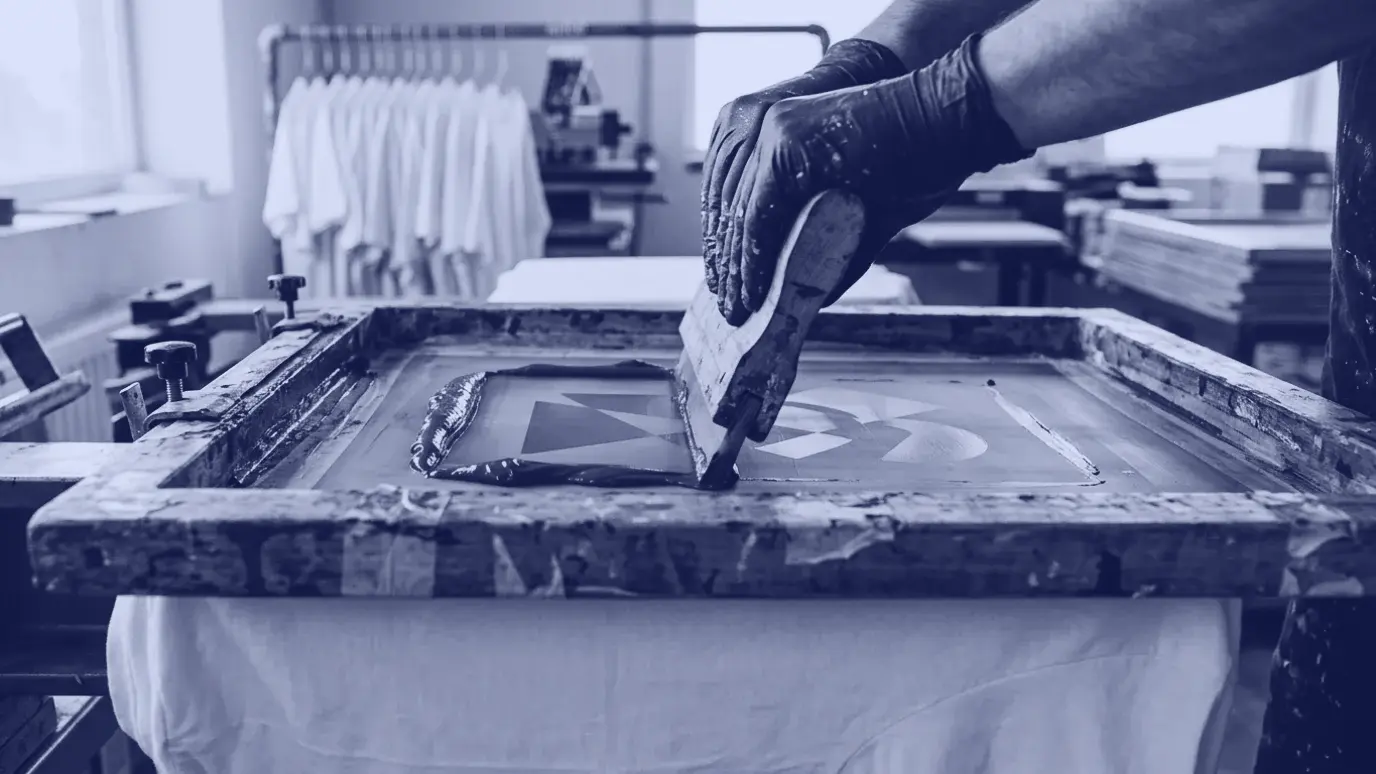
Screen printing is a printing method in which ink is pushed with a squeegee through a tightly stretched screen whose non-printing areas are blocked. In textiles it is also applied to finished products and cut pieces, and each color in the design needs its own screen. Turkish suppliers call it serigrafi.
- Published:
- Updated:
- Fact-checked by:
- Gizem Polat
Key facts
- Screen printing pushes ink with a squeegee through a screen whose non-printing areas are blocked, transferring it to the surface.
- A separate screen is prepared for each color in the design; because the set-up is spread over the quantity, the method suits few-color, repeat jobs.
- In textiles, plastisol, water-based and discharge inks are used; handle, opacity and durability vary with the ink family.
- Flat-screen and rotary printing are also screen-based, but they are yardage methods applied to roll fabric and are treated separately.
Screen printing is a printing method in which ink is pushed with a squeegee through a tightly stretched screen whose non-printing areas are blocked. Turkish suppliers call it serigrafi, which the Turkish Language Association (TDK) dictionary defines as “ipek baskı” (literally “silk printing”). The method is not specific to textiles; in textiles it can be applied to roll fabric, cut pieces and finished products such as T-shirts (SGIA technical guide). This entry covers printing on cut pieces and finished products; roll-fabric (yardage) methods are treated separately.
How screen printing works
A screen is a mesh stretched over a wooden or metal frame; e-PG Pathshala course material states that the mesh is made of synthetic fibers such as nylon or polyester. The areas of the design that will not print are blocked, and ink passes through the open areas onto the product with a squeegee (e-PG Pathshala, Chapter 11). A separate screen is prepared for each color in the design (CottonWorks).
Because the screens are prepared once before printing, the set-up burden per unit falls as the quantity rises. This is why screen printing stands out for few-color, repeat designs at medium to high quantities. A multi-color or photographic design needs as many screens as it has colors, and the set-up grows quickly. The quantity threshold varies with the company and the difficulty of the job, so no numerical limit is given.
After printing, the ink is cured (fixed) with heat. An ink manufacturer (Avient, Wilflex range) gives the cure temperature of standard plastisol inks as 160 °C (320 °F), and of its low-cure series as low as 121 °C (250 °F). The actual value varies with the product; the manufacturer’s technical data sheet is the reference.
Inks used in textiles
| Ink | Characteristics | Watch out for |
|---|---|---|
| Plastisol | 100% solids; the dried film is about five times thicker than water-based. Opaque on dark fabric when applied properly | On polyester, the fabric dye can migrate into the print (dye migration). One manufacturer (Avient) offers separate inks with high migration resistance, an underbase and low-cure series for polyester |
| Water-based | About 20% solids; the dried film is about one fifth as thick as plastisol, with a softer handle. Colors look slightly more muted than plastisol | High-opacity formulations can also be fully opaque on dark fabric; the product choice and application decide the result |
| Discharge | Removes the ground dye of dyed fabric with a chemical to create the pattern | Not every dye can be discharged; one manufacturer (Ryonet) asks that dryer air be vented outside. The ink is water-based, but the printing process is different |
The ink family changes the hand, opacity and durability of the print. So a quote should state the ink family, not only “screen printing”. Suppliers of textile printing ink are listed in the textile printing inks category, and shops that do screen printing in the textile printing category.
Strengths and limits
Strengths
- For few-color, repeat designs at medium to high quantities, the set-up burden is spread out.
- Opaque inks can give a clear color on dark fabric too.
- The ink choice changes the handle; water-based ink leaves a thinner, softer layer.
Limits
- As the number of colors rises, so do the screens and the set-up; for a photographic design, DTG or DTF is generally the more suitable candidate.
- At small quantities, screen set-up raises the unit cost.
- On polyester, the risk of dye migration means the ink and the cure conditions must be chosen with care.
Terms confused with screen printing
- Flat-screen and rotary printing: These are also screen-based, and e-PG Pathshala divides screen printing into flat and rotary. However, they are yardage methods applied to roll fabric before cutting. Rotary printing cannot print on products in garment form (CottonWorks).
- DTG and DTF: They use no stencil. DTG (direct-to-garment) prints directly on the product, DTF (direct-to-film) prints onto a film.
- Flex and flock: There is no screen; shapes cut from ready-made film are attached with a heat press.
- Sublimation: This is a dye transfer. The transfer paper can also be printed by screen printing, but the move from paper to product is the heat-driven sublimation step (SGIA technical guide).
Frequently asked questions
Is serigrafi the same as screen printing?
Yes. Serigrafi is the Turkish word, and the TDK dictionary defines it as “ipek baskı” (literally “silk printing”). Course material describes the mesh of today’s screens as synthetic fibers such as nylon or polyester.
Is screen printing or DTF better?
There is no absolute winner. Screen printing stands out for few-color, repeat designs at high quantities; DTF or DTG stand out for multi-color, small-quantity, many-style jobs. Base the decision on a sample print on the same fabric. For more detail, see the guide to textile printing methods.
How many washes does a screen print last?
It would not be right to give a single number; the result depends on the ink family, the curing and the washing conditions. Have color change and staining tested to a standard method such as ISO 105-C06. Cracking or peeling of the print layer is not expressed by these grades, so an acceptance criterion must be written separately.
Sources (8)
- TDK Güncel Türkçe Sözlük (Turkish Language Association dictionary), entry “serigrafi” (accessed October 9, 2026)
- e-PG Pathshala (INFLIBNET), Textile Colouration and Finishes, Chapter 11: Textile Printing (accessed October 9, 2026)
- CottonWorks (Cotton Incorporated): Cotton Printing Types & Techniques (accessed October 9, 2026)
- Kosloff, A. Sublimation Heat Transfer Printing. SGIA Technical Guidebook, Academy of Screen Printing Technology (dated 1999 in the PDF metadata; used for the applications of textile screen printing)
- Avient: Wilflex Plastisol Screen Printing Ink, Product Selection Guide (2024; plastisol cure temperatures, polyester inks and dye migration resistance)
- Screen Printing magazine: Getting into Water-Based Inks on Dark Garments (December 19, 1999)
- Ryonet: Discharge Agent (product information; accessed October 9, 2026)
- ISO 105-C06:2010, Textiles, Tests for colour fastness, Part C06: Colour fastness to domestic and commercial laundering
Author and fact-checking
Written by
Dyeing, Printing and Finishing Editor
Deniz Koç is Tekstil Rehberi's dyeing, printing and finishing editor. Deniz covers dyeing methods, digital, screen, transfer and sublimation printing, embroidery, garment washing and fabric finishes, and refers to the relevant test standards on topics such as color fastness and chemical compliance.
Content by Deniz KoçFact-checked by: Gizem Polat
This content was prepared by the Tekstil Rehberi editorial team. Before publication, our verification editor checked its figures, dates and sources against primary sources.
Spotted an error? Email us at [email protected] How we work →
Articles on this topic
Textile Printing Methods: Screen, Rotary, Digital, DTF and Sublimation
How screen, rotary, digital (DTG), DTF, heat transfer and sublimation printing compare, which fibres each suits, and how to brief a print supplier and set test criteria.