Dyeing, Printing and Finishing
Textile Printing Methods: Screen, Rotary, Digital, DTF and Sublimation
How screen, rotary, digital (DTG), DTF, heat transfer and sublimation printing compare, which fibres each suits, and how to brief a print supplier and set test criteria.
- Published:
- Updated:
- Fact-checked by:
- Gizem Polat
Key facts
- Textile printing methods fall into fabric (yardage) printing on rolls before cutting and garment (piece) printing on cut parts or finished products.
- Screen printing suits few-color repeat designs, DTG or DTF multicolor small runs, sublimation full-color prints on light polyester, and rotary long runs of printed yardage.
- Sublimation uses disperse dye, which enters synthetic fibers such as polyester and does not dye cotton.
- “Lasts 50 washes” on seller pages is a manufacturer claim; without a stated test standard and condition it cannot be compared with another print.
- ISO 105-C06 covers colorfastness to laundering and ISO 105-X12 to rubbing; results are graded 1 to 5, where 5 means no change or staining.
Textile printing methods fall into two groups: fabric (yardage) printing, where cloth is printed in roll form before cutting, and garment (piece) printing, where the design goes onto cut parts or finished products. Fabric printing uses rotary and flat-bed screens, industrial digital machines and roll-to-roll transfer; garment printing uses screen printing, digital (DTG), DTF, heat-transfer film (HTV/flex and flock) and sublimation. Fibre, quantity, colour count and detail, and the handle (hand feel) and durability you expect decide the method. No technique is best for every job.
You will find a comparison table, a fibre-to-method table, a scenario-based decision guide and a checklist for briefing a print supplier, with the Turkish terms found on quotations. There are no prices or exact quantity thresholds; they vary with the printer, the machine and the job.
Textile printing methods: how they are classified
Methods read on two axes: the stage of printing (on the fabric roll, or on the product after cutting and sewing) and the colourant (pigment, reactive, disperse or acid dye). The pairing of colourant and fibre shapes the result as much as the method does.
What “transfer printing” means: heat transfer versus dye transfer
The trade uses “transfer printing” for quite different jobs. Here it has one meaning: transfer printing is the umbrella name for methods in which a design is first printed on a carrier, such as paper or film, and then moved onto the fabric or product. It has two subgroups, named separately throughout:
- Heat transfer (film transfer; garment printing): an ink and adhesive layer on a carrier film is bonded to the finished product with a heat press. DTF, HTV (heat transfer vinyl, or “flex” on Turkish quotations) and flock belong here; the print sits on the surface.
- Dye transfer: the colourant moves from paper into the fibre. On a garment, with heat, it is sublimation; on a roll of fabric it is roll-to-roll transfer printing. For cotton, a “cold transfer” that needs no heat has been developed.
If a quotation says only “transfer”, ask which of the two it means.
Textile printing methods compared
The table is qualitative. Quantities are low, medium or high, not numbers, because thresholds depend on set-up cost and the printer. Every durability cell means “test it”: only a test report proves results, which depend on ink, curing and wash conditions.
| Method | Suitable fibres | Quantity | Durability (test it) |
|---|---|---|---|
| Screen printing (garment) | Cotton and blends; by ink family | Medium–high | Ink and curing |
| DTG (garment) | Mainly cotton; polyester on some machines with pretreatment | Low–medium | Pretreatment, curing, ink |
| DTF (garment, heat transfer) | Cotton, polyester, blends; per film and powder data sheet | Low–medium | Film, adhesive, press conditions |
| HTV (flex) and flock (garment, heat transfer) | Per film data sheet; nylon may need a special product | Low–medium | Film and application |
| Sublimation (garment, dye transfer) | Polyester, high-polyester fabric | Low–medium | Dye choice and process |
| Rotary (fabric) | By colourant | High | Reactive: good wash fastness; pigment: check rubbing fastness |
| Flat-bed (fabric) | By colourant | Medium–high | By colourant |
| Industrial digital (fabric) | Cotton, polyester, silk, wool, by ink class | Sample to short run | Dye and pre-/post-treatment |
| Roll-to-roll transfer (fabric, dye transfer) | Polyester, nylon (with heat); cotton (pretreated fabric, or cold transfer) | Medium–high | Dye choice |
Garment printing methods
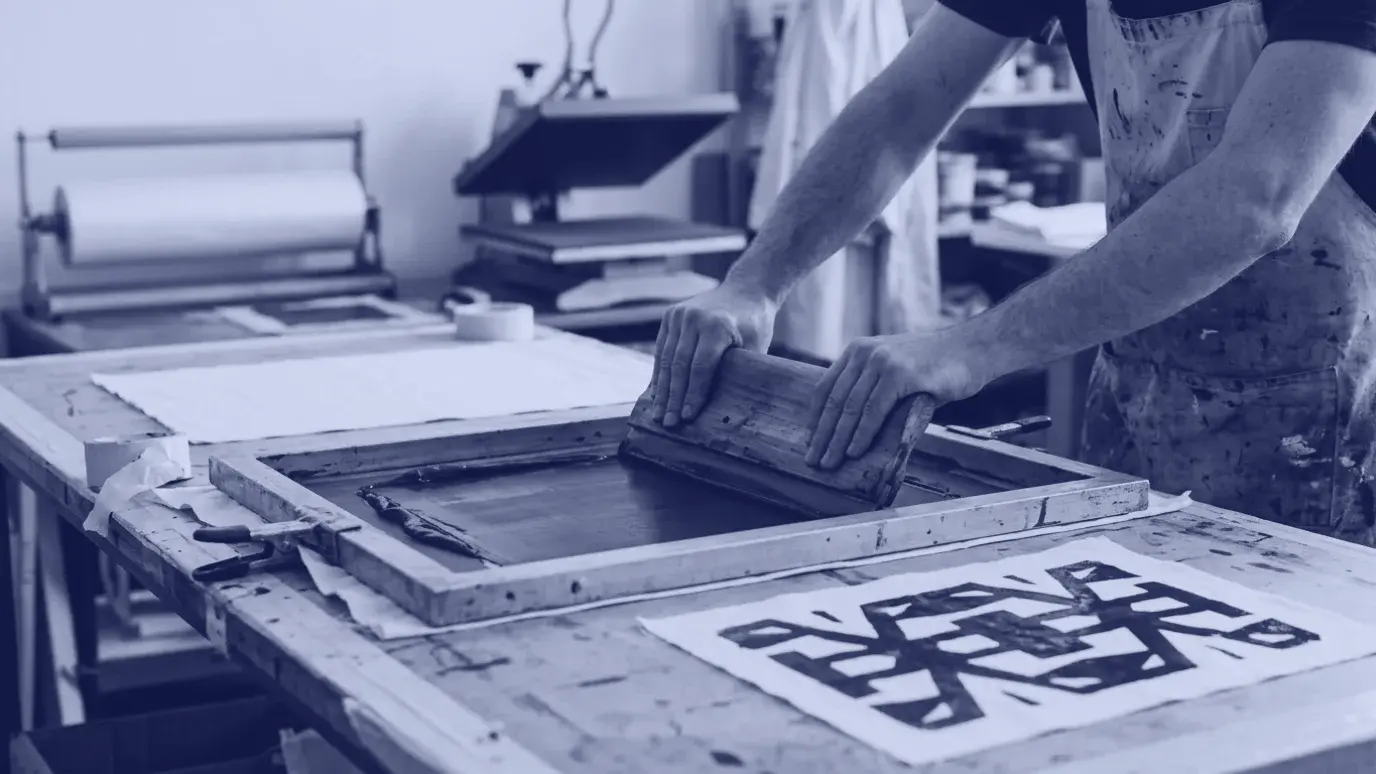
Screen printing
Each colour needs its own screen; ink passes through the open areas onto the fabric. The set-up is done once, so its burden per piece falls as quantity rises: the method is strong for few-colour, repeat designs at medium to high quantities. A multicolour or photographic design needs as many screens as colours, and set-up grows quickly.
The ink family shapes the result. Plastisol, a heat-cured ink widely used on T-shirts, covers dark fabric well and forms a film on the surface; water-based ink leaves a much thinner layer and a softer handle. Discharge printing removes the ground dye with a chemical to create the design. It works only on fabric whose dye can be discharged (in practice mostly cotton dyed with a suitable dye), so ask your fabric supplier.
Digital garment printing (DTG)
DTG (direct to garment) sprays the design straight onto the product, like an office printer. With no screen or film, preparation is short and even one piece can be printed. Colour count adds no set-up work, so photographic and gradient designs are its strength.
Fabric compatibility depends on the machine and ink system. For example, Epson’s SureColor F2270 guide supports fabrics with 50–100% cotton or 50–100% polyester (recommended: 100% cotton or 100% polyester) and calls for pretreatment liquid on polyester, and on cotton when white ink is used, that is, on dark fabric. For blends and synthetics, confirm ink and pretreatment from the machine maker’s data sheet and a sample print.
DTF
DTF (direct to film) prints the design, with a layer of white ink, on a special transfer film. Before the print dries, hot-melt powder adhesive is scattered on it, the excess is shaken off and the powder is melted with heat. The film is then heat-pressed onto the product and the carrier is peeled off. Because the print is made on the film, the product gets no pretreatment; Epson’s DTF guide gives separate press conditions for cotton and polyester T-shirts. Confirm the suitable fabric range from your film and powder data sheet.
The print does not penetrate the fibre: it sits on the surface and, because of the adhesive layer, can feel like a thin film. Durability depends on the film, adhesive and press conditions (see the testing section on why not to ask for a number of washes).
Heat-transfer film: HTV (flex) and flock
HTV (flex) and flock are shapes cut on a plotter from ready-made film, weeded and pressed on with a heat press. Flex is, for example, a thin, stretchy polyurethane (PU) film; flock is a velvet-textured film covered with short fibres such as viscose or polyamide. The film maker’s data sheet decides which fabrics suit it: one maker’s standard flex and flock films, for example, are not suitable for nylon and water-repellent fabrics, and a separate nylon product is recommended. They suit names, numbers and simple logos; colours are limited to the film range, and photographic or gradient designs are not what they are for.
Sublimation
The design is first printed in mirror image on transfer paper. A heat press vaporises the disperse dye on the paper and the dye enters the polyester fibre. Because it forms no separate surface film, the fabric’s texture is largely preserved; the method suits full-colour, large-area designs.
Disperse dyes enter synthetic fibres such as polyester, nylon, acetate and acrylic, and do not dye cellulosic fibres such as cotton. Cotton Incorporated (2018) makes the same point: what it calls standard heat transfer printing, dye transfer in this guide’s terms, works on polyester and nylon, not cotton. Manufacturers recommend 100% or high-percentage polyester; colours fade as the polyester share of a blend falls. The dye is not opaque: white cannot be printed, the print blends with the ground colour, and colours do not show on a dark ground.
Fabric (yardage) printing: industrial methods
In fabric printing the colourant and later steps matter as much as the method: the print paste is printed, dried, fixed (by steaming or dry-heat curing) and, where needed, washed. According to CottonWorks, a significant share of print defects trace back to fabric preparation.
Rotary screen printing
Perforated cylindrical screens rotate over the fabric and the print paste is forced from inside the cylinder onto the cloth. The process is continuous. According to Cotton Incorporated it is the fastest printing method for cotton, and its 2018 comparison says most printed cotton apparel is printed this way. Each colour needs its own cylinder. Engraving cost and the downtime for pattern changes are spread over a long run; on short runs rotary is generally not profitable.
Its limits: it prints only flat (spot) colours, is not suited to very fine detail and cannot print onto made-up garments. The repeat length is limited by the cylinder’s circumference. Its strength is openness to special effects such as glitter, puff and metallic.
Flat-bed screen printing
A flat screen for each colour is lowered onto the fabric. The process is semi-continuous (stop-and-go), so it is slower than rotary, and the repeat length is limited by the screen size. In return, multi-pass squeegeeing can work the print paste deep into pile surfaces. That is why flat-bed stands out on pile fabrics such as towels and blankets and on very wide goods such as bed sheets and flags.
Industrial digital fabric printing
Inkjet heads print the design from a file directly onto the cloth. There is no screen, the colour count is practically unlimited and the downtime for a pattern change is very short. This makes it the usual choice for samples, multicolour patterns and short runs.
According to Cotton Incorporated, reactive ink always needs pre- and post-treatment (steaming, washing) and pigment ink needs post-treatment (curing). The same document says non-contact printing lets the dye penetrate the fibre less, so fastness can be an issue, but that dye selection is the real determinant. If you print the sample digitally and the bulk by rotary, approve the difference in appearance at the start.
A 2019 master’s thesis at Bursa Uludağ University in Turkey (Rüzgar) used life cycle assessment to compare reactive printing on viscose apparel fabric on rotary and multi-pass digital machines, with 1-, 6- and 12-colour designs. Rotary’s energy and water use and environmental impacts rose with colour count while digital’s did not change noticeably; digital came out better in many impact categories as colours increased, rotary in electricity and natural gas use. It covers one facility and one fabric, so do not generalise it.
Roll-to-roll transfer printing
The design is first printed on paper and then moved onto the fabric roll. On polyester and nylon the transfer uses disperse dye and heat. On cotton, either dyes suited to pretreated fabric are transferred under heat and pressure, or cold transfer (no heat) is applied. Cotton Incorporated’s 2018 comparison says cold transfer can print photorealistic images on cotton with a soft handle, at a speed comparable to rotary, but calls it relatively new at that date, names cost and performance as the main barriers and notes it offers no raised effects such as glitter and puff. Ask the printer whether it is currently available.
Which colourant for which fibre?
Pigment adheres to the surface with a binder; dyes (reactive, disperse, acid) interact with the fibre or enter it. This directly affects handle, rubbing fastness and whether the cloth must be washed after printing.
| Colourant | Suitable fibres | How it is fixed | Typical character |
|---|---|---|---|
| Pigment | Any fibre, especially blends; it binds to the surface | Drying and dry-heat curing; washing afterwards generally not needed | Wide colour range, simple process; print can be felt, rubbing fastness is weak, fabric can be stiff |
| Reactive | Cellulosic fibres (cotton, linen, viscose); silk | Steaming with alkali; thorough washing essential | Chemical bond with the fibre; bright colour, soft handle, good wash fastness |
| Disperse | Polyester; some nylons | Steaming, high-temperature fixation or sublimation transfer; reduction clearing after steamed or thermofixed prints | Vivid, lasting colour on polyester; does not work on cotton |
| Acid | Wool, silk, nylon | Steaming; rinsing afterwards | Bright colour on protein and polyamide fibres |
Cationic (basic) dyes are used for acrylic; this guide covers the four most common classes.
Which print method for which fabric?
The table shows general pairings; for the fabrics themselves, see our guide to T-shirt fabric types. It is guidance only: print a sample on your product’s actual fabric before deciding.
| Fabric / situation | Suitable methods | Limits and cautions |
|---|---|---|
| Cotton | Garment: screen, DTG, DTF, HTV, flock. Fabric: reactive or pigment (rotary, flat-bed, digital), cold transfer | Sublimation unsuitable. Print quality depends on fabric preparation; sample a must if pre-finishing is unknown |
| Cotton–polyester blend | DTF, screen, HTV, flock; sublimation if polyester share is high. Yardage: mostly pigment | Blend ratio changes DTG and sublimation results: sample at your ratio |
| Polyester | Sublimation, DTF, screen, HTV; yardage: digital or transfer with disperse dye | Sublimation needs a light ground. Get written confirmation that ink and adhesive suit polyester |
| Elastane blends and nylon | Heat-applied dye transfer onto nylon is possible; for stretch, flexible films such as flex | Print must stretch with the fabric. Standard flex and flock may not suit nylon: ask for a nylon product, and test cracking and fading after stretching |
| Dark ground | Screen (opaque ink, discharge), DTG (white layer, pretreatment), DTF, HTV, flock | Sublimation shows no colour. White underbase and pretreatment can affect cost and handle |
| Knit and woven | Same garment methods on both; flat-bed on pile | Knits: stretch decides; wovens: surface smoothness. Try weight, surface and stretch together in the sample |
Company directory
Looking for manufacturers in this field?
Browse companies in the related categories or get quotes from several companies with one form.
Do you manufacture or offer services in this field?
How to choose a printing method
Work through these steps; each eliminates candidates:
- Fabric or garment? A pattern covering the whole surface and repeating continuously is fabric printing; a logo in a specific placement is garment printing.
- Which fibre? Sublimation goes to polyester or high-polyester fabric; cotton and blends separate the other candidates.
- How many colours; a photograph? Few colours favour screen printing; many colours and gradients favour digital methods.
- What quantity? Small runs favour methods without screens or cylinders; large runs favour methods that spread their set-up. The printer sets the minimum order quantity (MOQ): ask for it per method.
- What handle and durability? Dye transfer or water-based systems for a soft handle; plastisol or DTF for an opaque, vivid look. Write durability as a test condition, not a number.
| Scenario | First candidate | Watch out for |
|---|---|---|
| 100 pieces, 3-colour logo, cotton T-shirt | Screen printing; alternative DTF | Ink family (plastisol, water-based) changes the handle |
| Photographic design, 20 pieces | DTG or DTF | Pretreatment and white layer on dark ground |
| Polyester sports jersey, full colour, large area | Sublimation, or fabric printing before cutting | Needs a light ground; compare fabric printing with piece printing |
| Many styles, few pieces each, different placements | DTF or DTG | On reorders, compare unit cost with screen printing |
| One-colour opaque logo on dark cotton | Screen printing (plastisol); alternatives DTF, HTV | Discharge is an option, but only on cotton with a suitable dye |
| Printed yardage, same pattern, long run | Rotary (reactive or pigment on cotton) | Fastness and handle depend on colourant; ask for a test report |
| Printed fabric sample or short run, multicolour pattern | Industrial digital fabric printing | If production moves to rotary, approve sample against production look |
When several methods fit, get quotes from a few printers and decide on a sample: prints made on the same fabric, design and wash conditions compare more reliably than any table.
Quality, durability and safety: what to have tested
Colour fastness to washing and rubbing
Colour fastness measures how well colour survives washing and rubbing; the widely used international methods are in the ISO 105 series. ISO 105-C06 (2010) covers domestic and commercial laundering and ISO 105-X12 (2016) covers dry and wet rubbing, for both dyed and printed textiles. Accredited laboratories in Turkey list these as TS EN ISO 105-C06 and TS EN ISO 105-X12, so you may see the TS prefix on a Turkish report. Results are graded 1 to 5 on grey scales (intermediate grades such as 4-5 are given): ISO 105-A02 for colour change and ISO 105-A03 for staining of adjacent fabric. A 5 means no change or staining; lower grades mean more. AATCC’s accelerated laundering (TM61) and crocking (TM8) methods serve a similar purpose, so ask at the start which system your market expects.
In the test specification, state:
- The standard number and year (e.g. ISO 105-C06:2010)
- The wash programme and temperature
- The minimum grade (colour change and staining separately)
- Which fabric, colour and print method the tested sample used
- The laboratory’s name and the report date
The “how many washes will it last?” claim
“Lasts 50 washes” on seller pages is a manufacturer claim. A figure without a stated test standard and condition cannot be compared with another print. Under ISO 105-C06, a single (S) test corresponds roughly to one wash, and a multiple (M) test, in some cases at temperatures not exceeding 70 °C, to at most about five washes. In AATCC TM61 too, a single 45-minute test represents roughly five home launderings.
These tests give colour change and staining grades; cracking, peeling or edge lifting of the print layer is not expressed by them. For prints that form a surface film (DTF, HTV, plastisol), assess such damage separately: write the wash programme, number of cycles and acceptance criterion for film damage into the specification. ISO 6330 domestic washing and drying procedures are one option; according to the standard, each wash procedure represents a single domestic wash, and differences in washing machine, detergent and dryer type can affect the result.
Ink and chemical safety
Ink and chemical safety is a separate subject, proved with separate documents. OEKO-TEX STANDARD 100 tests textile products, from yarn to finished article, for harmful substances, including all components such as yarn, buttons and accessories. OEKO-TEX ECO PASSPORT is aimed at companies that make or distribute the chemicals, dyes and auxiliaries used in textile and leather production. ZDHC MRSL is a restricted substances list for chemical formulations used in production, with conformance documented at levels in the ZDHC Gateway.
Do not accept ink claims such as “phthalate-free” without a certificate or a test report with a defined scope. Check what the document covers (product, chemical or facility) and its validity date; see our textile certificates guide.
Briefing a print supplier: what to send and what to ask
A printer quotes what you describe. Before ordering, complete this checklist and copy it into the tech pack and purchase specification:
- Artwork file: vector if possible (AI, EPS, PDF); if raster, sufficient resolution.
- Colour separation and references: screen and rotary printing use a separate screen or cylinder per colour, so state the colour count and reference codes.
- Print area: size and position (for example, distance from the centre of the collar), drawn on the tech pack.
- Fabric: fibre content, weight (GSM), knit or woven, pre-finishing (preparation) status.
- Method and ink: name in writing the method and the ink or film system.
- Sample and test: approve the printed sample before and after washing; write the standard, wash programme and accepted grade into the specification.
Also settle what the quotation covers. A cut-make-trim (CMT) quote may not automatically include printing, so confirm in writing whether it does and by which method. Ask for set-up items (screens, cylinders, film, samples) as separate lines. Embroidery is a separate thread-based process, and special textured finishes such as embossing, foil and stones are outside this guide; quote them as separate lines and approve them with a sample. Printing cost is driven by the method and ink or film system, quantity and reorders, colour count, print area, fabric and pretreatment needs, set-up items, test requirements and lead time. As with MOQ, get MOQ and lead time in writing for your exact design, fabric and method.
Print terms on Turkish quotations
| Turkish term | English term | Note |
|---|---|---|
| parça baskı, metraj (kumaş) baskı | garment (piece) printing, yardage (fabric) printing | Cut parts or finished products; whole fabric rolls |
| serigrafi | screen printing | Garment printing |
| rotasyon baskı, düz şablon baskı | rotary, flat-bed screen printing | Fabric printing |
| dijital baskı | digital printing | Can mean DTG on garments or industrial digital printing on fabric; ask which |
| transfer baskı | transfer printing | Umbrella term: heat (film) transfer or dye transfer? |
| flex, flok | HTV, flock | Heat transfer (film) |
| süblimasyon | sublimation | Dye transfer, for polyester |
| çıkartma baskı | discharge printing | Not a sticker; removes ground dye |
| pigment, reaktif, dispers, asit | pigment, reactive, disperse, acid | Colourant classes |
| teknik föy | technical data sheet | Ask for it for inks and films |
Summary: choosing a method
Screen printing stands out for few-colour, repeating designs; DTG or DTF for multicolour small runs; sublimation for full-colour prints on light polyester; rotary for long runs of printed yardage. Tie the decision to a sample printed on your own fabric and a clear test specification. To find printers that meet these criteria, browse our printing companies directory. If you are planning production in Turkey more broadly, see how to find a clothing manufacturer in Turkey and sourcing fabric from Turkey.
Frequently asked questions
Which printing method is best for small orders?
Methods that need no screen or cylinder, namely DTG and DTF, stand out for small quantities; for simple single-colour shapes, HTV (flex) and flock also suit. In screen printing, the screen set-up raises the unit cost on small runs. Thresholds vary with the printer and the difficulty of the job, so get quotes from at least two printers and ask each for its minimum order quantity per method.
Can you use sublimation on cotton?
Not directly. Sublimation works with disperse dye, which enters synthetic fibres such as polyester and does not dye cotton fibre. Manufacturers recommend 100% or high-percentage polyester for the best result. On a cotton T-shirt use DTG, DTF or screen printing; to print cotton fabric itself, use reactive or pigment printing. Solutions marketed as sublimation for cotton move the dye into a separate transfer layer, not into the fibre.
How long do DTF prints last?
A single number would not be honest. Durability depends on the film, the adhesive, the press conditions and the wash programme. The right approach is to write down the wash programme and the acceptance criterion in advance and have a sample tested. ISO 105-C06 is used for colour change and staining; film damage such as cracking or peeling must be defined separately.
What is the difference between rotary and flat-bed screen printing?
Both are fabric (yardage) methods applied to rolls before cutting, unlike garment printing, which goes onto cut parts or finished products in a specific placement. Rotary printing uses perforated cylindrical screens and runs continuously, which suits long runs; the repeat length is limited by the circumference of the cylinder. Flat-bed printing lowers a flat screen onto the fabric in a stop-and-go (semi-continuous) process, is slower, is limited by screen size, and is chosen for pile fabrics and very wide goods. Both need a separate screen or cylinder for each colour.
What is the difference between pigment and reactive printing?
Pigment sticks to the fabric surface with a binder, so it depends little on the fibre and can be used on blends. It is cured with dry heat and generally needs no wash afterwards, but the print can be felt, rubbing fastness is weaker and the fabric can feel stiff. Reactive dye forms a chemical bond with cellulosic fibres (cotton, linen, viscose) and silk; it is fixed by steaming with alkali and must be washed thoroughly. It gives bright colour, a soft handle and good wash fastness.
Screen printing or DTF: which should I choose?
Screen printing needs a separate screen for each colour, so set-up grows with the colour count; it suits few-colour designs repeated at medium to high quantities. DTF needs no screen: the design is printed on film and bonded to the product with adhesive powder and a heat press. It suits many styles in small quantities and complex placements, but the print sits on the surface and can feel like a thin film. In both cases durability depends on the ink or film, the curing or press conditions and the wash test. For reorders, compare the unit cost of both on your design.
Sources (30)
- Cotton Incorporated, CottonPicks: Printing Techniques, A Comparison of Cotton Printing Techniques (2018)
- CottonWorks (Cotton Incorporated), Cotton Printing Types & Techniques
- CottonWorks (Cotton Incorporated), Printing Process
- S. Karpagam Chinnammal, Printing with synthetic dyes, Textile Colouration and Finishes, e-PG Pathshala (INFLIBNET), Chapter 14
- S. Karpagam Chinnammal, Digital Printing, Textile Colouration and Finishes, e-PG Pathshala (INFLIBNET), Chapter 12
- R. Sukanya Devi, Disperse and Sulphur dyes, Textile Colouration and Finishes, e-PG Pathshala (INFLIBNET), Chapter 7
- Ali Rüzgar, Rotasyon ve dijital reaktif baskıların çevresel etkilerinin yaşam döngüsü analizi tekniğiyle karşılaştırılması (Comparison of the environmental impacts of rotary and digital reactive printing using life cycle assessment; master’s thesis, Bursa Uludağ University, 2019; in Turkish)
- ISO 105-C06:2010, Textiles, Tests for colour fastness, Part C06: Colour fastness to domestic and commercial laundering
- ISO 105-X12:2016, Textiles, Tests for colour fastness, Part X12: Colour fastness to rubbing
- ISO 105-A02:1993, Textiles, Tests for colour fastness, Part A02: Grey scale for assessing change in colour
- ISO 105-A03:2019, Textiles, Tests for colour fastness, Part A03: Grey scale for assessing staining
- ISO 6330:2021, Textiles, Domestic washing and drying procedures for textile testing
- TÜRKAK, TÜBİTAK Bursa Test and Analysis Laboratory accreditation scope AB-0494-T (for TS EN ISO equivalents)
- AATCC TM61-2013e(2020)e2, Test Method for Colorfastness to Laundering: Accelerated
- AATCC TM8-2016e(2022)e, Test Method for Colorfastness to Crocking: Crockmeter
- AATCC, Gray Scales for Staining & Color Change
- Epson, SureColor F2270 User's Guide: Supported Media Specifications (DTG)
- Epson, DTF Film Printing Guide (CMP0437-00 EN)
- Epson, Can I sublimate to 100% cotton or a cotton/polyester blend? (SureColor F7200 SSS)
- GRAPHICS PRO, Why doesn't sublimation work on cotton? (October 1, 2019)
- Sawgrass, SubliJet ink (product and substrate information)
- Impressions, Sawgrass, Siser Partner for Color Sublimation (May 6, 2019)
- Poli-Tape, POLI-FLEX PREMIUM (product page and technical data sheet)
- Poli-Tape, TUBITHERM FLOCK
- Avient, Wilflex Product Selection Guide (plastisol inks)
- Screen Printing, Getting into Water-Based Inks on Dark Garments (December 19, 1999)
- Ryonet, Discharge Agent (product information)
- OEKO-TEX, STANDARD 100
- OEKO-TEX, ECO PASSPORT
- ZDHC Foundation, Manufacturing Restricted Substances List (MRSL)
Author and fact-checking
Written by
Dyeing, Printing and Finishing Editor
Deniz Koç is Tekstil Rehberi's dyeing, printing and finishing editor. Deniz covers dyeing methods, digital, screen, transfer and sublimation printing, embroidery, garment washing and fabric finishes, and refers to the relevant test standards on topics such as color fastness and chemical compliance.
Content by Deniz KoçFact-checked by: Gizem Polat
This content was prepared by the Tekstil Rehberi editorial team. Before publication, our verification editor checked its figures, dates and sources against primary sources.
Spotted an error? Email us at [email protected] How we work →
Related articles
T-Shirt Production Cost: How to Calculate It, with a Worked Example
How to calculate T-shirt production cost: the cost lines, kilogram-based fabric use, waste, sewing and print costs, and a hypothetical worked example you can rerun with your own numbers.
CMT Cost per T-Shirt in Turkey: How to Calculate and Compare Quotes
How a Turkish workshop prices CMT T-shirt sewing: the minute-cost formula, what a quote leaves out, a worked example in Turkish lira and a checklist for comparing quotes.
T-Shirt Fabric Types: A Buyer’s Guide to Jersey, Piqué, Interlock and Rib
How single jersey, piqué, interlock and rib behave in a T-shirt, how to write the fabric spec for your supplier, and what Turkish terms such as süprem and penye mean.