What Are Garment Trims? Buttons, Zippers, Labels, Interlining and Elastic
What garment trims are, the six groups from closures to packaging, how to specify each one, which tests to request, HS codes and a sourcing checklist for buyers working with Turkish suppliers.
- Published:
- Updated:
- Fact-checked by:
- Gizem Polat
Key facts
- Garment trims are the auxiliary materials in a garment apart from its fabric: buttons, zippers, labels, interlining, elastic, tape, bias binding, hangers and packaging.
- Turkey's Ministry of National Education (MEB) training module counts lining, interlining, thread, buttons and zippers as auxiliary materials and asks that they suit the fabric.
- Button size is given in ligne: 1 ligne is 1/40 inch, about 0.635 mm, so a 24-ligne button is about 15.2 mm across.
- Nickel release from metal parts in direct and prolonged skin contact is limited to 0.5 µg per cm² per week in the EU and in Turkey (as of October 2026).
- Common HS headings for trims: 96.06 buttons and snaps, 96.07 zippers, 83.08 base-metal clasps and buckles, 58.07 woven labels, 58.06 narrow woven tapes.
Garment trims are the materials that go into a garment apart from its main fabric: closures such as buttons, snaps and zippers; support materials such as interlining, elastic, tape and bias binding; labels; and packaging items such as hangers, polybags and cartons. Turkish suppliers call them aksesuar (accessories). The Turkish Ministry of National Education (MEB), in a vocational-training module, calls them auxiliary materials and says they must suit the main fabric.
This guide sorts trims by function, lists what to write in a trim specification, and covers the testing and regulation points that matter when you source from Turkey: nickel, EU fiber labels, cords on children's clothing and packaging rules. It ends with HS codes for customs paperwork and a buying checklist. Belts, hats and bags are also called accessories in everyday language (the second meaning in the dictionary of the Turkish Language Association, TDK); this guide covers only the materials that go into the garment itself. MEB's vocational-education modules are teaching material rather than industry standards, and they are cited throughout.
What are garment trims? Six groups
MEB's cutting module lists auxiliary materials as “lining, interlining, thread, buttons, zippers, etc.” beyond the fabric (our translation). The same module warns that an interlining or lining that does not suit the fabric can harm the quality, use and appearance of the garment (MEB, Cutting, 2011, p. 3). In the Tekstil Rehberi supplier directory, sewing thread is one of the trims sub-sectors, while lining is listed under fabrics. Sewing thread is also an auxiliary material in MEB's definition, but it is not treated as a separate group in the six groups below.
| Group | Items | Function in the garment | First things to specify |
|---|---|---|---|
| Buttons | Buttons, snaps, rivets, clasps | Open and close the garment | Material, size (ligne and mm), holes or shank, color |
| Zippers | Metal, coil, molded plastic (Turkish: kemik) and invisible zippers; sliders | Open and close the front, side or a pocket | Tooth type, tooth width (mm), end construction, length |
| Labels | Woven, printed, care, size and hang tags | Carry the brand and the mandatory information | Type, size, placement, text to print |
| Interlining | Fusible and sew-in interlining (Turkish: tela) | Keeps the shape and strength of areas such as collar and cuff | Base (woven, knitted, nonwoven), bonding method, suitability to the fabric |
| Elastic and tape | Elastic, tape, bias binding, cord, hook-and-loop tape | Gives stretch, finishes edges, ties | Width (mm), construction, stretch, color |
| Packaging and hangers | Hangers, polybags, cartons, boxes | Packs the product and prepares it for shipment | Size, material, print, packing instruction |
Closures: buttons, snaps, clasps and zippers
Buttons and other closures
Button size is given in ligne (L). According to a retail supply chart, 40 ligne equal one inch, so 1 ligne is about 0.635 mm (Wawak, size chart). On that basis an 18 L button is about 11.4 mm and a 24 L button about 15.2 mm. Retail tables round their values, so a difference close to 1 mm can appear: the same table lists 18 L as 11 mm and 24 L as 5/8 inch. That is why the order should give the millimeter size as well.
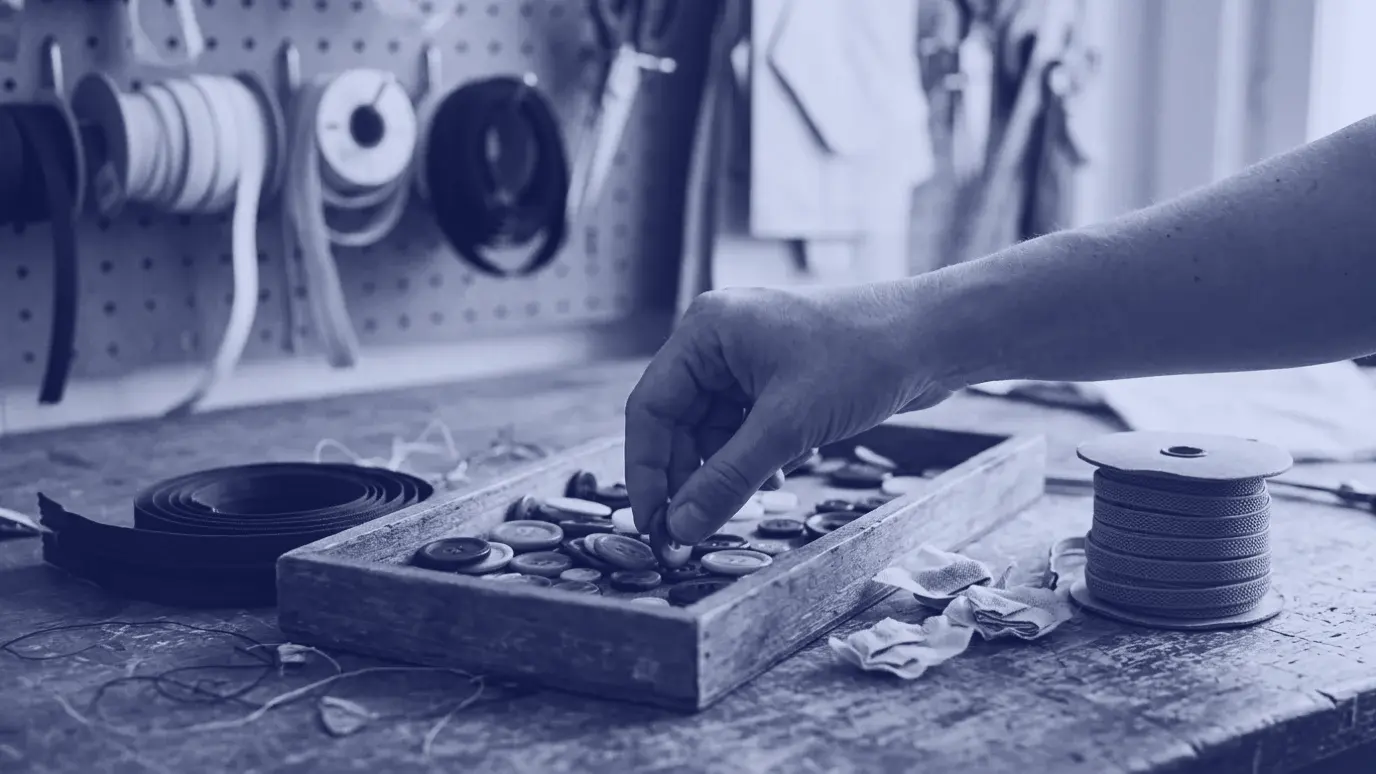
Two common button types follow from the way they are attached: the flat (sew-through) button, sewn on with thread through its holes, and the shank button, which has a hollow protrusion on the back. Common materials are plastic, seashell (mother-of-pearl), metal and wood (Wikipedia, Button); the Tekstil Rehberi directory separates buttons into polyester, metal, mother-of-pearl and wood. In a quote, state ligne and millimeters, the number of holes or the shank type, thickness, material, color and surface finish. Sew the sample onto the fabric and wash it; check the buttonhole length against the button's diameter and thickness by actually buttoning.
Snaps, rivets and clasps are specified the same way, and metal parts that touch the skin also need the nickel requirement (see the test table below). On children's garments, a button that does not come off and small-part safety come first. In common quality-control defect lists, a trim that fails a small-part test counts as a critical defect (AQL inspection); decide with a test laboratory which standard applies to your destination market.
Zippers
Three decisions set a zipper: tooth type (metal, coil, molded plastic or invisible), end construction (closed-end, where a bottom stop joins the two tapes, or open-end, where the two halves separate) and size number. A size number is not equal to a millimeter value, so write the tooth width in millimeters when you order. Types, size tables, length measurement and a quotation line are in the zipper types and sizes guide.
Labels: brand, content and care
A label carries the brand and the required information. Three types stand out: the woven label, mostly used as the main brand label; the printed label, for text-heavy information such as care, content and size; and the hang tag, which carries store and tracking information. The label supplier mostly prints the text you give it, so the accuracy of the content is your responsibility.
Fiber content labeling is set separately in the EU and in Turkey:
- EU. Fiber composition labeling is based on Regulation (EU) No 1007/2011. According to the EU's official portal Your Europe, a product with at least 80% textile fibers must carry a label that shows the fibers in descending order of percentage, using the names in Annex I of the Regulation. The label must be firmly attached and translated into the official languages of the member states where the product is sold to consumers. If care information is given, it must be clearly separate from the composition. According to the European Commission's FAQ document on the Regulation, there is no harmonized EU rule on telling consumers how to wash or care for a textile product.
- Turkey. The Turkish Regulation on Textile Fiber Names and the Labeling and Marking of the Fiber Composition of Textile Products was issued by the Ministry of Customs and Trade (as it was then called) and published in the Official Gazette of April 25, 2015, no. 29337. It requires textile products placed on the market to be labeled or marked with their fiber composition (Article 15). Products with at least 80% textile fibers by weight are covered (Article 2), and labeling is also made in Turkish (Article 17/3). This matters if you also sell in Turkey.
These points are valid as of the date of this guide (October 2026); the texts can change. Check the current version at the source and, if needed, ask a regulatory specialist. The international system for care symbols is ISO 3758 (current edition 2023). For the full list of mandatory information, whether a care label is required and how the rules differ by market (EU, UK, US and Turkey), see clothing label requirements and care symbols.
Do not move to bulk printing without a written approval of the print proof: a wrong symbol or missing information can mean removing labels after shipment. Test that a printed label stays legible after washing.
Interlining: shape and strength
MEB's cutting module defines interlining (Turkish: tela) as an intermediate fabric added to the main fabric, by sewing or bonding, so that the garment keeps a clean, regular shape. According to the module, interlining is used most in collars, pockets, cuffs, sleeve openings and facings (Turkish: mostra); it strengthens the fabric, keeps the form of the garment, prevents stretching and makes sewing easier (MEB, Cutting, p. 4). Interlining can be fusible or sew-in; fusible interlining is bonded with heat and pressure in a fusing press.
Interlining must suit the fabric. In MEB's example, using woven fusible interlining on a thin silk fabric is the wrong choice; the right one is silk interlining. If the fabric and the interlining shrink differently, waviness and puckering can occur in the seam area or on the surface (Ankara University, “Tela nedir?” lecture note). So wash and measure the interlined sample; you can find the shrinkage percentage with the shrinkage calculator. Bond strength is measured with methods such as DIN 54310 and ASTM D2724; the buyer's specification decides which one is used.
Company directory
Looking for manufacturers in this field?
Browse companies in the related categories or get quotes from several companies with one form.
- Trims and Accessories
- Buttons and Metal Trims
- Zippers
- Clothing Labels
- Interlinings
- Elastics and Tapes
- Garment Hangers and Packaging
- Sewing Thread
Do you manufacture or offer services in this field?
Elastic, tape, bias binding and cord
This group works where the garment is stretched and washed most: waist, cuffs, hem and edge finishing. The Turkish dictionary TDK defines biye (bias binding) as a thin strip, generally of the garment's own fabric or of another fabric, run around the collar, sleeve or hem (our translation). For elastic and tape, the definition includes the construction (woven, knitted or braided), width (mm), fiber content, expected stretch and recovery, color and unit (meter or spool).
Elastic tapes can change length in washing and ironing; wash and press the sample, then measure. Length change is calculated as for fabric: (before − after) ÷ before × 100. Elastic and tape are dyed separately from the fabric, so shade differences can appear; compare the color with the fabric in the same light and get approval in writing.
Cords and drawstrings on children's clothing have a separate rule. The current edition of EN 14682 (2014) sets requirements for cords and drawstrings on children's clothing up to 14 years of age; the requirements vary with age group and the area of the garment. As of this guide's date, the current edition is from 2014; standards can be revised, so ask your test laboratory which requirement applies to your product and market. In common quality-control defect lists, a drawstring over the permitted limit is a critical defect.
Packaging and hangers
Hangers, polybags, cartons, boxes and hang tags are mostly set by the buyer's packing instructions: the product can be folded flat in a polybag, boxed or shipped on a hanger. The bag size follows the folded product, and the carton size follows the number of pieces per carton and the carton layout. Shipping on hangers can take more volume, and the hanger is a separate cost line; make a sample pack with the real product before you fix the sizes.
For sales into the EU, according to the European Commission the Packaging and Packaging Waste Regulation (EU) 2025/40 entered into force on February 11, 2025, and its general date of application is August 12, 2026. As of the date of this guide, confirm its effect on your packaging with your buyer, the current text and, if needed, a regulatory specialist.
How do you write a trims list?
MEB's cutting module wants the model definition form to include samples of main and auxiliary materials next to the parts list; in the trade, the counterpart is the tech pack (Turkish: teknik föy). The trims list is part of the tech pack. Giving the supplier and the workshop the same written description keeps the quotes comparable.
| Item | What to state | Approval and checks |
|---|---|---|
| Buttons, snaps | Material, ligne and mm, holes or shank, thickness, color, surface finish | Sew onto the fabric, then wash and press trial; buttonhole fit; nickel report for metal parts; small-part and pull-off check on children's garments |
| Zippers | Tooth type, tooth width (mm), end construction, slider type, length, tolerance and measuring method, tape fiber and color | Trial under use and washing conditions; nickel report; specification to EN 16732 |
| Labels | Type, size, placement drawing, text to print (composition, care, size, origin, producer or importer), languages | Written print proof approval; legibility after washing |
| Interlining | Base, bonding method, suitability to the fabric, bonding conditions (from the interlining's data sheet) | Wash the interlined sample; bond strength test; shrinkage difference |
| Elastic, tape, bias binding | Width (mm), construction, fiber content, stretch, color, unit | Length measurement after washing and pressing; color comparison; cord requirement on children's garments |
| Packaging, hangers | Size, material, print, carton layout, packing instruction | Sample pack with the real product; packaging regulation when selling into the EU |
Sourcing trims: who supplies them, when and how?
- Who supplies them? In the contract (fason) model the party placing the order usually supplies the trims; in the full-package model the manufacturer does. Settle this in writing before the order (contract manufacturing guide).
- When are they final? Buyers generally want the pre-production (PP) sample sewn with the real fabric and trims, and bulk production does not start until the sample is approved. Changing a trim afterwards disturbs both the approval and the delivery date (garment manufacturing process).
- Stock or custom production? Ask separately about minimum quantity, lead time and sample terms for stock items and for custom production (color, logo, mold). Find out whether the other party is a manufacturer or a dealer; who can meet a custom-production or technical-change request depends on it. Minimum quantity and lead time differ from company to company, so this guide gives no numbers. To look for manufacturers and wholesalers, see garment trims and accessories suppliers in Turkey.
- Color. Send the fabric swatch or swatch card (Turkish: kartela) to the supplier and get the approval in writing, on the fabric that will be used in production; dye lots of the fabric can differ in shade. Matching the same color on a reorder can be hard, so consider ordering the requirement in one go, with an allowance for spare.
- Receiving. Trims are checked together with the fabric before cutting: the shrinkage of interlining and lining should match the fabric, and the heat resistance of the interlining should be close to the fabric's (MEB, Cutting, p. 8). For the sampling logic of lot acceptance, see the AQL inspection guide above.
- Cost. CBI's apparel cost study suggests adding about 2% waste on trims and packing; this is a starting point, so replace it with your own batch records. For a line-by-line calculation example, see T-shirt production cost.
Testing and compliance: what to ask for
The table collects the regulations and standards mentioned in this guide. Requirements depend on the market and the product; the information is valid as of the date of this guide (October 2026) and should be confirmed against the current texts, your test laboratory and, if needed, a regulatory specialist. For laboratories, see testing laboratories.
| Topic | Which trims | Basis | Note |
|---|---|---|---|
| Nickel release | Metal parts in direct and prolonged skin contact; the example list names rivet buttons, rivets and zippers on garments | EU: REACH Annex XVII, entry 27. Turkey: KKDİK Regulation (Turkey's chemicals registration and restriction regulation), Annex-17, entry 27. Reference method EN 1811:2023 | Limit 0.5 µg/cm² per week; ask for a test report |
| CMR substances (carcinogenic, mutagenic, toxic for reproduction) | Garments and related accessories for consumer use | EU: REACH Annex XVII, entry 72 (Regulation (EU) 2018/1513), since November 1, 2020 | Non-textile fasteners and decorative parts are exempt; check with your laboratory how textile parts such as labels, tapes and interlining are treated. EU market only; check Turkey's counterpart in the current KKDİK Annex-17 |
| Harmful-substances certificate | All components | OEKO-TEX STANDARD 100 | Every thread, button and accessory is tested; the certificate is valid for one year; its scope must match your product |
| Zipper performance | Zippers | EN 16732:2025 | Read the performance levels from the current text |
| Cords and drawstrings | Children's garments | EN 14682:2014 | Up to 14 years; confirm the current edition with your laboratory |
| Bond strength | Fusible interlining | DIN 54310; ASTM D2724 | The buyer's specification decides the method |
| Care symbols | Care label | ISO 3758:2023 | Check the market's additional requirements separately |
| Fiber composition | Main label | EU: Regulation (EU) No 1007/2011. Turkey: regulation of April 25, 2015 | See the labels section |
For how OEKO-TEX certificates differ from other certificates, see the textile certifications guide.
HS codes and activity codes for trims
When you prepare an invoice, an import or an export document, you need the classification of the trim. The numbers below are international Harmonized System (HS) headings. The Turkish customs tariff number (GTİP) is a longer national subdivision of these; for example, a Turkish revenue-administration ruling lists zipper parts as 9607.20.10.00.00 and 9607.20.90.00.00.
| HS heading | Scope | Trim example |
|---|---|---|
| 96.06 | Buttons, snap fasteners and similar articles; button molds and other parts | 9606.21 plastic buttons and 9606.22 base-metal buttons (not covered with textile material); 9606.10 snap fasteners and parts |
| 96.07 | Slide fasteners (zippers) and parts | 9607.11 zippers with base-metal teeth; 9607.19 other zippers; 9607.20 parts |
| 83.08 | Base-metal clasps, buckles, hooks, eyelets and rivets | Metal clasps and buckles for garments and accessories |
| 58.06 | Narrow woven fabrics, 30 cm wide or less; 5806.20: containing at least 5% by weight of elastomeric yarn or rubber thread | Woven tape, woven elastic |
| 60.02 | Knitted fabrics 30 cm wide or less, containing at least 5% by weight of elastomeric yarn or rubber thread | Knitted elastic |
| 58.07 | Labels, badges and similar articles (not embroidered) | 5807.10 woven labels |
Interlining, polybags, hangers and paper labels are not in the table because their heading changes with the material and construction. Confirm the exact tariff number of your product with your customs broker.
Activity codes (NACE). According to Eurostat's explanatory notes to NACE Rev. 2, manufacture of buttons, snap fasteners and zippers falls under class 32.99 (other manufacturing n.e.c.). Manufacture of narrow woven fabrics, labels and badges, and decorative trimmings such as braids and tassels falls under class 13.96 (other technical and industrial textiles). These are four-digit EU classes; Eurostat says EU statistics have used NACE Rev. 2.1 since 2025. A firm's registered activity code in Turkey is a longer, six-digit national code; check it against the official code list.
Checklist before you buy
- List: is every trim written in the tech pack with size, material, color and placement?
- Quote: did all suppliers receive the same written description?
- Color: was the approval given in writing and on the production fabric?
- Sample: were the buttons, zippers, interlining, elastic and labels washed and pressed together with the fabric?
- Tests: are requirements such as nickel, OEKO-TEX, cords on children's clothing and small parts written in the quote and the order confirmation?
- Label: were fiber composition, care, size and origin information checked on the print proof?
- Cost and classification: was the waste allowance added, and was the HS code confirmed with a customs broker?
Frequently asked questions
What are garment trims?
Garment trims are the materials in a garment other than its main fabric: closures (buttons, snaps, zippers), interlining, elastic, tape, bias binding, cord, labels, and packaging such as hangers, polybags and cartons. In Turkish trade they are called aksesuar. Turkey's Ministry of National Education (MEB) cutting module lists lining, interlining, thread, buttons and zippers as auxiliary materials and says they must suit the fabric. Belts, hats and bags are also called accessories in everyday language, but they are outside this group.
What is the HS code for buttons, zippers and labels?
International HS headings: buttons and snap fasteners 96.06, zippers 96.07, base-metal clasps and buckles 83.08, woven labels 58.07 and narrow woven tapes 58.06. The Turkish customs tariff number (GTİP) is a longer subdivision of these. In NACE Rev. 2, the EU's activity classification, manufacture of buttons, snaps and zippers is class 32.99, and manufacture of labels, badges and narrow woven tapes is class 13.96. The exact classification depends on the product's construction, so confirm it with your customs broker.
Which tests should I ask a trims supplier for?
It depends on the product and the market. Commonly cited are nickel release for metal parts in direct and prolonged skin contact (reference method EN 1811), EN 16732 for zippers, EN 14682 for cords and drawstrings on children's clothing, and bond strength for fusible interlining (DIN 54310 or ASTM D2724). If your buyer requires OEKO-TEX STANDARD 100, check that the certificate covers your product group and is still valid. The buyer's specification and your test laboratory decide which tests are mandatory.
Is a label a trim, and what must it show?
Yes, labels belong to the trims group. In the EU, Regulation (EU) No 1007/2011 requires the fiber composition to be shown on products with at least 80% textile fibers, in descending order of percentage and in the official languages of the country of sale. Turkey's regulation of April 25, 2015 also requires a composition label and adds that labeling is made in Turkish too. According to the European Commission, there is no harmonized EU rule on telling consumers how to wash or care for a textile product. These points are valid as of October 2026; ask a regulatory specialist about your own case.
How do trims enter product cost?
Trims come from the materials list of the tech pack and are added to the cost per piece. CBI's apparel cost study suggests adding about 2% waste on trims and packing; treat this as a starting point and replace it with your own batch records. For a line-by-line example, see the T-shirt production cost guide.
What does ligne mean in button sizes?
Ligne (L) is a unit of button size. According to a retail supply chart, 40 ligne equal one inch, so 1 ligne is about 0.635 mm: an 18 L button is about 11.4 mm and a 24 L button about 15.2 mm. Retail charts round their values, so a difference of close to 1 mm can appear. Write the size in millimeters on the order as well.
Sources (26)
- Turkish Ministry of National Education (MEB), Garment Production Technology: Cutting (Kesim) (542TGD003), Ankara 2011, pp. 3-4 and 8-9: main and auxiliary materials used in garment production, fabric and material inspection, model analysis (copy on Ankara University Open Courseware; accessed October 11, 2026; in Turkish)
- TDK (Turkish Language Association), Current Turkish Dictionary, entry “aksesuar” (accessed October 11, 2026; in Turkish)
- TDK (Turkish Language Association), Current Turkish Dictionary, entry “biye” (accessed October 11, 2026; in Turkish)
- Wawak, Button Size Chart (ligne and millimeter equivalents; accessed October 11, 2026)
- Wikipedia, Button (ways of attachment and common materials; accessed October 11, 2026)
- Ankara University Open Courseware, “Tela nedir?” (What is interlining?) lecture note (author and date not stated; accessed October 9, 2026; in Turkish)
- European Union, Your Europe: Textile label (accessed October 11, 2026)
- Regulation (EU) No 1007/2011 on textile fibre names and related labelling and marking of the fibre composition of textile products
- European Commission, Frequently Asked Questions (FAQs) on Regulation (EU) No 1007/2011 (questions 2.1 and 2.3; accessed October 11, 2026)
- Official Gazette of the Republic of Türkiye, Ministry of Customs and Trade, Regulation on Textile Fiber Names and the Labeling and Marking of the Fiber Composition of Textile Products (Tekstil Elyaf İsimleri ve Tekstil Ürünlerinin Elyaf Kompozisyonlarıyla İlgili Etiketleme ve İşaretleme Hakkındaki Yönetmelik), April 25, 2015, no. 29337 (Articles 2, 15 and 17; accessed October 11, 2026; Turkish text)
- EVS-EN ISO 3758:2023 Textiles — Care labelling code using symbols (ISO 3758:2023, valid since December 6, 2023)
- OEKO-TEX, STANDARD 100 (accessed October 11, 2026)
- EUR-Lex, Commission Regulation (EC) No 552/2009: REACH Annex XVII, entry 27 (nickel)
- Official Gazette of the Republic of Türkiye, Regulation on the Registration, Evaluation, Authorisation and Restriction of Chemicals (KKDİK), June 23, 2017, no. 30105 (repeated); Annex-17, entry 27 (Turkish text)
- EVS-EN 1811:2023 Reference test method for release of nickel from all post assemblies which are inserted into pierced parts of the human body and articles intended to come into direct and prolonged contact with the skin
- Commission Regulation (EU) 2018/1513: REACH Annex XVII, entry 72 (CMR substances in clothing, related accessories and footwear; from November 1, 2020); read from the EU text copy on legislation.gov.uk (accessed October 11, 2026)
- EVS-EN 16732:2025 Slide fasteners (zips) - Specification
- EN 14682:2014 Safety of children's clothing - Cords and drawstrings on children's clothing - Specifications (current edition, December 17, 2014)
- DIN 54310:1980-07 Testing of textiles; delamination of fusible interlinings from upper fabrics, mechanical delamination test
- ASTM D2724-19(2025)e1 Standard Test Method for Bond Strength of Bonded, Fused, and Laminated Apparel Fabrics
- European Commission, Packaging waste (Packaging and Packaging Waste Regulation (EU) 2025/40; accessed October 9, 2026)
- CBI, How to calculate the cost price of an apparel item? (last updated September 26, 2024; accessed October 9, 2026)
- HS 2022 heading texts: 96.06 (buttons, snap fasteners), 96.07 (zippers), 58.06, 58.07, 60.02 (tariffnumber.com; accessed October 11, 2026)
- Revenue Administration (GİB), Istanbul Tax Office Directorate, ruling no. 39044742-130[Özelge]-135427 of May 17, 2017: Turkish Customs Tariff texts for headings 83.08 and 96.07 (copy on a taxpayer's website; a ruling binds only the applicant; used here for the 83.08 heading text and the format of Turkish tariff numbers; Turkish text)
- Eurostat, NACE Rev. 2 - Statistical classification of economic activities in the European Community (2008), explanatory notes: class 13.96 (p. 127) and 32.99 (p. 196)
- Eurostat, NACE: NACE Rev. 2.1 (Commission Delegated Regulation (EU) 2023/137; used in EU statistics from 2025; accessed October 11, 2026)
Author and fact-checking
Written by
Trims and Accessories Editor
Emre Doğan is Tekstil Rehberi's trims and accessories editor. He writes about choosing and sourcing buttons, zippers, labels, interlinings, elastics, tapes and packaging, and takes sizes, materials and labeling rules from standards and regulations.
Content by Emre DoğanFact-checked by: Gizem Polat
This content was prepared by the Tekstil Rehberi editorial team. Before publication, our verification editor checked its figures, dates and sources against primary sources.
Spotted an error? Email us at [email protected] How we work →
Related articles
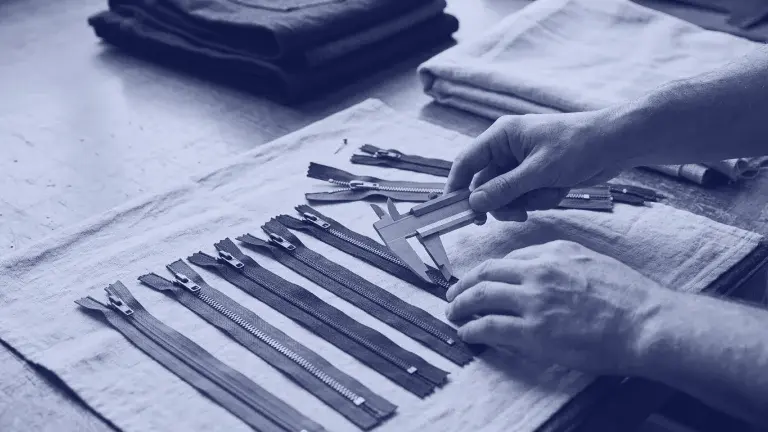
Zipper Types and Sizes: Which Zip for Which Garment?
Metal, coil, moulded plastic and invisible zips, closed-end and open-end construction, what zip size numbers really mean, and how to decode Turkish terms such as dipli, separe and “tip”.
Clothing Label Requirements and Care Symbols: EU, UK, US
What a clothing label must carry in the EU, UK and US when you source from Turkey: fiber content rules, care label law, how ISO 3758:2023 care symbols work, label language and a pre-shipment checklist.