What is Napping (Napped Fabric)?
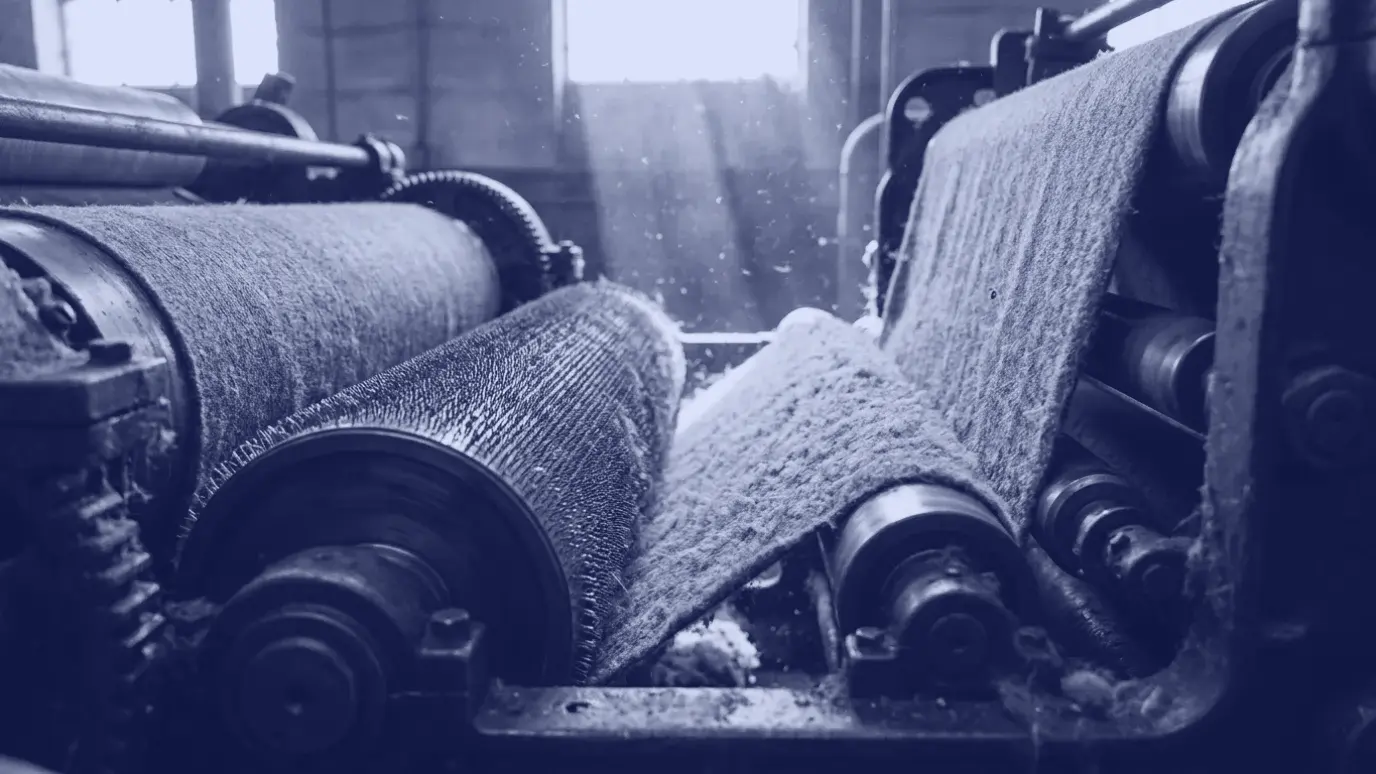
Napping is a mechanical finishing process in which a fabric is run over rotating rollers covered with steel wire points, which raise the surface fibers into a fuzzy pile. It gives fleece, flannel and similar fabrics their soft, warm face or reverse. Turkish suppliers call it şardon.
- Published:
- Fact-checked by:
- Gizem Polat
Key facts
- Napping is a mechanical finishing process: fabric is run over rotating rollers covered with steel wire points, which raise the surface fibers into a fuzzy pile.
- According to Cotton Incorporated, what separates fleece from French terry is whether the inside loops are napped.
- Napping pulls fibers out; shearing evens the pile height, singeing removes protruding fibers and sanding abrades the surface.
- Napped constructions are used for cold-weather garments; Polartec says the raised pile traps body heat in air pockets (manufacturer’s statement).
- For napped fabric, state whether the reverse is napped or not, the weight in GSM, and the pilling test method and acceptance grade.
Napping is a mechanical finishing process in which fabric is run continuously over rotating rollers covered with steel wire points, which raise the fibers on its surface into a fuzzy pile (Cotton Incorporated, CottonWorks). A fabric that has been through the process is called napped. Turkish suppliers call the process şardon (also şardonlama, tüylendirme or fırçalama) and the fabric şardonlu (Fersan; Altunkaya, 2024). The best-known napped products are fleece-type knits: two-thread fleece, three-thread fleece and polar fleece.
How napping is done
The fabric passes over a series of rotating rollers covered with wire points (up to 30 in CottonWorks’ description). Two kinds of roller work on it, depending on how the wire points meet the fabric:
| Roller | Effect |
|---|---|
| Counter-pile | The wire points dig straight into the yarn surface and pull fibers out irregularly |
| Pile | The backs of bent wires act like a comb; they arrange the raised fibers and lay them parallel |
The speed ratio of the two roller types and the type of wire decide the result. The more counter-pile action, the more random and irregular the fibers; the more pile action, the flatter and smoother the surface (CottonWorks). An article on fleece production describes the same step as rotating cylindrical brushes that split the loops into a fluffy layer, after which spiral blades shear the surface to even out the thickness (Hossain et al., 2021).
In knits, napping is usually done on the reverse. Turkish producers describe it as combing and raising the thick backing yarn on the back (Fersan; Altunkaya, 2024). CottonWorks adds that in two-thread (two-end) fleece the yarn floating on the back is thicker and lower in twist, so it can be napped more efficiently.
Napped fabrics
- Fleece family (knit): According to CottonWorks, what separates French terry from fleece is whether the inside loops are napped. Napped two-thread fleece suits cold-weather and active garments, three-thread fleece suits cold-weather garments that need extra warmth, and unnapped two-thread fleece, which is French terry, serves all seasons.
- Polar fleece: Polartec presents fleece as a knitted material converted into a soft, fuzzy pile structure (manufacturer’s statement).
- Flannel (woven): CottonWorks defines flannel as a woven fabric whose surface fibers are brushed up, giving it more cover and softness.
Suppliers do not agree on which constructions can be napped: Altunkaya (2024) writes that three-thread can be napped and two-thread cannot, while Fersan offers napped two-thread. The two-thread fleece entry covers brushed and unbrushed versions.
How napping differs from similar processes
| Process | What it does | Difference from napping |
|---|---|---|
| Shearing | Cuts the fibers rising from the surface to even out the pile height (CottonWorks) | Does not pull fibers out; in fleece production it follows napping to level the thickness |
| Singeing | Passes the fabric over a heated roller or flame to remove protruding fibers (CottonWorks) | The opposite of napping: no pile is formed and the surface becomes smoother |
| Sanding | Abrades the surface with abrasive material; the fabric looks softer and more textured and can resemble suede (CottonWorks) | Does not pull fibers out; it abrades the surface |
| Brushing in denim | Wire or bristle brushes abrade the surface to give a worn look (CottonWorks) | The aim is distressing, not pile; do not confuse it with napping in fabric finishing |
What to specify when buying napped fabric
- State the reverse: Next to the composition, write “napped” or “unnapped.” The same name, two-thread or three-thread, can cover both. Fersan says the depth of the nap can be adapted to the pattern, so approve the depth on a sample.
- State the weight together with the state of the reverse: Supplier weight ranges differ for napped and unnapped versions (see fabric weight by product). To calculate weight from a sample, use the fabric GSM calculator; the measurement method is EN 12127.
- Set the pilling method: In the ISO 12945 series, Part 1 is the pilling box method and Part 2 the modified Martindale method. Write which one you want and the acceptance grade in the specification.
- Have dimensional change measured: By ISO 5077, with washing and drying to ISO 6330 procedures. Work out the cutting allowance from the result with the shrinkage calculator.
Mills that do napping can be found among dye houses and polar fleece suppliers, and knitters of the base fabric among French terry (two-thread) and three-thread fleece manufacturers.
Frequently asked questions
What does napped fabric mean?
Napped fabric is fabric that has been through napping: its surface fibers have been raised into a fuzzy pile, on the face or, in knits, usually on the reverse. Fleece and flannel are typical examples.
Is napping the same as brushing?
Not always. Fleece-production literature describes the napping step as rotating cylindrical brushes (Hossain et al., 2021), and Turkish suppliers also say fırçalama. In denim finishing, however, CottonWorks uses brushing for abrading the surface to a worn look, which is not napping.
Is napped fabric warm?
Napped constructions are used for cold weather: CottonWorks places two-thread fleece in cold-weather and active garments and three-thread fleece in garments that need extra warmth, and Polartec says the raised pile traps body heat in air pockets (manufacturer’s statement). To put a number on insulation, ask for thermal and water-vapor resistance measured to EN ISO 11092.
Is napped fabric breathable?
Brushed fabrics cannot stop sweating; the body relies on it to cool down. Napped fabrics are made to keep heat in: Altunkaya recommends napped three-thread for winter and unnapped (diagonal) three-thread for the in-between seasons. Academic literature links two- and three-thread fleece fabrics with good thermal comfort, low air permeability and protection against cold (Uyanık, 2023). No independent study isolating the effect of napping alone on air and water-vapor permeability was found. For a decision, ask for the fabric’s EN ISO 9237 air permeability and EN ISO 11092 water-vapor resistance. How fiber, structure and weight affect moisture management is covered in breathable fabrics for summer.
Does napped fabric pill?
Pilling on a fuzzy surface needs to be measured, and it changes markedly with finishing. In a study of a polyester-cotton blend three-thread fleece, untreated fabric scored grade 1 (the worst) and fabric with singeing and heat setting together scored grade 4; the study tested those two treatments, not napping itself (Hossain et al., 2021).
Are napping and polar fleece the same thing?
No. Napping is a process; polar is the name of a fabric, usually polyester, whose surface is napped. Napped two-thread or three-thread fabrics are also often not called polar. The boundary is not sharp, as the polar fleece entry explains.
Sources (18)
- CottonWorks (Cotton Incorporated), Textile Encyclopedia: Napping (accessed October 11, 2026)
- CottonWorks (Cotton Incorporated), Learning Hub: Mechanical Finishing (napping, shearing and sanding sections; accessed October 11, 2026)
- CottonWorks (Cotton Incorporated), Textile Encyclopedia: Singeing (accessed October 11, 2026)
- CottonWorks (Cotton Incorporated), Textile Encyclopedia: Flannel (accessed October 11, 2026)
- CottonWorks (Cotton Incorporated), Learning Hub: Single & Double Knits (fleece and French terry section; accessed October 11, 2026)
- CottonWorks (Cotton Incorporated), Learning Hub: Denim Finishing (brushing section; accessed October 11, 2026)
- Hossain, M. S., Islam, M. M., Dey, S. C., Hasan, N. (2021). An approach to improve the pilling resistance properties of three thread polyester cotton blended fleece fabric. Heliyon, 7(4), e06921
- Polartec, The Original Synthetic Fleece Fabric: Polar Fleece (accessed October 11, 2026)
- Uyanık, S. (2023). İki iplik örme kumaşlarda farklı astar ipliği oranlarının kumaş özelliklerine etkileri (The effects of different backing yarn ratios on the properties of two-thread knitted fabrics; in Turkish). Çukurova University Journal of the Faculty of Engineering, 38(3), 819-826
- Fersan Tekstil (polyester knitted fabric manufacturer): İki İplik (French Terry) Kumaş Üreticisi (two-thread (French terry) fabric manufacturer; Turkish; updated October 3, 2026; accessed October 11, 2026)
- Altunkaya Tekstil: 2 İplik ve 3 İplik Farkı Nedir? (What is the difference between two-thread and three-thread?; Turkish; July 20, 2024; accessed October 11, 2026)
- ISO 12945-1:2020 Textiles: Determination of fabric propensity to surface pilling, fuzzing or matting, Part 1: Pilling box method (EVS-EN ISO 12945-1:2020 record)
- ISO 12945-2:2020 Textiles: Determination of fabric propensity to surface pilling, fuzzing or matting, Part 2: Modified Martindale method (BS EN ISO 12945-2:2020 record)
- EN 12127:1997 Textiles. Fabrics. Determination of mass per unit area using small samples (EVS-EN 12127:2000 record)
- ISO 6330:2021 Textiles: Domestic washing and drying procedures for textile testing
- ISO 5077:2007 Textiles: Determination of dimensional change in washing and drying (confirmed in 2022)
- EN ISO 9237:1995 Textiles: Determination of permeability of fabrics to air (EVS-EN ISO 9237:2000 record)
- EN ISO 11092:2026 Textiles: Physiological effects: Measurement of thermal and water-vapour resistance under steady-state conditions (EVS record)
Author and fact-checking
Written by
Dyeing, Printing and Finishing Editor
Deniz Koç is Tekstil Rehberi's dyeing, printing and finishing editor. Deniz covers dyeing methods, digital, screen, transfer and sublimation printing, embroidery, garment washing and fabric finishes, and refers to the relevant test standards on topics such as color fastness and chemical compliance.
Content by Deniz KoçFact-checked by: Gizem Polat
This content was prepared by the Tekstil Rehberi editorial team. Before publication, our verification editor checked its figures, dates and sources against primary sources.
Spotted an error? Email us at [email protected] How we work →
Articles on this topic
Denizli Towel and Bathrobe Industry: How Turkey's Home Textile Hub Works
Why Denizli leads Turkey's towel and bathrobe production, how the chain runs from yarn to sewing, how to read the 2025 numbers and what to ask a supplier.
What GSM Should a T-Shirt Be? Fabric Weight for T-Shirts, Hoodies and Joggers
GSM ranges for T-shirts, hoodies and joggers, what light, mid and heavy weights mean, why one fabric can carry different GSM figures, and how to write GSM into a supplier spec.
Textile Certifications Guide: OEKO-TEX, GOTS, GRS and Better Cotton
What OEKO-TEX, GOTS, GRS and Better Cotton actually prove, which one to ask a Turkish supplier for, how to verify a certificate, and which rules change in 2026–2027.