
Trims and Accessories
What Are Garment Trims? Buttons, Zippers, Labels, Interlining and Elastic
15 min read
Searches companies, categories, products, listings, guides and the glossary.
Browse sectors
Button, snap, rivet, eyelet, buckle and clasp suppliers in Turkey. Define the size in ligne and millimeters, and get color approval and a nickel test report from the supplier in writing.
For buyers
No companies are listed on this page yet. You do not have to wait for the list: describe what you need and request quotes.
Tell us the product, quantity and delivery location. You confirm your request with the link we e-mail you; requests are screened for spam, and our team reviews your first request. It is then sent to up to 20 companies working in this field and stays open for quotes in their company panel for 30 days. You compare the quotes you receive on one page.
Trims and Accessories
Get your company listed on this page. If you manufacture or provide services in this field, create your free profile; companies are listed after our team has reviewed them.
List your company for freeThree things decide button sourcing: the match between size and style, color that matches the fabric, and durability after sewing and washing. Writing all three into the quote makes it easier to get the same button in bulk as the one approved on the sample.
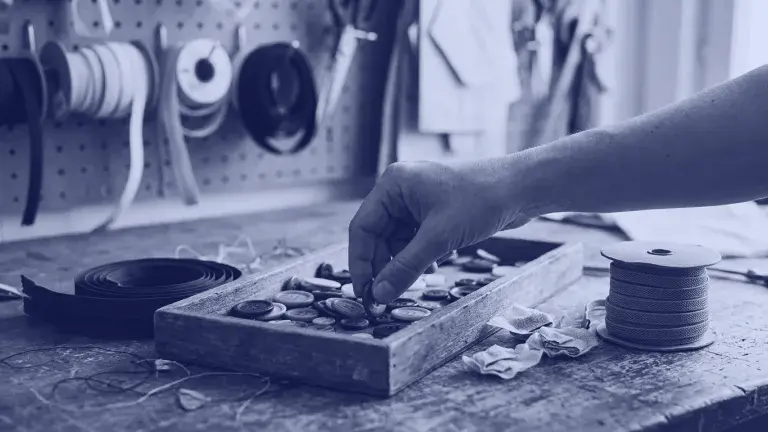
Polyester, metal, mother-of-pearl and wood buttons, plus closures such as snap fasteners, rivets and clasps; also metal trims such as eyelets (grommets), jeans buttons and rivets, buckles, belt buckles and metal logo plates. The companies here make or sell the material; sewing buttons onto garments and cutting buttonholes is the work of CMT sewing workshops. Jeans buttons and rivets are trims for denim garments; if you are looking for a jeans manufacturer, see denim apparel. If you are looking for zippers, see zipper companies.
Of the 165 firms with a valid TOBB capacity report under the product code that covers buttons, snap fasteners, hooks and zippers together (32.99.23), 137 are in Istanbul (October 2026). There is no separate code for buttons, so the figure does not show button makers alone; rivets, eyelets and metal buckles may be registered under other metal goods codes. Only manufacturers holding a valid capacity report enter the figure; workshops without a report and trading firms stay outside it. TOBB, which keeps the database, is the Union of Chambers and Commodity Exchanges of Türkiye.
Suppliers talk about button size in ligne (L), while you measure millimeters with a caliper. To convert, multiply the ligne number by 0.635: 18 L is about 11.4 mm. Write both values in the quote. The number of holes, the thickness and whether the button is flat or shank (footed) are part of the specification too. The buttonhole length must suit the button's diameter and thickness; check it by making and opening a buttonhole on the sample.
To match color, send the fabric sample or a swatch card to the supplier and get the color approval in writing. Dye lots of the fabric can differ in shade, so do the approval against the fabric that will be used in production. Matching the same color on a reorder can be hard; where possible, order the full requirement at once, with a spare allowance.
Material (polyester, metal, mother-of-pearl, wood), diameter and thickness, surface treatment (plating, dyeing, printing or laser work), custom mold or logo, number of colors and order quantity. For metal buttons, the type of plating affects both appearance and cost.
Ligne (L) is a unit used for button diameter, equal to 1/40 inch or about 0.635 mm. For example, 24 ligne is about 15.2 mm; supplier tables may differ by a few tenths of a millimeter because of rounding. State both ligne and millimeters on the order.
Some companies offer custom molds and logo production. Because tooling must be prepared, the minimum quantity and lead time are calculated differently from stock items, and a mold charge may be asked separately. Ask about the mold charge, the minimum quantity and the time needed for an approval sample at the first meeting.
Secure attachment and small-part safety matter most. In commonly used quality-control defect lists, an accessory that fails the small-parts test is a critical defect, and a single critical defect can stop the lot; the classification is set by the buyer's defect list. Ask for a test report on pull-off strength, and agree with a test laboratory which standard applies for your sales market.
Minimum quantity and lead time are calculated separately for a ready stock style and for custom mold or logo production, so no single number applies. Price depends on the material (polyester, metal, mother-of-pearl, wood), diameter and thickness, surface treatment (plating, dyeing, printing or laser work), number of colors and order quantity. To compare quotes, give every company the same size in ligne and millimeters, the same material and the same color.
Of the 165 firms with a valid TOBB capacity report under the product code that covers buttons, snap fasteners, hooks and zippers together (32.99.23), 137 are in Istanbul (October 2026); the remaining 28 are spread across 17 provinces, none with more than four. Because there is no separate code for buttons, the figure does not show button makers alone. Rivets, eyelets and metal buckles may be registered under other metal goods codes and are not in this count.