
Trims and Accessories
What Are Garment Trims? Buttons, Zippers, Labels, Interlining and Elastic
15 min read
Searches companies, categories, products, listings, guides and the glossary.
Browse sectors
Fusible and sew-in interlining and shoulder pad suppliers in Turkey: woven, knitted and nonwoven bases. Test the interlining on your own fabric and ask the supplier for fusing values and the selling unit.
For buyers
No companies are listed on this page yet. You do not have to wait for the list: describe what you need and request quotes.
Tell us the product, quantity and delivery location. You confirm your request with the link we e-mail you; requests are screened for spam, and our team reviews your first request. It is then sent to up to 20 companies working in this field and stays open for quotes in their company panel for 30 days. You compare the quotes you receive on one page.
Trims and Accessories
Get your company listed on this page. If you manufacture or provide services in this field, create your free profile; companies are listed after our team has reviewed them.
List your company for freeInterlining (tela in Turkish) is the invisible support material that holds the shape of areas such as collars, cuffs, jacket fronts and waistbands. Because it is washed and ironed together with the garment, its compatibility with the fabric matters more than its price. Below is what to ask an interlining supplier and what to test before bulk production.
Fusible interlining (bonded to the fabric with heat and pressure) and sew-in interlining, in woven, knitted and nonwoven bases. Padding (vatka in Turkish trade) is two different products: shoulder pads (a garment trim) are listed on this page; roll, fiber or quilted wadding belongs under nonwovens; loose fill fiber belongs under textile fibers. Spunbond, which Turkish buyers also call “tela” (“tela kumaş” for the fabric, “tela çanta” for bags made from it), is a nonwoven, not an interlining; spunbond rolls are listed under nonwovens. Lining is outside this page: lining fabrics are listed under fabrics. Fusing interlining onto cut pieces is mostly done in the cutting room; for that service, see fabric cutting workshops.
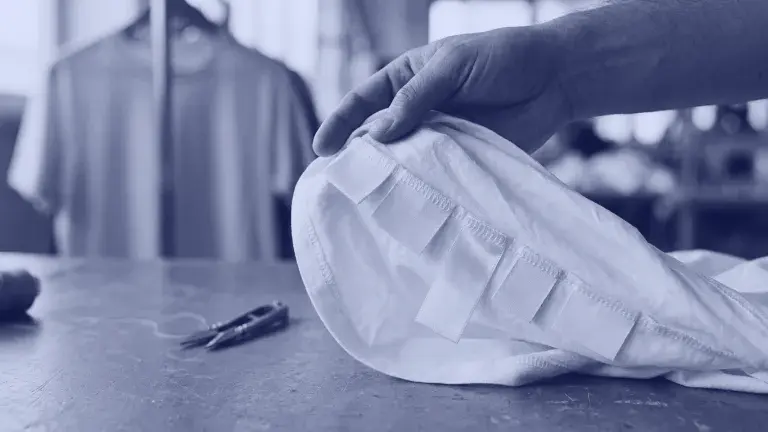
In washing and ironing, the interlining and the fabric must behave together: if their shrinkage and heat resistance are far apart, the garment can lose its shape. The base structure (woven, knitted or nonwoven) must also suit the stretch behavior of the fabric. On a thin, flexible fabric, an overly stiff interlining can spoil the drape, so the collar, cuff and pocket opening on the same garment may need different interlinings. On light-colored or thin fabric, the adhesive can strike through to the surface or the color of the interlining can show. Which interlining suits which fabric is learned not from the catalog but from a trial on your own fabric.
Base type (woven, knitted or nonwoven), weight, adhesive type and density, width, color, special treatments and order quantity. Quotes with different weights and adhesives cannot be compared; fix the specification first.
With care. Fusible interlining is bonded with heat and pressure, so it may not suit a fabric that cannot withstand heat or pressure; in that case sew-in interlining is considered. Before deciding, fuse the interlining to your own fabric and check the surface for marks, shine or adhesive strike-through.
The interlining's shrinkage should match the fabric and its heat resistance should be close to the fabric's; a mismatched material shrinks differently in washing and can distort the shape of the garment. Ask for a fusing and wash sample on your own fabric.
The companies on this page make or sell the interlining material. Fusing is a separate operation done in a fusing press and, in the garment production flow, is usually applied after cutting, in the cutting room. If the supplier does not offer this service, discuss fusing separately with the cutting room or the sewing workshop.
Price depends on the base type (woven, knitted or nonwoven), weight, adhesive type and density, width, color, special treatments and order quantity, so no single number applies. The pricing unit also affects the comparison: a quote can be per meter, per roll or per kilo, so convert quotes to the same unit before comparing them. For a special weight or a special adhesive outside the weights kept in stock, ask whether the minimum and the lead time change.
Delivery time can differ between the weights kept in stock and a special weight or special adhesive; ask about the reorder time up front too. Because compatibility with the fabric shows in a trial on your own fabric, not in the catalog, add a fusing and wash sample round to your lead time plan. Fusing is a separate operation, so include the cutting room's or sewing workshop's schedule in the delivery plan as well.