What is Interlining?
Interlining is a supporting material that sits between two layers of fabric in a garment part and gives areas such as collars, cuffs and plackets their shape and strength. It comes in fusible types, bonded with heat and pressure, and sewn-in types.
- Published:
- Fact-checked by:
- Gizem Polat
Key facts
- Interlining is a supporting material between two layers of fabric that gives areas such as collars, cuffs and plackets their shape and strength.
- Interlining is made on a woven, knitted or nonwoven base and is applied to the fabric as fusible or sewn.
- In fusible interlining, a thermoplastic resin on the surface (such as polyamide, polyester, HDPE or LDPE) melts with heat and bonds to the fabric.
- Fusing temperature, time and pressure affect the peel resistance and stiffness of the fused fabric.
- If interlining and fabric shrink differently, rippling and puckering appear in the sewing area; the interlining is expected to change size in step with the fabric.
Interlining is a supporting material that sits between two layers of fabric in a garment part and supports the shape, crispness and strength of that area. Turkish suppliers call it tela. The Turkish Language Association (TDK) defines tela as a “starched cloth placed between the fabric and the lining to keep the garment upright” (our translation from the Turkish). Today interlining is made on a woven, knitted or nonwoven base; in fusible types the surface of the base is coated with a resin that melts under heat (Seyidzade, 2022).
What interlining does and where it is used
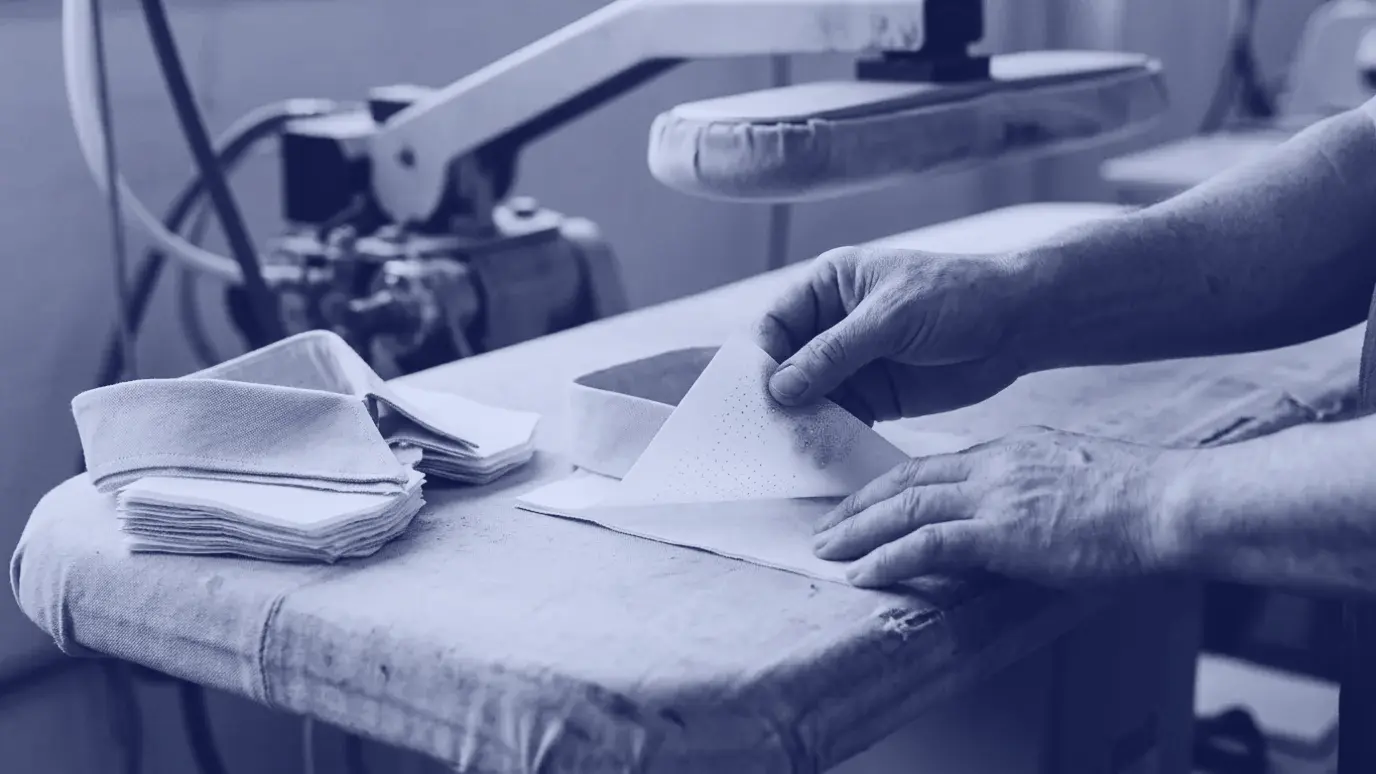
Bonding interlining to cut garment parts is called fusing (telalama in Turkish). According to the MEB cutting-room module, fusing is done to increase the strength of the fabric, prevent stretching, keep the garment’s shape, give the fabric a firmer look and make sewing easier (MEB, 2008, p. 23). The main places where interlining is used are collars, cuffs, plackets, pocket openings, waistbands, and the front body of jackets and coats (Ankara University lecture notes; Gürarda et al., 2019).
Interlining types
Interlining is classified by two criteria: the structure of the base and the method of attaching it to the fabric.
By base structure
| Base | How it is made | Strength | Limit |
|---|---|---|---|
| Woven | Warp and weft yarns interlace as in fabric | Can be made from any fiber. Interlining cut along the straight grain prevents stretch; cut on the bias it gives stretch | More expensive than nonwoven; the edge tends to fray |
| Knitted | Mostly warp-knitted or raschel | Warp-knitted types are stable. A raschel structure with weft insertion gives crosswise stretch, lengthwise stability and softness | Warp-knitted types have very little stretch |
| Nonwoven | Fibers are laid and bonded without being made into yarn; can be oriented or random | The edge does not fray and sewing is easier; random-fiber types stretch in every direction | Low strength; may be inadequate where load is applied, such as buttonholes and waistbands |
The table is based on the Ankara University open-course notes.
By attachment method
- Fusible interlining: A thermoplastic resin on its surface melts with heat and bonds to the fabric. Polyamide, polyester, HDPE, LDPE and various copolymers are used as resin (Seyidzade, 2022). According to the course notes, the resin is applied to the base by powder dot, paste dot, double dot or coating methods. Double dot is meant to prevent the adhesive from passing through to the face of the fabric and to the back of the interlining.
- Sewn interlining: Attached directly between the two layers of fabric by stitching, with no heat or pressure (Gürarda et al., 2019).
Fusing: temperature, pressure and time
Fusible interlining is bonded in a fusing press with heat and pressure. Temperature, time and pressure affect the peel resistance and stiffness of the fused fabric. In a study in which three different interlinings (plain woven, twill and nonwoven) were fused to a woven face fabric, the effect of increasing temperature and time on stiffness differed by interlining type (Gürarda et al., 2019). So one setting does not suit every interlining.
According to the MEB module, heat is set according to the type of interlining and the properties of the fabric; fine interlining gets lower heat than thick, otherwise the interlining may melt. At the press exit, while the fabric is still hot, the interlining may separate or bubble; for this reason a cooling station is used (MEB, 2008, p. 22). Because values vary by product, rely on the range in the interlining’s technical data sheet and on a trial on your own fabric.
Interlining, lining and related terms
- Lining: TDK defines astar as a “thin layer put on the inside of fabric or leather” (our translation from the Turkish). A lining is a layer of fabric that covers the inside of the garment and is sewn like the garment itself. Interlining is the support material between the fabric and the lining.
- Nonwoven: A sheet obtained by bonding fibers without making them into yarn. Garment interlining is one of the uses of nonwovens, but interlining is also made on woven and knitted bases (Seyidzade, 2022). So not every nonwoven is an interlining, and not every interlining is a nonwoven.
- Ekstrafor: One of the materials placed in the shoulder seam of knitted garments to prevent stretching. MEB’s T-shirt sewing module lists ekstrafor as a material separate from tape interlining (MEB, T-shirt Sewing, pp. 19 and 37).
Common problems and tests
The course notes list the following problems in fused production:
- Adhesive strike-through to the back: The adhesive passes to the back of the interlining and soils the press belt or the table.
- Adhesive strike-through to the face fabric: If heat, pressure or time is excessive, the adhesive comes through to the face of the fabric; this is common in thin, light fabrics such as tulle.
- Differential shrinkage: If fabric and interlining shrink differently, rippling and puckering appear in the sewing area.
- Separation and bubbling: If the bond is weak, or the fabric is taken from the press without enough cooling, the interlining separates and the fabric bubbles.
- Color change: Excess heat or adhesive can cause temporary or permanent color change.
Bond strength is measured in the laboratory. DIN 54310:1980-07 tests the mechanical delamination of fusible interlining from the face fabric. ASTM D2724 determines the bond strength of bonded, fused and laminated apparel fabrics before and after washing or dry cleaning. The buyer’s specification decides which method is used.
Frequently asked questions
Is interlining washed with the garment?
Yes. Interlining is part of the garment and goes through washing, ironing and, if needed, dry cleaning. According to the course notes, interlining is expected not to separate from the fabric in washing, for its adhesive not to dissolve in dry cleaning, and to move with the fabric, that is, to change size in step with it.
Where is fusing done?
In garment production it is usually done after cutting, in the cutting room, on a fusing press; the parts are then checked and go to sewing (MEB, 2008). For its place in the production flow, see the garment manufacturing process guide.
Where do you start when choosing an interlining?
First look at the function of the area: nonwoven interlining may be inadequate where load is applied, such as buttonholes and waistbands, and for knitted fabrics raschel-based interlinings with weft insertion that stretch crosswise are also used (course notes). Then fuse the interlining to your own fabric and test it by washing. For suppliers, see the interlining suppliers page.
Sources (9)
- TDK Güncel Türkçe Sözlük (Turkish Language Association dictionary), entry “tela” (accessed October 9, 2026)
- TDK Güncel Türkçe Sözlük (Turkish Language Association dictionary), entry “astar” (lining) (accessed October 9, 2026)
- Turkish Ministry of National Education (MEB), MEGEP, Giyim Üretim Teknolojisi: Kesimhanede Son İşlemler, 542TGD180 (Garment Production Technology: Final Operations in the Cutting Room; in Turkish), Ankara 2008 (pp. 10–12, 22–23)
- Turkish Ministry of National Education (MEB), MEGEP, Giyim Üretim Teknolojisi: Tişört Dikimi, 542TGD008 (Garment Production Technology: T-shirt Sewing; in Turkish), pp. 19 and 37
- Seyidzade, L. (2022). Biyobozunur polimerlerle yapışkan tela geliştirilmesi ve uygulama parametrelerinin incelenmesi (Development of fusible interlining with biodegradable polymers and investigation of application parameters; in Turkish). Bursa Uludağ University Graduate School of Natural and Applied Sciences, master’s thesis (abstract)
- Gürarda, A., Kanık, M. and Çalışkan, N. (2019). Peel resistance and stiffness of woven fabric with fusible interlinings. Industria Textila, 70(2), 139–146. DOI: 10.35530/it.070.02.1571 (full text)
- Ankara University Open Courses, “Tela nedir?” (What is interlining?; lecture notes, PDF, 11 pp.; in Turkish; author and date not stated; accessed October 9, 2026)
- DIN 54310:1980-07 Testing of textiles; delamination of fusible interlinings from upper fabrics, mechanical delamination test
- ASTM D2724-19(2025)e1 Standard Test Method for Bond Strength of Bonded, Fused, and Laminated Apparel Fabrics
Author and fact-checking
Written by
Trims and Accessories Editor
Emre Doğan is Tekstil Rehberi's trims and accessories editor. He writes about choosing and sourcing buttons, zippers, labels, interlinings, elastics, tapes and packaging, and takes sizes, materials and labeling rules from standards and regulations.
Content by Emre DoğanFact-checked by: Gizem Polat
This content was prepared by the Tekstil Rehberi editorial team. Before publication, our verification editor checked its figures, dates and sources against primary sources.
Spotted an error? Email us at [email protected] How we work →
Articles on this topic
What Are Garment Trims? Buttons, Zippers, Labels, Interlining and Elastic
What garment trims are, the six groups from closures to packaging, how to specify each one, which tests to request, HS codes and a sourcing checklist for buyers working with Turkish suppliers.