What is Nonwoven?
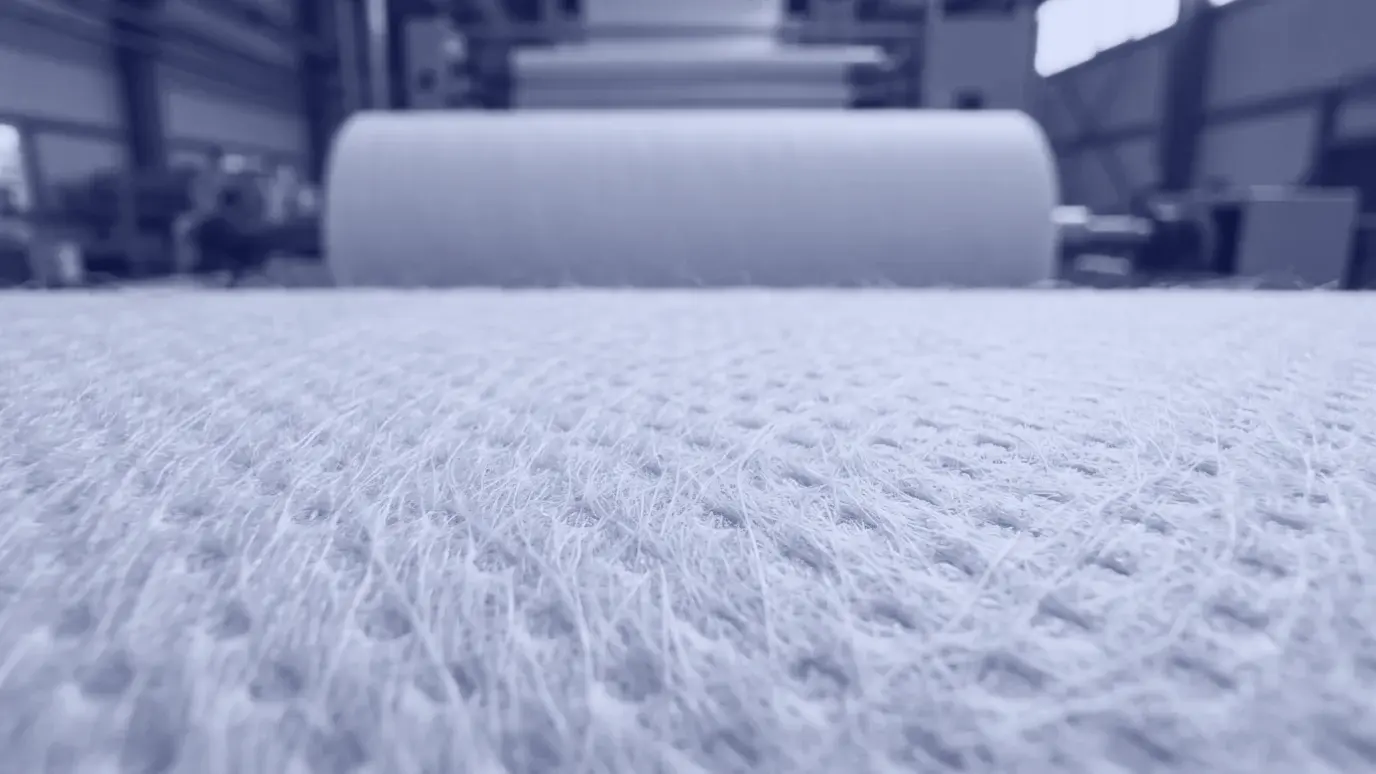
A nonwoven is a sheet made of fibers or filaments that is bonded by physical and/or chemical means, without weaving or knitting. It is used in hygiene products, medical supplies, filtration and construction, among other fields.
- Published:
- Updated:
- Fact-checked by:
- Gizem Polat
Key facts
- A nonwoven is a sheet of fibers or filaments bonded without weaving or knitting; there is no yarn-making stage.
- The ISO 9092 definition quoted by EDANA excludes weaving, knitting and paper making.
- Production has three stages: web forming, bonding (mechanical, thermal or chemical) and finishing.
- Spunbond and meltblown are web-forming methods from polymer, needle-punching and spunlace are bonding methods, and SMS has a meltblown layer between two spunbond layers.
- In the customs tariff nonwovens are heading 56.03 (Turkish name: dokunmamış mensucat); felt is 56.02.
- According to EDANA, 2,919,000 metric tons of nonwovens were produced in Greater Europe in 2025; hygiene is the largest end use by volume.
Properties
- Fiber content
- Natural or manufactured fibers; continuous filaments. Spunbond and meltblown make filaments directly from molten polymer (e.g. polypropylene)
- Structure
- Flat sheet of fibers or filaments; no yarn; mechanical, thermal or chemical bonding
- Weight range
- There is no single standard range. The customs tariff (HS 5603) divides weight into four classes: 25 g/m² and under, 25–70, 70–150 and over 150 g/m² (CBSA, 2023)
- Uses
- Hygiene products, wet wipes, medical supplies, filters, construction and roofing materials, geotextiles, automotive interiors, upholstery, garment interlining, agricultural covers, envelopes and labels
- Care
- Varies by product. EDANA’s list of properties includes being washable, dry-cleanable and sterilizable; take care instructions from the product data sheet
A nonwoven is a sheet made of fibers or filaments that is bonded by physical and/or chemical means, without weaving or knitting. Because the fabric is built directly from fiber rather than yarn, the yarn-making stage is skipped (INDA definition, NPTEL). Uses named by EDANA include hygiene products, wet wipes, medical supplies, filters and construction materials.
Nonwoven definition and names
According to the ISO 9092 definition quoted by EDANA, a nonwoven is a predominantly planar, engineered fibrous structure that has been given a designed level of structural integrity by physical and/or chemical means other than weaving, knitting or paper making. The 2019 revision moved the definition away from the word “textile” towards the idea of an “engineered material” (Textile World, 2019). The current edition of the standard is EN ISO 9092:2026; the definition quoted by EDANA is used here.
In Turkish the same product group goes by three names: “dokusuz yüzey” in academic writing, “nonwoven” in trade language, and “dokunmamış mensucat” in the Turkish Customs Tariff, as the name of heading 56.03 (GİB ruling, 2016). Knowing all three helps when you read Turkish quotations, technical sheets and customs documents.
How is it made?
EDANA describes production in three stages; converting steps such as cutting, folding, sewing and heat sealing come after these.
- Web forming: Fibers or filaments are formed into a sheet (dry-laid, wet-laid or polymer-laid).
- Bonding: The sheet is consolidated by mechanical, thermal or chemical means.
- Finishing: Properties are added or changed by mechanical or chemical treatments; for example, the product can be made conductive, flame retardant, water repellent or breathable.
Nonwoven types by method
| Web forming | How it works | Distinguishing feature (EDANA) |
|---|---|---|
| Carded (dry-laid) | Fibers opened from bales are turned into a web by carding drums | If the fibers are laid mostly in the machine direction (parallel), the web has good tensile strength and low elongation in that direction; fibers can also be oriented randomly |
| Air-laid (dry-laid) | Short fibers are carried by an air stream to a moving belt, forming a randomly oriented web | Lower density and softer handle than a carded web; no layered structure |
| Wet-laid | A mixture of water and fiber is drained on a moving wire | The principle is similar to paper making |
| Spunlaid (spunbond) | Molten polymer is drawn into continuous filaments and laid on a belt | Higher strength than carding; the name “spunbond” is reserved for thermally bonded spunlaid |
| Meltblown | Partly molten filaments are thinned by hot air | Much finer filaments, low tensile strength; diameter goes down to about 1 micron |
The bonding method also shapes the product. In needle-punching, special needles pass through the web and entangle the fibers. In hydroentanglement (spunlace), fine high-pressure water jets interlock the fibers; pressure directly affects the strength of the web. In thermal bonding, thermoplastic fibers are fused with controlled heat; in calendering this is done with heat and high pressure between rollers. In chemical bonding, a liquid binder is applied to the web; water-based binders are the most common (EDANA).
SMS is a composite structure in which a meltblown layer is placed between two spunbond layers: the spunbond layers give the structure strength, and the meltblown layer acts as a barrier (US 11479017 B2).
Properties
EDANA describes nonwovens as materials designed for their end use, ranging from thin and light to strong and durable. Their properties are set by the choice of raw material, the web-forming and bonding method, and finishes such as printing, embossing and lamination. Among the properties EDANA lists are absorbency, breathability, liquid repellency, flame resistance, washability, sterilizability and durability; a product carries not all of these, only those suited to the job it was designed for.
An example of the effect of finishing: in spunbond fabrics used in hygiene, liquid uptake and rewet are important, so manufacturers apply hydrophilic chemicals (Dönmez et al., 2019).
Uses
| Field | Examples | Source |
|---|---|---|
| Hygiene | Baby diapers, sanitary pads, tampons, adult incontinence products | EDANA |
| Wipes | Wet wipes, personal care wipes | EDANA |
| Medical | Sterile medical supplies, filter layer of nonwoven masks | NPTEL; EDANA, 2020 |
| Filtration (filter fabrics) | Filters | EDANA |
| Construction and geotextiles | Construction and roofing materials, geotextiles | EDANA; NPTEL |
| Automotive and upholstery | Automotive interior materials, upholstery | EDANA, 2026 |
| Other | Garment interlining, agricultural covers, envelopes, labels, insulation | NPTEL |
According to EDANA’s statistics of 7 April 2026, nonwoven production in Greater Europe (EDANA’s statistical region) fell by about 2.2% in 2025 to 2,919,000 metric tons; hygiene remained the largest end use by volume. The figures are tonnage and do not reflect changes in weight per square meter.
In medical use, product performance is set by standards: EN 13795-1:2025 covers single-use and reusable surgical drapes and gowns and sets test methods and performance requirements; being a nonwoven does not by itself mean a product complies. For nonwoven masks, EDANA names the filter layer as a meltblown web; the filtration efficiency of a surgical mask depends on the material properties and design (Seid, 2022).
How it differs from similar terms
| Term | Difference from a nonwoven |
|---|---|
| Woven fabric | Formed by interlacing two sets of yarns (CottonWorks) |
| Knitted fabric | Yarn is turned into loops that are interlocked (CottonWorks) |
| Paper | The definition excludes paper making; wet-laying resembles it, but the boundary is drawn by ISO 9092 (EVS) |
| Felt | Formed when fibers such as wool interlock through heat, moisture, movement and pressure; Turkish course notes classify it as a type of nonwoven. In the customs tariff, felt (including needle-punched felt) is 56.02 and nonwovens are 56.03 (CBSA) |
| Spunbond, meltblown, spunlace, needle-punching | Not product names but web-forming or bonding methods |
For a general comparison of woven, knitted and nonwoven fabrics, see the fabric types guide.
Specifying and testing
- Specification: Write the method (spunbond, SMS, needle-punched, etc.), the raw material, the weight (g/m²) and its tolerance, the width and the finish separately.
- Testing: Mass per unit area is measured to EN ISO 9073-1:2023, and tensile strength and elongation at break by the strip method to EN ISO 9073-3:2023 (the latter offers 25 mm and 50 mm sample width options). EN ISO 13934-1, written for woven fabric, is normally not applied to nonwovens.
Suppliers of nonwoven rolls can be found in the nonwoven manufacturers category.
Frequently asked questions
Is every nonwoven disposable?
No. EDANA defines nonwovens as materials designed for their purpose and lists washability and durability among their properties. Disposable hygiene products are common, but nonwovens are not limited to them.
What is the customs tariff heading of nonwovens?
As of the date of this entry (October 2026), it is heading 56.03 in Chapter 56 of the Turkish Customs Tariff: “Dokunmamış mensucat (emdirilmiş, sıvanmış, kaplanmış veya lamine edilmiş olsun olmasın)”, that is, nonwovens, whether or not impregnated, coated, covered or laminated (GİB ruling, 2016). In the HS-based tariff, subheadings are split by whether the product is made of man-made filaments and by weight (thresholds of 25, 70 and 150 g/m²); products completely embedded in plastics or rubber, or completely coated or covered on both sides with them, go to Chapter 39 or 40 (CBSA, 2023). The exact code depends on your product’s structure and coating; check the current tariff schedule and confirm with your customs broker.
Sources (19)
- EDANA, What are nonwovens? (ISO 9092 definition, properties, end uses; accessed October 9, 2026)
- EDANA, How are nonwovens made? (web forming, bonding and finishing; accessed October 9, 2026)
- EN ISO 9092:2026 Nonwovens - Vocabulary (EVS record; EVS-EN ISO 9092:2026, in force since May 4, 2026; previous edition 2019)
- Textile World, Global Nonwovens Association Leaders Meet at IDEA: Updated Definition of Nonwovens (April 2019)
- NPTEL (IIT Delhi), Module 1: Overview of Nonwovens (INDA definition and applications; accessed October 9, 2026)
- EDANA, 2025 Nonwoven Production in Greater Europe (April 7, 2026)
- EDANA, European producers set for 20-fold increase in nonwoven face mask output by November (June 23, 2020)
- US 11479017 B2, High strength nonwoven barrier material (definition of the SMS structure; accessed October 9, 2026)
- Dönmez, U., Kaçmaz, E. and Kurt, H. A. (2019). Tek kullanımlık spunbond kumaşlarda hidrofilik verimliliği üzerine bir çalışma (A study on hydrophilic efficiency in disposable spunbond fabrics; in Turkish). Mühendislik Bilimleri ve Tasarım Dergisi, 7(3), 514-521. DOI: 10.21923/jesd.445212
- Seid, Z. M. (2022). Dokusuz yüzey kumaşların fiziksel özelliklerini ve tasarımını analiz ederek cerrahi maske verimliliğinin arttırılması (Increasing surgical mask efficiency by analysing the physical properties and design of nonwoven fabrics; in Turkish). Pamukkale University Graduate School of Natural and Applied Sciences, master’s thesis
- EN 13795-1:2025 Surgical clothing and drapes - Requirements and test methods - Part 1: Surgical drapes and gowns (EVS record; in force since February 17, 2025)
- EN ISO 9073-1:2023 Nonwovens - Test methods - Part 1: Determination of mass per unit area (EVS record)
- EN ISO 9073-3:2023 Nonwovens - Test methods - Part 3: Determination of tensile strength and elongation at break using the strip method (EVS record)
- EN ISO 13934-1:2013 Textiles - Tensile properties of fabrics - Part 1: Strip method (EVS record; scope note)
- CBSA, Customs Tariff 2023, Chapter 56: Wadding, felt and nonwovens (headings 56.02 and 56.03, subheadings and Note 3; accessed October 9, 2026)
- Revenue Administration (GİB), İstanbul Tax Office Directorate, ruling no. 39044742-KDV 28-9221 (February 4, 2016; Turkish name of Chapter 56 and heading 56.03; in Turkish; text on Lexpera, accessed October 9, 2026)
- CottonWorks (Cotton Incorporated), Learning Hub: Weaving Basics (accessed October 9, 2026)
- CottonWorks (Cotton Incorporated), Learning Hub: Knit Basics (accessed October 9, 2026)
- Ankara University Open Courses, Dokusuz Yüzeyler (Non Wowen) (Nonwoven surfaces; lecture slides in Turkish; author and date not stated; used only for the Turkish term and the definition of felt; accessed October 9, 2026)
Author and fact-checking
Written by
Technical Textiles Editor
Kerem Aksoy is Tekstil Rehberi's technical textiles editor. He covers medical textiles, protective clothing, automotive, filtration and geotextile applications and nonwoven products, and bases performance requirements on the relevant EN and ISO standards.
Content by Kerem AksoyFact-checked by: Gizem Polat
This content was prepared by the Tekstil Rehberi editorial team. Before publication, our verification editor checked its figures, dates and sources against primary sources.
Spotted an error? Email us at [email protected] How we work →
Articles on this topic
What Are Technical Textiles? Types, Examples and Sourcing in Turkey
What technical textiles are, the 12 application areas, product examples, which documents apply by sector, and why Turkey's export figures do not add up to one number.
Fabric Types and Properties: A Buyer’s Guide to Knit, Woven and Nonwoven Fabrics
How fabrics are classified by construction, fibre, yarn and finish; the main knit, woven and nonwoven types and their properties; the test methods behind them; and a checklist for ordering fabric.