What is DTF Printing?
DTF (direct to film) printing is a film-transfer method in which a design is first printed as a mirror image onto a special transfer film, adhesive powder is scattered over the wet ink and cured with heat, and the film is then transferred to the product with a heat press. The printing is done on the film, not the fabric, so the product needs no pretreatment.
- Published:
- Updated:
- Fact-checked by:
- Gizem Polat
Key facts
- DTF is a film-transfer method: the design is printed on transfer film, cured with adhesive powder and heat-pressed onto the product.
- Colored ink is printed on the film first, then white ink; according to Epson’s guide, the powder does not stick to film printed without white ink.
- The printing is done on film, not fabric, so Epson says the product needs no pretreatment; press settings come from the film and powder maker’s data sheet.
- Epson says DTF gives a more raised feel than DTG; durability depends on film, powder and press conditions, so no single number of washes can be given.
DTF (direct to film) printing is a film-transfer method in which a design is first printed as a mirror image onto a special transfer film, adhesive powder is scattered over the wet ink and cured with heat, and the film is then transferred to the product with a heat press. The printing is done on the film, not directly on the fabric, so the product itself needs no pretreatment (Epson). The method belongs to the film-transfer group that is covered under “transfer printing”; the usual short name is DTF.
How DTF printing is done
- Printing: The design is printed on the film as a mirror image. Colored ink (CMYK) is printed first, then white ink (Epson).
- Powder: While the ink is still wet, adhesive powder is scattered evenly over the design and the excess is shaken off. According to Epson’s guide, the powder does not stick to film printed without white ink.
- Curing: The powder is cured with heat.
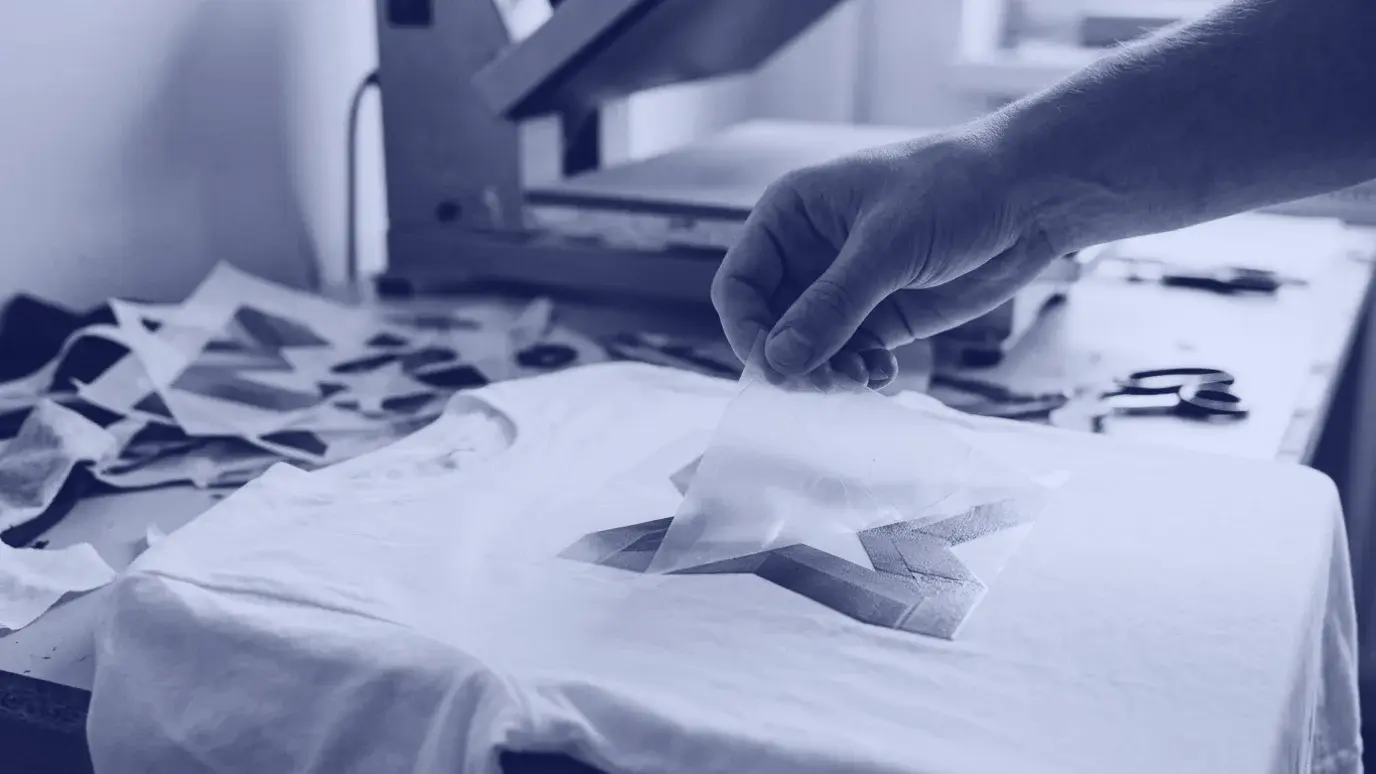
- Transfer: The film is placed design-side down on the product and pressed with a heat press.
- Peeling: The carrier film is peeled off and the design stays on the product.
Press temperature, time and pressure are taken from the film and powder manufacturer’s instructions; Epson also notes that the post-processing steps vary with the film and powder used. For this reason this entry gives no numerical values.
Features of DTF printing
| Topic | DTF |
|---|---|
| Fabric | Epson says the method can be used on almost any fabric and that the fabric needs no pretreatment; this is a manufacturer’s statement. For nylon, water-repellent or blended fabrics, confirm suitability from the film and powder data sheet and with a sample print |
| Feel | A layer forms on the surface; Epson states that it gives a more raised feel than DTG |
| Color and placement | With no screens, the number of colors does not add to set-up work; multicolor designs and complex placement can be printed |
| Quantity | Epson notes that several designs can be placed on one sheet of film and produced in a batch. It stands out for low-to-medium quantities and multi-design jobs; the threshold varies by company |
| Durability | Depends on the film, adhesive powder, press conditions and care; Epson says life varies with film and powder type and with care |
How DTF differs from similar methods
| Method | Difference from DTF |
|---|---|
| DTG | Prints directly on the product. According to Epson it needs pretreatment with white ink and on polyester; the feel is flatter |
| Flex and flock | Shapes are cut from a ready-made film roll, weeded (the surplus film is removed) and heat-pressed (Poli-Tape). Colors are limited to the film options; DTF creates the image by printing |
| Sublimation | The dye vaporizes and passes into the polyester fiber. In DTF a layer is attached to the surface of the product with adhesive |
| Screen printing | A separate screen is needed for each color; DTF has no screens |
Suppliers of DTF ink, film and powder are listed in the textile printing inks category, and shops that do DTF printing in the textile printing category.
Frequently asked questions
Does DTF printing come off in the wash?
No single wash count can be promised for DTF. Durability depends on the film, adhesive, press conditions and wash program. Color change and staining are measured to ISO 105-C06; film damage such as cracking or peeling is not expressed by those ratings, so write a separate acceptance criterion. For more, see the textile printing methods guide.
What is the difference between DTF and DTG?
DTG prints directly on the product; DTF prints on film and transfers it to the product with adhesive powder and a heat press. Fabric compatibility, pretreatment needs and feel differ: Epson states that DTG gives its best result on cotton, and recommends DTF for polyester.
Can DTF printing be done on cotton and polyester fabric?
Epson says the method can be used on almost any fabric; this is a manufacturer’s statement. For cotton, polyester, blended, elastane or nylon fabric, confirm suitability from the film and powder data sheet, and have a sample tested after stretching and washing.
Sources (6)
- Epson: DTG & DTF Printers for Small Businesses (DTFilm process and FAQ page; accessed October 9, 2026)
- Epson Europe: DTG and DTF Printing (DTG and DTF comparison; accessed October 9, 2026)
- Epson, SureColor F2270 User’s Guide: Overview of the Printing Process (DTF post-processing and pretreatment note; accessed October 9, 2026)
- Epson, DTF Film Printing Guide (CMP0437-00 EN)
- Poli-Tape: POLI-FLEX PREMIUM (flex film product page: cutting, weeding, heat press; accessed October 9, 2026)
- ISO 105-C06:2010, Textiles, Tests for colour fastness, Part C06: Colour fastness to domestic and commercial laundering
Author and fact-checking
Written by
Dyeing, Printing and Finishing Editor
Deniz Koç is Tekstil Rehberi's dyeing, printing and finishing editor. Deniz covers dyeing methods, digital, screen, transfer and sublimation printing, embroidery, garment washing and fabric finishes, and refers to the relevant test standards on topics such as color fastness and chemical compliance.
Content by Deniz KoçFact-checked by: Gizem Polat
This content was prepared by the Tekstil Rehberi editorial team. Before publication, our verification editor checked its figures, dates and sources against primary sources.
Spotted an error? Email us at [email protected] How we work →
Articles on this topic
Textile Printing Methods: Screen, Rotary, Digital, DTF and Sublimation
How screen, rotary, digital (DTG), DTF, heat transfer and sublimation printing compare, which fibres each suits, and how to brief a print supplier and set test criteria.