What is Overlock (Serger)?
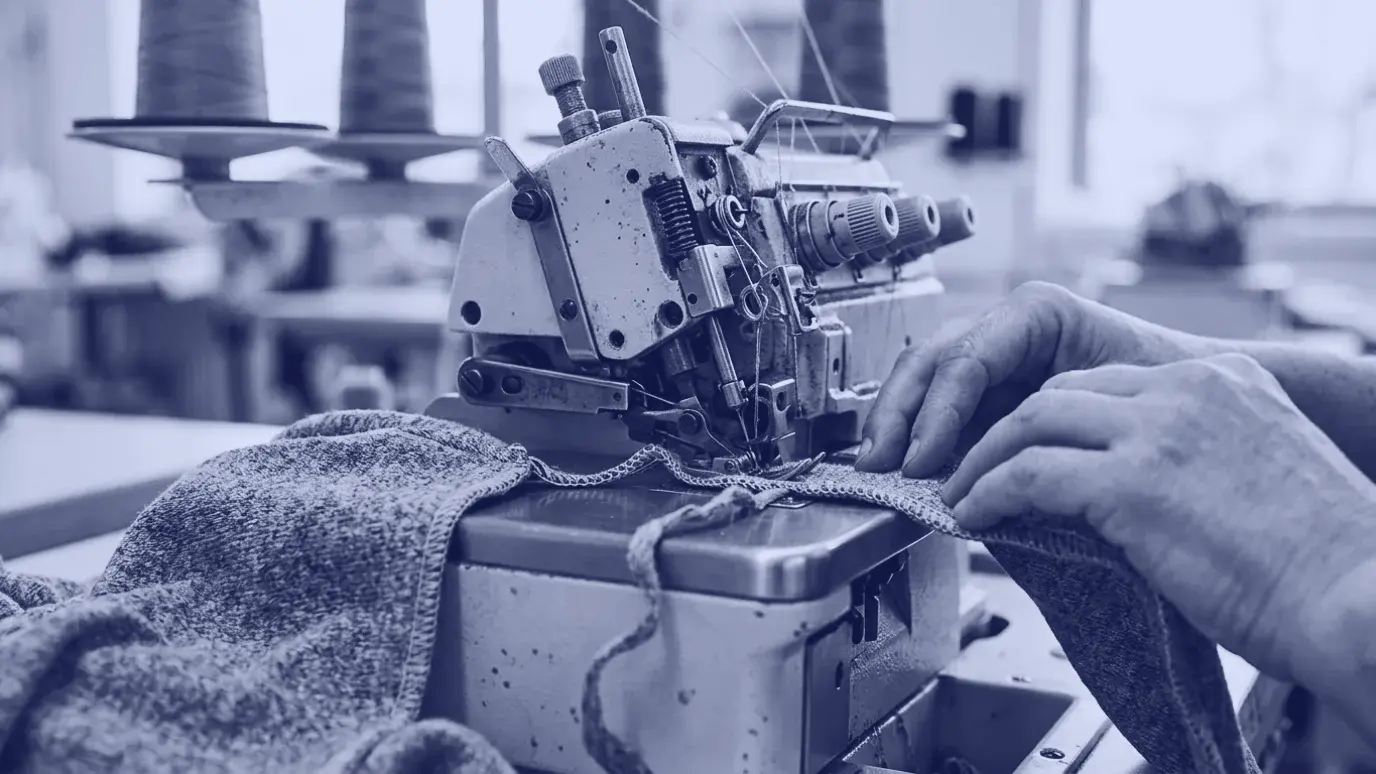
An overlock machine, called a serger in North America, is an industrial sewing machine that forms a looped stitch over the fabric edge with needle and looper threads and, on most models, trims the edge with a knife at the same time. The stitch it makes is also called overlock; it is used for edge finishing, seaming knits and safety stitching.
- Published:
- Updated:
- Fact-checked by:
- Gizem Polat
Key facts
- An overlock machine forms a looped stitch over the fabric edge with needle and looper threads; on most models a knife trims the edge at the same time.
- In ISO 4915, 500-series stitches are the overlock class; the 3-thread overlock (504) finishes edges and joins plies, and the 5-thread (516) adds a chain stitch.
- The overlock stitch is stretchy and keeps raw edges from fraying, so it is used on knit and stretch fabrics in apparel, sportswear and underwear.
- An overlock wraps the edge; a coverstitch (reçme) does not and can be sewn away from the edge; a lockstitch (301) locks the needle and bobbin threads in the middle of the fabric.
- The Turkish MEGEP module gives Nm 90 (14) needles for normal-weight fabric and Nm 75 (11) for lightweight fabric; overlock needles wear quickly at high speed.
An overlock machine, called a serger in North America (Emborado), is an industrial sewing machine that forms a looped stitch over the fabric edge with needle and looper threads. On most models a knife trims the edge at the same time. The stitch the machine makes is also called overlock. It is used for edge finishing, for seaming knit fabric pieces and for safety stitching.
The Turkish Language Association (TDK) dictionary defines overlok as a tight zigzag stitch made by machine on the edge of fabric, carpet, kilim and similar items, and links the word to English overlock. In the trade the same word names the machine too (overlok makinesi). This entry describes the industrial type.
How an overlock machine works
The fabric is fed by feed dogs behind the needle while a knife trims the edge; the needles and loopers form the stitch over the edge (MEGEP, Overlock, p. 7). MEGEP modules are vocational training texts published by Turkey’s Ministry of National Education. A looper is the element that carries a thread and loops it with another thread (Coats). An overlock has no bobbin; the threads are fed from cones (Wikipedia; MEGEP). Models without a knife also exist (Wikipedia). The stitch uses much more thread than a standard stitch, which is why thread makers offer long-length packages such as cones, large bobbins and compact tubes (MEGEP, p. 9). In the ISO 4915 classification, the 500-series stitches are the overlock class (AMANN; Coats).
Overlock by number of threads
| Threads | Structure | ISO 4915 | Use |
|---|---|---|---|
| 2 | Two-thread edge cover | 503 | Single-ply edge finishing, T-shirt hems; not suitable for seaming, and lies flat under lateral load |
| 3 | 1 needle, 2 loopers | 504 | Stops the edge from fraying and joins two or more plies; very good stretch. Edge finishing on wovens; the main seam in knitwear and circular knits |
| 4 | 2 needles, 2 loopers | 512, 514, 515 | Durable, stretchy seam; edge finishing and seaming on knits and wovens. With one needle removed it sews a 3-thread stitch |
| 5 | 2 needles, 3 loopers | 516 | Combination of the 401 chain stitch and 504. High thread consumption; used for shirts, pajamas and sweatpants |
Sources: Coats; MEGEP, Overlock.
A safety stitch is a stitch that sews a chain stitch (401) and an overlock stitch together in one pass (515: 401 and 503; 516: 401 and 504). In 516, the chain stitch carries the load and the overlock closes the edge (Coats).
Features and uses
- It covers the edge and stretches: The looper threads wrap the raw edge and prevent fraying; because the seam is stretchy, it suits knit and stretch fabrics (AMANN). MEGEP writes that the 3-thread stitch is preferred as the main seam in knitwear and circular knits for its thinness and stretch.
- Where it is used: In apparel, sportswear, underwear and knit production (AMANN). In MEB’s T-shirt instruction, the joining seams are sewn with 3- or 4-thread overlock, and the hem and sleeve opening are finished with 3-thread overlock (MEGEP, T-shirt Sewing, p. 5). For where overlock sits among the sewing operations, see the garment manufacturing process.
- Caution: When trimming rough edges, the knife should not cut too far into the fabric (MEGEP, p. 23).
Settings and selection notes
- Needle: MEGEP gives Nm 90 (14) for normal-weight fabric and Nm 75 (11) for lightweight fabric. Because an overlock runs at high speed (up to 6,000–8,500 stitches/min in Juki’s 2026 catalog), needles wear quickly; a blunt, bent or rough needle causes stitching problems (MEGEP, p. 7).
- Thread: Overlock threads are generally finer and more elastic than general-purpose threads; multi-ply textured threads without excess twist are used (MEGEP, p. 9).
- Differential feed: The independent adjustment of the front and rear feed dogs. Set correctly, knits do not stretch into waves and thin fabric does not pucker; gathering can also be produced on purpose (Emborado; MEGEP). A catalog example: on the Juki MO-6900S series, gathering is 1:2 and stretching 1:0.7; this value belongs to that model, not to overlocks in general.
For machines, needles and loopers, see industrial sewing machine suppliers and textile machinery spare parts suppliers, and for maintenance and adjustment, textile machinery repair companies.
How overlock differs from similar terms
- Lockstitch (301): The needle thread is locked with the bobbin thread in the middle of the fabric; it does not wrap the edge (Coats; MEGEP, Lockstitch on the Machine).
- Chain stitch (401): There is no bobbin; the needle thread is looped with a lower thread carried by a looper (MEGEP, Lockstitch on the Machine). In the 5-thread overlock, the 401 chain is sewn together with 504 (516).
- Coverstitch (Turkish: reçme): It does not wrap the edge and can also be sewn in the middle areas of the fabric; parallel straight rows show on the face and a covering stitch on the underside. Because the underside of a hem coverstitch looks like an overlock, no overlock is run on that area separately (MEGEP, Coverstitch, pp. 5–6).
- Interlock: First of all the name of a knit fabric. On the manufacturer’s page, Pegasus machines in the “Coverstitch (Plain seaming)” group are called “interlock stitch machines,” and the W3500P series was introduced in the trade press as a “flatbed interlock sewing machine” (Apparel Resources, 2014). If “interlock” appears in a quote or a listing, ask whether the fabric or the machine is meant, and if it is the machine, ask for the stitch number.
- Edge finishing on woven fabric: MEGEP also calls this sürfile yapmak in Turkish, a term you may meet on Turkish workshop documents.
Safety
The MEGEP overlock module says the machine has a finger guard, an eye guard, a needle plate cover and a looper cover, and that a belt guard must be fitted over the handwheel; before maintenance, adjustment, cleaning, threading and needle changes, the power is cut and the motor must stop completely (MEGEP, pp. 6 and 20). Turkey’s Regulation on Health and Safety Conditions in the Use of Work Equipment (Official Gazette, April 25, 2013, no. 28628; last amended December 23, 2025, no. 33116; title translated by Tekstil Rehberi) asks in Annex-I, 2.8 for suitable guards or protective devices against the risk of contact with moving parts. Under Annex-I, 2.13, maintenance is done with the equipment switched off, its energy connection cut and all movement stopped. Article 11 requires workers who will use the equipment to be trained on the risks and the ways of protection before they start. This information is valid as of the date of this entry (October 2026); confirm the current text and the practice in the workshop with an occupational safety professional.
Frequently asked questions
How many threads should an overlock have?
It depends on the operation. A 3-thread machine is chosen for edge finishing and stretchy seaming, and a 4- or 5-thread machine where a safety stitch is needed together with edge finishing; the 5-thread stitch uses more thread (MEGEP). Decide with a trial seam on your own product.
Is an overlock the same as a serger?
Yes, they are the same type of machine. Serger is the North American name (Emborado), which also lists “overlock machine” and “overedge machine” as other names.
Is an overlock the same as a coverstitch?
No. An overlock sews over the edge and, on most models, cuts it. A coverstitch (reçme) does not wrap the edge; it is used for hems, sleeve openings, bands and elastic attachment (MEGEP, Coverstitch).
Why does fabric pucker on an overlock?
In its section on stitching faults, MEGEP explains puckering by too-tight thread tension. If the upper or lower looper thread is too tight, it pulls the other looper thread to its own side and the fabric puckers and curls under the seam; if the needle threads are too tight, the fabric puckers lengthwise. The remedy is to loosen the tension knob of the tight thread: for looper threads until the threads lock at the edge, for needle threads until the fabric lies flat (MEGEP, pp. 25–26). The differential feed setting also affects puckering (Emborado).
Sources (14)
- TDK Güncel Türkçe Sözlük (Turkish Language Association dictionary), entry “overlok” (accessed October 11, 2026)
- T.C. Millî Eğitim Bakanlığı (Turkish Ministry of National Education), MEGEP, Giyim Üretim Teknolojisi: Overlok (Garment Production Technology: Overlock; 542TGD002; in Turkish), Ankara 2011
- T.C. Millî Eğitim Bakanlığı (Turkish Ministry of National Education), MEGEP, Giyim Üretim Teknolojisi: Reçme (Garment Production Technology: Coverstitch; 542TGD051; in Turkish), Ankara 2010 (pp. 5–6)
- T.C. Millî Eğitim Bakanlığı (Turkish Ministry of National Education), MEGEP, Giyim Üretim Teknolojisi: Makinede Düz Dikiş (Garment Production Technology: Lockstitch on the Machine; 542TGD001; in Turkish), Ankara 2007 (pp. 4–5; Ankara University OpenCourseWare copy)
- T.C. Millî Eğitim Bakanlığı (Turkish Ministry of National Education), MEGEP, Giyim Üretim Teknolojisi: Tişört Dikimi (Garment Production Technology: T-Shirt Sewing; 542TGD008; in Turkish), p. 5
- Coats Group, Basic Stitch Types (technical bulletin; accessed October 11, 2026)
- AMANN Knowledge Hub, Stitch types and sewing thread requirement, and 500 Series: Overlock Stitch Types (ISO 4915 classes; accessed October 11, 2026)
- ISO 4915:1991 Textiles - Stitch types - Classification and terminology
- Emborado, Overlocker (Serger) glossary entry (accessed October 11, 2026)
- Juki, Apparel Sewing Machines 2026 General Catalogue (2026 Version 1; Overlock / Safety Stitch Machines, pp. 25–30)
- Wikipedia, Overlock (secondary source; accessed October 11, 2026)
- Pegasus, Coverstitch (Plain seaming) product group (accessed October 11, 2026)
- Apparel Resources, Pegasus launches the new W3500P flatbed interlock sewing machine (August 1, 2014)
- İş Ekipmanlarının Kullanımında Sağlık ve Güvenlik Şartları Yönetmeliği (Regulation on Health and Safety Conditions in the Use of Work Equipment; title translated by Tekstil Rehberi; in Turkish), Official Gazette, April 25, 2013, no. 28628; last amended December 23, 2025, no. 33116 (current text: Article 11; Annex-I, 2.8 and 2.13; accessed October 11, 2026)
Author and fact-checking
Written by
Machinery and Technology Editor
Burak Çelik is Tekstil Rehberi's machinery and technology editor. He covers sewing, knitting, weaving, cutting and printing machines, buying used machinery, CAD/ERP software and automation in production, and checks technical specifications against manufacturer documentation.
Content by Burak ÇelikFact-checked by: Gizem Polat
This content was prepared by the Tekstil Rehberi editorial team. Before publication, our verification editor checked its figures, dates and sources against primary sources.
Spotted an error? Email us at [email protected] How we work →
Articles on this topic
Types of Industrial Sewing Machines for Garments: Lockstitch, Overlock, Coverstitch and Chainstitch
What lockstitch, chainstitch, overlock, coverstitch, buttonhole, button-sewing and bartack machines do, which product and operation each is used for, and what to check when choosing a machine.