Fabric Testing Standards: Color Fastness, Martindale, Pilling, Shrinkage and Strength Tests
The standards behind color fastness, Martindale abrasion, pilling, shrinkage and strength tests, how to read a fabric test report, and how to write a test line into a supplier spec.
- Published:
- Fact-checked by:
- Gizem Polat
Key facts
- A fabric test measures one property by a standard method; color fastness, abrasion, pilling, dimensional change and strength each have their own ISO standard.
- In ISO 12945-4, pilling is graded 1–5, where 5 means no change; light fastness is graded against blue wool references (for example a set numbered 1–8).
- The Martindale load is 12 kPa for workwear, upholstery, bed linen and technical fabrics and 9 kPa for apparel and home textiles (ISO 12947-2:2016).
- Test standards define the method but set no pass limit; for Martindale, pilling or shrinkage there is no universal threshold, so the buyer's spec or the product standard sets it.
- A reliable report states the standard number and year, the conditions and each specimen's result; also ask whether the test falls within the lab's accreditation scope.
- ISO 5077 reports dimensional change separately for length and width, rounded to the nearest 0.5%, with shrinkage written with a minus sign.
Fabric testing standards define how a property such as color fastness, abrasion, pilling, shrinkage or strength is measured. They do not set a pass limit: the buyer's spec, or a product standard where one exists, does. A complete spec line names the test, the standard and its year, the conditions and the acceptance limit.
This guide explains the ISO and EN methods behind color fastness, Martindale abrasion, pilling, dimensional change and strength tests, how to read a test report, and how to write the test lines into a spec for a Turkish mill or supplier. ASTM and AATCC methods are outside its scope.
Who asks for fabric tests, and what is covered here?
A fabric test comes up in three places: in the buyer's spec, in an independent laboratory's report and in the producer's own internal control. This guide covers physical and color tests. Chemical safety tests and OEKO-TEX-type certificates are in the textile certificates guide, and sampling of a garment lot is in the AQL quality control guide.
The method has to be a standard one, because the result depends on the conditions. ISO 12947-2 says that only results obtained in the same test atmosphere can be compared, and ISO 13934-1 asks that the result of one method not be compared with the result of another.
Fabric testing standards at a glance: which test measures what
The standard years below are the editions listed in EVS records in October 2026. "EVS" marks the record page of Estonia's standards body; "ISO text" marks the published preview text of the standard.
| Test | Standard and basis | What it measures | Specimen and conditions | Result | Keep in mind |
|---|---|---|---|---|---|
| Washing fastness | EN ISO 105-C06:2010 (EVS) | Color change in washing and dye transferred to the adjacent fabric | Washed with an adjacent fabric (usually multifiber); conditions are coded | Two gray-scale grades | The condition code must be in the report |
| Rubbing fastness | EN ISO 105-X12:2016 (EVS, ISO text) | Transfer of color to another surface | Dry and wet cotton cloth; 9 N; 20 rubs | Staining grade on the cloth | State the water pick-up of the wet cloth |
| Perspiration fastness | EN ISO 105-E04:2013 (EVS, ISO text) | Resistance of color to human perspiration | Acid and alkaline solution; 37 °C, 4 hours | Two grades per solution | The solutions are reported separately |
| Light fastness | EN ISO 105-B02:2014 (EVS, Q-Lab) | Fading under xenon light | Exposed with blue wool references | Blue wool grade or gray-scale grade | State the method number |
| Martindale abrasion | EN ISO 12947-2:2016 (EVS, ISO text) | Number of rubs at which the specimen breaks down | Lissajous motion; 12 or 9 kPa | Number of rubs | Coated fabrics are out of scope |
| Pilling | EN ISO 12945-2:2020; assessment EN ISO 12945-4:2020 (EVS, ISO text) | Pills, fuzzing, matting | Modified Martindale; 155 g carrier, 415 g with extra weight | Grades 1–5, half grades allowed | The pilling box method is separate |
| Dimensional change | EN ISO 6330:2021; EN ISO 5077:2008 (EVS, ISO text) | Change in length and width after washing | Procedure chosen from ISO 6330 | Length and width as separate %; shrinkage is minus | State the procedure |
| Tensile (breaking) | EN ISO 13934-1:2013 (EVS, ISO text) | Maximum force and elongation | 50 mm strip, 200 mm gauge length | N and % | Mainly for woven fabric |
| Tear | EN ISO 13937-2:2000 (EVS, ISO text) | Force that propagates an existing tear | 200 × 50 mm strip, 100 mm slit | N | Generally not suitable for knits |
| Bursting | EN ISO 13938-2:2019 (EVS, ISO text) | Bursting strength under air pressure | Specimen clamped over a diaphragm | kPa and distension | The hydraulic method is ISO 13938-1 |
Last checked: October 2026.
How is color fastness tested?
Color fastness is the degree to which a dyed or printed fabric keeps its color when it meets an effect such as washing, rubbing, perspiration or light. Every test grades two things: the color change in the specimen (ISO 105-A02 gray scale) and the dye that stains the adjacent fabric or the rubbing cloth (ISO 105-A03 staining scale). On the change scale, 5 is given only when no difference from the original fabric can be seen and 1 is the largest difference; half grades such as 4-5 are used (ISO 105-A02:1993).
Washing fastness test (ISO 105-C06)
This test measures how well color survives domestic or commercial laundering, using a reference detergent. The standard defines S tests, which give a result close to a single wash, and M tests, which have a higher mechanical action; in some cases the result of an M test approaches that of up to five washes at no more than 70 °C. The specimen is joined to an adjacent fabric (usually a multifiber strip) and washed. Temperature and conditions are given by a code, and the code must appear in the report.
Rubbing fastness test (ISO 105-X12)
Two separate tests are run, dry and wet. A rubbing finger travels 20 times in total (10 forward, 10 back) over a 104 mm track on the specimen with a force of 9 N, and the staining on the cotton cloth is graded on the A03 scale. The standard describes the water pick-up of the wet cloth as 95–100%, says other pick-ups may be used, and notes that the pick-up can change the result a great deal. The pick-up used must be written in the report.
Perspiration fastness test (ISO 105-E04)
The specimen and an adjacent fabric are wetted with two solutions that contain histidine: an alkaline one (pH 8) and an acid one (pH 5.5). Each is held between two plates under 12.5 kPa at 37 °C for 4 hours. Color change and staining are graded with the gray scales, and each solution gets its own grade.
Light fastness test (ISO 105-B02)
The specimen is exposed in a xenon-lamp device that imitates daylight, together with blue wool references. The standard allows two different reference sets, and the results from the two sets may not be the same. Q-Lab's summary describes sets numbered 1 to 8 and says the standard contains five methods: some give a grade against the references, and one compares the specimen with an agreed reference specimen. In a report, look for the method number and the reference set.
How is the Martindale abrasion test done?
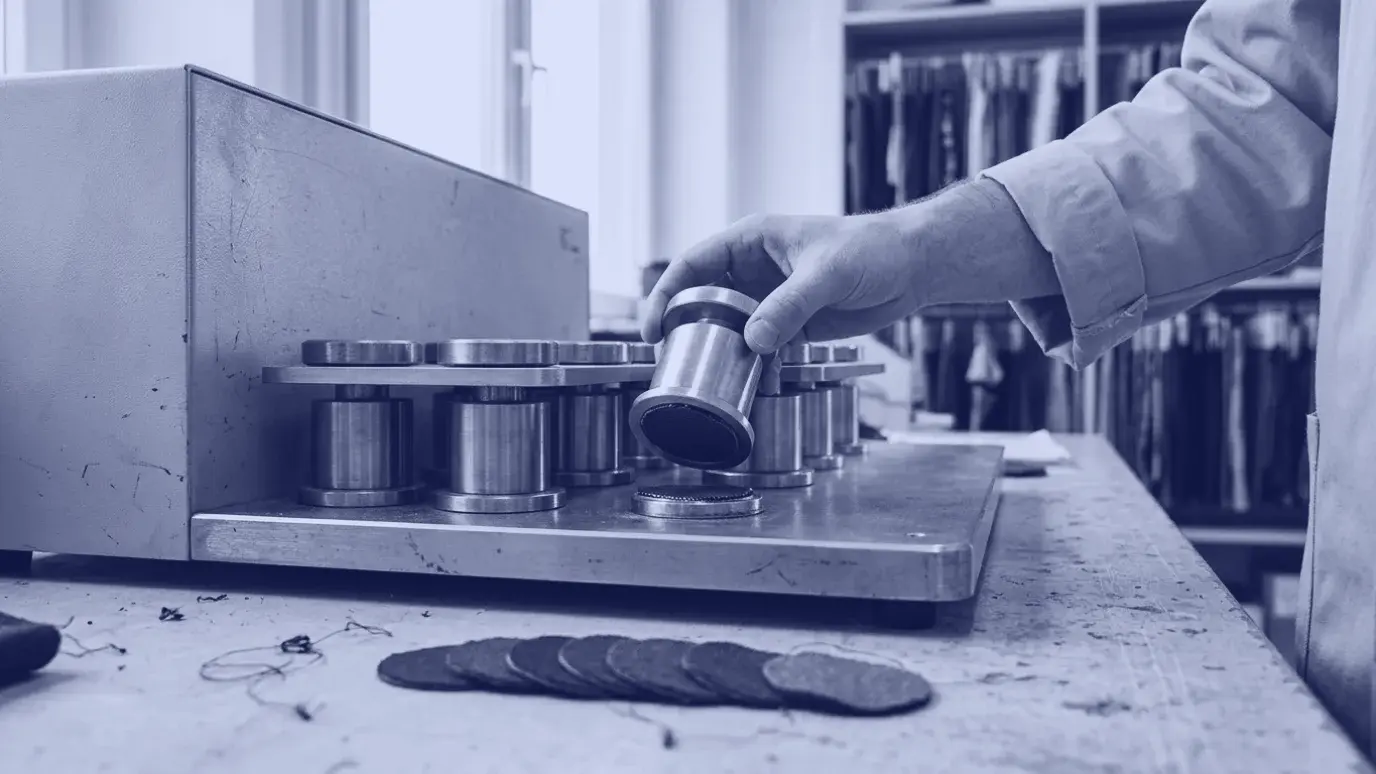
The Martindale test (ISO 12947-2) measures how well a fabric resists wear by rubbing. A round specimen is rubbed against a standard abradant fabric under load in a Lissajous-figure motion and is checked at intervals. It counts as broken down when a yarn breaks or the worn-area criterion is met. The result is the last number of rubs (cycles) at which no breakdown had been seen.
The load depends on end use: 12 kPa (795 ± 7 g) for workwear, upholstery, bed linen and technical fabrics, and 9 kPa (595 ± 7 g) for apparel and home textiles other than upholstery and bed linen. A spec for upholstery fabric or workwear (see workwear standards) must state the load as well. The standard gives no acceptance limit for the number of rubs, and there is no single universal threshold. Coated and laminated fabrics are out of scope (ISO 5470).
Company directory
Looking for manufacturers in this field?
Browse companies in the related categories or get quotes from several companies with one form.
Do you manufacture or offer services in this field?
How is the pilling test done?
Pilling is the entangling of surface fibers into small balls. ISO 12945-4 separates it from fuzzing and matting, and the three are graded separately. In the modified Martindale method (ISO 12945-2), a round specimen is rubbed against the fabric itself or, where needed, against a wool abradant, with a 155 g carrier (415 g in total with the optional extra weight), and is assessed by eye at defined stages.
Grades follow ISO 12945-4: 5 is no change, 4 is partial pill formation, 3 moderate, 2 distinct and 1 severe pilling; intermediate values such as 3-4 are written. The assessment is done in a dark room under D65 light of at least 600 lux, from a distance of 30–50 cm. The standard gives no acceptance grade, so the contract must say which grade at which stage is acceptable.
According to the introduction to ISO 12945-2, three processes decide the outcome: fibers entangling into pills, more fibers working their way to the surface, and fibers and pills wearing off through abrasion. With durable fibers, pill formation is faster than wear-off, so pills build up. Hossain and colleagues (2021) treat pilling as a surface defect in a polyester-cotton three-thread fleece. In their pilling box test (ISO 12945-1:2000), applying singeing and heat setting together raised the grade from 1 to 4.
How is the fabric shrinkage test done?
A dimensional change (shrinkage) test measures how much length and width change after washing and drying. The specimen is marked and measured (ISO 3759), processed with an ISO 6330 washing and drying procedure that the parties choose, and measured again under ISO 5077. Where possible, ISO 5077 calls for three specimens.
Dimensional change (%) = (later measurement − original measurement) ÷ original measurement × 100. It is calculated separately for length and width and rounded to the nearest 0.5%; shrinkage is written with a minus sign and extension with a plus sign. A different machine, detergent or dryer can change the result (ISO 6330). For the cutting allowance, use the shrinkage allowance calculator.
How is fabric strength tested? Tensile, tear and bursting
Three tests load the fabric in different ways: pulling, tearing and inflating. Their results cannot stand in for one another. For help matching a woven or knitted structure to a method, see the fabric types and properties guide.
Tensile (breaking) strength test (ISO 13934-1)
In the strip method, a specimen 50 mm wide is pulled at a constant rate until it breaks, over a 200 mm gauge length (100 mm if more than 75% elongation is expected). The maximum force and the elongation at that force are recorded. Separate sets are cut for warp and weft, with at least five specimens in each. The method is mainly for woven fabric; it is not normally applied to nonwovens and coated fabrics.
Tear strength test (ISO 13937-2)
In the trouser method, a 100 mm slit is cut in the middle of a 200 × 50 mm strip, the two legs are clamped in the jaws and the tear is propagated at 100 mm/min. The result is the force needed to keep the tear going, in N, and it is named for the yarn set that is torn (warp or weft). The method is mainly for woven fabric; it is generally not suitable for knitted fabric and stretch woven fabric.
Bursting strength test (ISO 13938-2)
The specimen is clamped over a flexible diaphragm with a ring, and air pressure from below is raised until the specimen bursts; the time to burst is 20 ± 5 seconds. Bursting strength is the bursting pressure minus the diaphragm pressure. The method suits knitted, woven, nonwoven and laminated fabrics; for high-pressure technical textiles, the hydraulic method (ISO 13938-1) is more suitable.
How do sampling and conditioning affect test results?
ISO 139 defines the standard atmosphere as 20 °C and 65% relative humidity (±2 °C, ±4%). If the parties agree, an alternative atmosphere of 23 °C and 50% can be used, and ISO 12947-2 and ISO 105-X12 then require the atmosphere to be stated in the report. Specimens rest in this atmosphere first: at least 18 hours under ISO 12947-2 and at least 4 hours under ISO 105-X12.
The specimen must represent the fabric. ISO 12947-2 asks for a piece cut from the full fabric width where possible, containing at least two complete pattern repeats; ISO 13934-1 and ISO 13937-2 ask for cutting at least 150 mm in from the edge of the fabric. How GSM changes with the state of measurement is covered in the T-shirt, hoodie and jogger GSM guide; for your own fabric, use the fabric weight (GSM) calculator.
How do you read a fabric test report?
When a mill or laboratory sends you a report, check these fields. The table gives the basis for each.
| Report field | What to check | Basis |
|---|---|---|
| Laboratory and accreditation | The test was done within the laboratory's accreditation scope | ISO/IEC 17025:2017 (EVS); TÜBİTAK BUTAL 2026 list |
| Specimen identification | Lot, roll, direction, face; that the specimen represents the fabric | ISO 12947-2 cl. 7; ISO 13934-1 cl. 5 |
| Standard number and year | Example: EN ISO 5077:2008 | ISO 5077 cl. 9; ISO 105-E04 cl. 7 |
| Conditions and program | Washing procedure, load, method, atmosphere, wet-cloth pick-up | ISO 5077 cl. 9; ISO 105-X12 cl. 8; ISO 12947-2 cl. 6 |
| Result unit and scale | Grade, N, kPa, %, number of rubs; per specimen and as a mean | ISO 12945-4 cl. 9; ISO 105-X12 cl. 8 |
| Deviations and unusual observations | A note on deviations from the standard; ask the laboratory about measurement uncertainty | ISO 12945-4 cl. 9 |
| Date and signature | Test date, approving person | ISO 12945-4 cl. 9 (date); the signature is our addition, not in the standard |
Last checked: October 2026.
How do you write fabric tests into a spec?
Every spec line says four things: the test, the standard and year, the conditions and the acceptance limit. A test standard defines the method, not the limit; the limit is set by the buyer or, where one exists, by the relevant product standard. Put these lines into the spec you send to the mill, and send the same lines to every supplier you compare. The table below has a blank template and two hypothetical examples; the letters A and N stand for values the buyer sets and are not recommendations.
| Test | Standard and year | Conditions | Acceptance limit (set by the buyer) |
|---|---|---|---|
| … | … | … | … |
| Rubbing fastness (example) | EN ISO 105-X12:2016 | Dry and wet; wet-cloth pick-up stated; warp and weft direction | Staining of at least grade A |
| Martindale (example) | EN ISO 12947-2:2016 | 12 kPa; upholstery; breakdown criterion stated | No breakdown before N rubs |
TÜBİTAK BUTAL's 2026 laboratory list cites these methods by "TS EN ISO" number, without the year. Before you write a number into a spec, confirm the year and number in the catalog of TSE, the Turkish Standards Institution.
Which test for which problem?
The table is our own assessment, not a standard, and it contains no limit values.
| Problem or risk | Test to consider | Why |
|---|---|---|
| Dark or multicolor fabric (for example denim) touching white or light colors | Rubbing (dry, wet) and washing fastness | Measures color transfer by two routes |
| Garment in contact with perspiration | Perspiration fastness | Gives separate results in acid and alkaline solution |
| Product exposed to sun (curtains, awnings) | Light fastness | Grades fading against references |
| Heavy use (upholstery, workwear) | Martindale (12 kPa) | Breakdown is measured in number of rubs |
| Knitted or polyester-blend surfaces and fleece | Pilling | Pills can build up on durable fibers |
| Garment size and pattern fit after washing | Dimensional change | Length and width change are given separately |
| Carrying or tension (bags, belts, workwear) | Tensile, tear (woven); bursting (knitted) | The method that matches the type of load |
How do you choose a testing lab and send samples?
The first question is whether the test falls within the laboratory's accreditation scope. ISO/IEC 17025:2017 sets out the requirements for a laboratory to work competently, impartially and consistently. In Turkey, TÜRKAK, the Turkish Accreditation Agency, accredits testing laboratories and publishes current information on accreditation, suspension and changes of scope on its website (Regulation on the Accreditation of Conformity Assessment Bodies, art. 5; Official Gazette, November 3, 2017). You can also ask the laboratory for the scope annex of its accreditation certificate.
Scope is defined by method and range. In TÜBİTAK BUTAL's 2026 list, tests within the accreditation scope are marked (A): the strip tensile test on woven fabric is marked up to 7,500 N, and the 7,500–50,000 N range is not. In the same list, the customer sets the conditions of the washing fastness test.
To find a laboratory, see our directory of textile testing laboratories in Turkey and garment quality control and inspection services. When you send samples:
- Write each test with its standard number and year.
- Write the conditions for each test: washing procedure, load, method number.
- Take the specimen so that it represents the fabric, and mark the face and the warp direction.
- Ask whether the test is within the accreditation scope and in which language the report will be issued.
- Read the report against the fields in the table above.
Common mistakes in fabric test requests
- Writing the standard number without its year.
- Writing only "fastness 4"; it is not clear whether it means washing or rubbing, dry or wet.
- Leaving the load (12 or 9 kPa) out of a Martindale line.
- Combining the length change and the width change in one number.
- Not saying which grade at which stage is acceptable in a pilling test.
- Asking for the strip tensile method on knitted fabric; the standard mainly covers woven fabric.
- Reading only the word "pass" in the report.
Summary checklist
- Is the standard number and year written for every test?
- Are the conditions (washing procedure, load, method number, wet-cloth pick-up) written?
- Is the acceptance limit set for each test, by the buyer?
- Is the test within the laboratory's accreditation scope?
Frequently asked questions
What are the main fabric tests buyers ask for?
Fabric tests measure one property by a standard method and report the result as a number, a percentage or a grade. The main groups are color fastness (washing ISO 105-C06, rubbing ISO 105-X12, perspiration ISO 105-E04, light ISO 105-B02), abrasion (Martindale, ISO 12947-2), pilling (ISO 12945-2 and ISO 12945-4), dimensional change (ISO 6330 and ISO 5077) and strength (tensile ISO 13934-1, tear ISO 13937-2, bursting ISO 13938-2). The standards define the method; the acceptance limit comes from the buyer's spec or, where one exists, the product standard.
How is a color fastness test done?
The specimen is exposed to an effect (washing, rubbing, perspiration or light) under standard conditions, and two things are graded on gray scales: the color change in the specimen and the dye that stains the adjacent fabric or rubbing cloth. Washing uses ISO 105-C06, rubbing ISO 105-X12 (dry and wet) and perspiration ISO 105-E04 (acid and alkaline solution). On the change scale 5 means no visible difference from the original fabric. Light fastness (ISO 105-B02) is graded against blue wool references, for example a set numbered 1–8. Read the condition code and the method number in the report.
What should a Martindale spec say?
A Martindale line gives the method and year (ISO 12947-2:2016), the load and the minimum number of rubs. The load follows end use: 12 kPa for workwear, upholstery, bed linen and technical fabrics, 9 kPa for apparel and home textiles. The standard defines the method but sets no acceptance limit; the result is the last number of rubs (cycles) at which no breakdown had been seen, and the buyer, or the product standard where one applies, sets the minimum in the contract. There is no single universal Martindale value.
How is a pilling test done?
The ISO 12945 series has three pilling methods: pilling box (ISO 12945-1), modified Martindale (ISO 12945-2) and random tumble (ISO 12945-3). In the modified Martindale method a round specimen is rubbed against the fabric itself or a wool abradant, and the specimen is assessed by eye at defined stages (ISO 12945-4). Grades run from 5 (no change) to 1 (severe pilling), with half grades such as 3-4. The standard gives no acceptance grade, so write into the contract which grade at which stage is acceptable.
How is a fabric shrinkage test done?
A shrinkage test measures the change in length and width after washing and drying. The specimen is marked and measured (ISO 3759), washed and dried with one of the ISO 6330 procedures the parties choose, and measured again under ISO 5077. Dimensional change (%) = (later measurement − original measurement) ÷ original measurement × 100, calculated separately for length and width and rounded to the nearest 0.5%; shrinkage is written with a minus sign.
What should a fabric test report include?
Check first the standard number and year, then conditions such as the washing procedure, the load and the method number. The unit and scale of the result (grade, N, kPa, %, number of rubs) should be given per specimen and as a mean, and there should be notes on deviations from the standard and unusual observations. Also check the test date and whether the laboratory ran the test within its accreditation scope.
Sources (36)
- EN ISO 105-C06:2010 Textiles — Tests for colour fastness — Part C06: Colour fastness to domestic and commercial laundering (EVS record and scope; accessed October 22, 2026)
- Textile Learner, Colour Fastness to Washing Procedure (ISO 105 C06); secondary source, used only for the adjacent fabric and the condition code (accessed October 22, 2026)
- EN ISO 105-X12:2016 Textiles — Tests for colour fastness — Part X12: Colour fastness to rubbing (EVS record; accessed October 22, 2026)
- ISO 105-X12:2016 standard preview text (iTeh Standards; accessed October 22, 2026)
- EN ISO 105-E04:2013 Textiles — Tests for colour fastness — Part E04: Colour fastness to perspiration (EVS record; accessed October 22, 2026)
- ISO 105-E04:2013 standard preview text (iTeh Standards; accessed October 22, 2026)
- EN ISO 105-B02:2014 Textiles — Tests for colour fastness — Part B02: Colour fastness to artificial light: Xenon arc fading lamp test (EVS record; accessed October 22, 2026)
- Q-Lab, ISO 105-B02 (xenon-arc light fastness: blue wool references, five methods; the page describes the 2013 edition; accessed October 22, 2026)
- ISO 105-B02:2014 project record and scope (two blue wool reference sets; stage 90.93, confirmed October 16, 2025; DPS, the Albanian standards body, mirror of ISO project data; accessed October 22, 2026)
- EVS-EN 20105-A02:2000 Textiles — Tests for colour fastness — Part A02: Grey scale for assessing change in colour (ISO 105-A02:1993; EVS record; accessed October 22, 2026)
- ISO 105-A02:1993 standard preview text (iTeh Standards; accessed October 22, 2026)
- EVS-EN ISO 105-A03:2019 Textiles — Tests for colour fastness — Part A03: Grey scale for assessing staining (EVS record; accessed October 22, 2026)
- EN ISO 12947-2:2016 Textiles — Determination of the abrasion resistance of fabrics by the Martindale method — Part 2: Determination of specimen breakdown (EVS record; accessed October 22, 2026)
- ISO 12947-2:2016 standard preview text (iTeh Standards; cl. 1–7.5.2; accessed October 22, 2026)
- EN ISO 12945-1:2020 Textiles — Determination of fabric propensity to surface pilling, fuzzing or matting — Part 1: Pilling box method (EVS record; accessed October 22, 2026)
- EN ISO 12945-2:2020 Textiles — Determination of fabric propensity to surface pilling, fuzzing or matting — Part 2: Modified Martindale method (EVS record; accessed October 22, 2026)
- ISO 12945-2:2020 standard preview text (French-language preview; iTeh Standards; accessed October 22, 2026)
- EN ISO 12945-4:2020 Textiles — Determination of fabric propensity to surface pilling, fuzzing or matting — Part 4: Assessment of pilling, fuzzing or matting by visual analysis (EVS record; accessed October 22, 2026)
- ISO 12945-4:2020 standard preview text (iTeh Standards; accessed October 22, 2026)
- Hossain, M. S., Islam, M. M., Dey, S. C. and Hasan, N. (2021). An approach to improve the pilling resistance properties of three thread polyester cotton blended fleece fabric. Heliyon, 7(4), e06921 (full text on PMC; pilling box method per ISO 12945-1:2000; accessed October 22, 2026)
- EN ISO 6330:2021 Textiles — Domestic washing and drying procedures for textile testing (EVS record and scope; accessed October 22, 2026)
- EN ISO 5077:2008 Textiles — Determination of dimensional change in washing and drying (ISO 5077:2007; EVS record; accessed October 22, 2026)
- ISO 5077:2007 standard preview text (iTeh Standards; accessed October 22, 2026)
- EN ISO 13934-1:2013 Textiles — Tensile properties of fabrics — Part 1: Determination of maximum force and elongation at maximum force using the strip method (EVS record; accessed October 22, 2026)
- ISO 13934-1:2013 standard preview text (iTeh Standards; accessed October 22, 2026)
- EN ISO 13937-2:2000 Textiles — Tear properties of fabrics — Part 2: Determination of tear force of trouser-shaped test specimens (Single tear method) (EVS record; accessed October 22, 2026)
- ISO 13937-2:2000 standard preview text (iTeh Standards; cl. 1–9.4; accessed October 22, 2026)
- ISO 13937-2:2000 project record (stage 90.93, confirmed September 22, 2023; DPS, mirror of ISO project data; accessed October 22, 2026)
- EN ISO 13938-2:2019 Textiles — Bursting properties of fabrics — Part 2: Pneumatic method for determination of bursting strength and bursting distension (EVS record; accessed October 22, 2026)
- ISO 13938-2:2019 standard preview text (iTeh Standards; cl. 3–6.1; accessed October 22, 2026)
- EN ISO 139:2005 Textiles — Standard atmospheres for conditioning and testing (EVS record, including Amendment A1:2011; accessed October 22, 2026)
- ISO 139:2005 standard preview text (iTeh Standards; cl. 1–3.3; accessed October 22, 2026)
- EN ISO/IEC 17025:2017 General requirements for the competence of testing and calibration laboratories (EVS record; accessed October 22, 2026)
- TÜBİTAK BUTAL, Malzeme-Tekstil Laboratuvarı Test ve Analizleri 2026 (Materials-Textile Laboratory Tests and Analyses 2026; Turkish PDF, English title translated by us; pp. 14–19: standard numbers and accreditation-scope marker; accessed October 22, 2026)
- Uygunluk Değerlendirme Kuruluşlarının Akreditasyonu Hakkında Yönetmelik, art. 5 (Regulation on the Accreditation of Conformity Assessment Bodies; Official Gazette of Turkey, November 3, 2017, No. 30229; Turkish, English title translated by us; accessed October 22, 2026)
- TÜRKAK, Turkish Accreditation Agency (accessed October 22, 2026)
Author and fact-checking
Written by
Fabrics and Fibers Editor
Elif Karaca is Tekstil Rehberi's fabrics and fibers editor. She writes guides and glossary entries on knitted, woven and nonwoven fabrics, fiber properties and choosing the right fabric for each product, and bases values such as GSM, width, shrinkage and color fastness on standards and mill technical data sheets.
Content by Elif KaracaFact-checked by: Gizem Polat
This content was prepared by the Tekstil Rehberi editorial team. Before publication, our verification editor checked its figures, dates and sources against primary sources.
Spotted an error? Email us at [email protected] How we work →
Related articles
Knit vs Woven Fabric: How to Tell Them Apart
How knit and woven fabrics differ, five checks to tell them apart, the cases that mislead, how to choose by product, and what changes in production, testing and customs classification.
Fabric Types and Properties: A Buyer’s Guide to Knit, Woven and Nonwoven Fabrics
How fabrics are classified by construction, fibre, yarn and finish; the main knit, woven and nonwoven types and their properties; the test methods behind them; and a checklist for ordering fabric.
Breathable Fabrics for Summer: Linen, Cotton, Viscose and Modal
No fabric stops sweating, but some manage sweat better. What test data show for linen, cotton, viscose and modal, how construction and weight change the result, and which tests to ask a fabric supplier for.