What is Color Fastness?
Color fastness (colorfastness) is how well the color of a dyed or printed textile resists change and transfer to other fabrics when exposed to washing, rubbing, perspiration or light. The result is reported as a grade, 1–5 on the gray scale or 1–8 on the blue wool scale, depending on the test method. In Turkish it is called haslık.
- Published:
- Fact-checked by:
- Gizem Polat
Key facts
- Color fastness is how well a dyed or printed textile keeps its color against washing, rubbing, perspiration and light; both color change and staining of other fabrics are measured.
- It is not one number: washing (ISO 105-C06), rubbing (X12), perspiration (E04) and light (B02) each have their own test and their own grade.
- Color change and staining are graded on a gray scale from 1 to 5, with half grades such as 4-5; grade 5 means no difference.
- Light fastness is read on the 1–8 blue wool scale; a higher number means more resistance to light.
- A fastness grade means little without the standard, edition and condition (for example ISO 105-C06 A1M); there is no single universal pass grade.
- GOTS 8.0 is one example: minimum 2 for wet rubbing and 3-4 for dry rubbing, perspiration, light and washing, with 3 allowed for fiber blends in dry rubbing and perspiration.
Color fastness (colorfastness) is how well a dyed or printed textile keeps its color when exposed to washing, rubbing, perspiration, light and similar factors. Both the change in the textile's own color and the staining of other fabrics are measured. The result is a grade, 1–5 on the gray scale or 1–8 on the blue wool scale depending on the method; a higher grade means better fastness.
What is color fastness?
ISO 105-A01 defines color fastness as the resistance of a textile's color to the agents it meets during manufacture and use. A change in the color itself and staining of the adjacent undyed fabric count as the fastness grade; luster change or shrinkage are separate properties and are reported separately (EVS record of ISO 105-A01:2010). ISO titles spell the term “colour fastness”; US methods such as AATCC's write “colorfastness”.
Types of color fastness
Color fastness is a family of tests, one per agent. The most requested are these:
| Type | Resists | ISO 105 part | Result scale |
|---|---|---|---|
| Washing fastness | Domestic and commercial laundering | C06 | Gray scale: color change and staining |
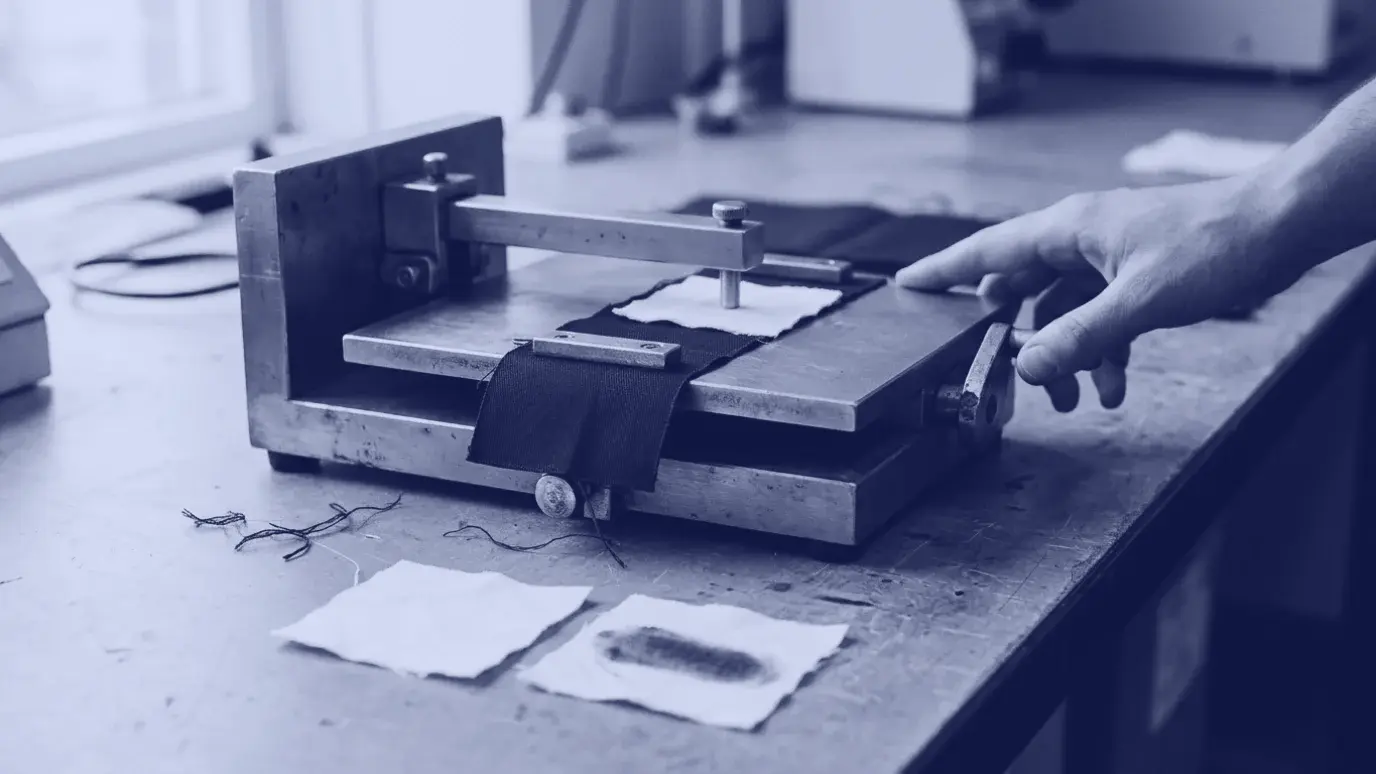
| Rubbing fastness, dry and wet | Transfer of color to another surface by friction | X12 | Gray scale: staining on the rubbing cloth |
| Perspiration fastness | Acid and alkaline human perspiration | E04 | Gray scale: color change and staining |
| Light fastness | Daylight or a xenon arc lamp | B01, B02 | Blue wool scale, 1–8 |
| Water fastness | Immersion in water | E01 | Gray scale |
Separate parts exist for dry cleaning (D01), hot pressing (X11) and washing with oxygen bleach (C09). A specification that says only “oxidative fastness” should name the standard. ISO 105-C09 measures the change in tone when washing with an oxygen-bleach reference detergent, applies to all textiles except wool and silk and does not assess staining (AFNOR); that the term maps to one standard part could not be verified, so ask the laboratory to confirm it in writing.
In the US, AATCC methods are used. TM61 imitates about five washes in one test and the S test of ISO 105-C06 about one wash, so do not compare grades from the two methods directly. For how the tests are run, see the fabric testing standards guide.
How to read a color fastness grade
Color change and staining are graded by eye with gray scales: 5 means no difference and 1 means the largest difference. With the half grades (4-5, 3-4, 2-3, 1-2) the scale has nine steps. ISO's part for the color change scale is A02 and for the staining scale A03. In washing and perspiration tests, staining is read on an undyed adjacent fabric held in contact with the specimen, often a multifiber adjacent fabric (ISO 105-F10). Because the assessment is visual, two assessors can differ by half a grade (Özkan and Oğulata, 2018, a Turkish study); ISO 105-A05 instead measures color change with an instrument and converts it into a gray scale grade.
For light fastness, the specimen is exposed together with blue wool references numbered 1–8. A higher number means more resistance to light, and each step needs roughly 2–3 times as much light to cause the same fading (Canadian Conservation Institute).
There is no single universal threshold; a numeric minimum comes from the buyer's specification or a certificate. As an example, GOTS 8.0 (a voluntary standard, published in March 2026 and applying from March 1, 2027) asks for these minimum grades on GOTS-labeled final consumer products (Table 7, accessed October 22, 2026):
| Test | Minimum grade |
|---|---|
| Dry rubbing (X12) | 3-4 (3 for fiber blends) |
| Wet rubbing (X12) | 2 |
| Perspiration (E04): color change and staining | 3-4 (3 for fiber blends) |
| Light (B02) | 3-4 |
| Washing (C06 A1M, 40 °C / 104 °F): color change and staining | 3-4 (animal fibers and their blends: A1S, 30 °C / 86 °F, without steel balls) |
| Saliva (baby products only) | 5 |
What does color fastness depend on?
The fiber, the dye class, the depth of shade and the steps after dyeing act together. Dark shades are tested harder. In one study of reactive-dyed cotton knit fabric, light pink scored 4-5 in wet rubbing, while dark black scored 2-3 with the conventional process and 4 with a cationic pretreatment, salt-free process (Ghosh and Rupanty, 2023; one study of one dye class, so do not generalize). Fastness is related to after-treatments as much as to the dyeing method (Özkan and Oğulata, 2018), so have the test run on a specimen taken from the finished fabric. The entries on denim (indigo wears off the surface), sublimation printing (high fastness on polyester) and mercerization (higher dye uptake) give more detail.
How to specify color fastness in an order
- Choose the agent: for garments, washing, rubbing and perspiration come first; for curtains and upholstery, light fastness stands out (our recommendation).
- Write the standard, edition and condition: for example “ISO 105-C06:2010, A1M”. Editions are replaced: ISO 105-X11 moved to a new edition in 2026 (EVS).
- Ask for separate grades: one minimum for color change and one for staining, and separate minimums for dry and wet rubbing.
- Set the minimum by end use: if a certificate or brand specification applies, use its table as the baseline.
- Take the specimen correctly: from the finished fabric, in the same color and finish as the order. Textile testing laboratories or the dye house's own laboratory can issue the report; the standard and condition must be written on it.
What color fastness is not
- Fading and staining: color change is the specimen's own color changing, staining is color moving onto another fabric; they have separate scales and separate grades.
- Color consistency: two lots of a high-fastness fabric can still come out in different shades; shade difference between lots or within a roll is not measured by a fastness test.
- Swatch cards and lab dips: they show whether a color matches, not how fast it is; see the swatch card entry.
- Other performance properties: shrinkage, pilling and abrasion are not fastness.
Frequently asked questions
What is a color fastness grade?
It is the result of a fastness test: color change and staining are graded 1–5 and light fastness 1–8, and a higher number means better fastness.
What is wet rubbing fastness?
It is fastness tested in wet conditions. In ISO 105-X12, a dampened standard cloth is rubbed on the specimen and the color that transfers is graded. Washing (C06) and water (E01) tests are also run wet. A wet rubbing grade is often lower than the dry one; GOTS 8.0 asks for 3-4 dry and 2 wet.
What is light fastness?
Light fastness is a color's resistance to fading in daylight (ISO 105-B01) or under a xenon arc lamp (B02); it is graded 1–8 on the blue wool scale.
Sources (23)
- EVS-EN ISO 105-A01:2010, Textiles, Tests for colour fastness, Part A01: General principles of testing (EVS standards record; the definition of color fastness and the principle that color change and staining are fastness grades while luster change and shrinkage are separate properties; valid from April 6, 2010; accessed October 22, 2026)
- ISO 105-A02:1993, Textiles, Tests for colour fastness, Part A02: Grey scale for assessing change in colour (EVS standards record; basic scale of 5 grades, extended scale of 9 grades with four half grades; accessed October 22, 2026)
- EVS-EN ISO 105-A03:2019, Textiles, Tests for colour fastness, Part A03: Grey scale for assessing staining (EVS standards record; valid from November 1, 2019; accessed October 22, 2026)
- EVS-EN ISO 105-A05:2000, Textiles, Tests for colour fastness, Part A05: Instrumental assessment of change in colour for determination of grey scale rating (EVS standards record; accessed October 22, 2026)
- EVS-EN ISO 105-B01:2014, Textiles, Tests for colour fastness, Part B01: Colour fastness to light: Daylight (EVS standards record; valid from October 6, 2014; accessed October 22, 2026)
- EVS-EN ISO 105-B01:2000 (record of the earlier edition; scope: the specimen is exposed together with eight dyed blue wool references; accessed October 22, 2026)
- EVS-EN ISO 105-B02:2014, Textiles, Tests for colour fastness, Part B02: Colour fastness to artificial light: Xenon arc fading lamp test (EVS standards record; valid from November 7, 2014; accessed October 22, 2026)
- EVS-EN ISO 105-C06:2010, Textiles, Tests for colour fastness, Part C06: Colour fastness to domestic and commercial laundering (EVS standards record; the S test approximates one wash; accessed October 22, 2026)
- EVS-EN ISO 105-X12:2016, Textiles, Tests for colour fastness, Part X12: Colour fastness to rubbing (EVS standards record; dry and wet rubbing cloth; accessed October 22, 2026)
- EVS-EN ISO 105-E04:2013, Textiles, Tests for colour fastness, Part E04: Colour fastness to perspiration (EVS standards record; accessed October 22, 2026)
- EVS-EN ISO 105-E01:2013, Textiles, Tests for colour fastness, Part E01: Colour fastness to water (EVS standards record; accessed October 22, 2026)
- EVS-EN ISO 105-D01:2010, Textiles, Tests for colour fastness, Part D01: Colour fastness to dry cleaning using perchloroethylene solvent (EVS standards record; accessed October 22, 2026)
- EVS-EN ISO 105-X11:2000, Colour fastness to hot pressing (EVS standards record; replaced by EVS-EN ISO 105-X11:2026 on July 15, 2026; accessed October 22, 2026)
- AFNOR, ISO 105-C09:2001, Textiles, Tests for colour fastness, Part C09: Colour fastness to domestic and commercial laundering, Oxidative bleach response (catalog record and abstract; December 2001; accessed October 22, 2026)
- AFNOR, NF ISO 105-F10, Specification for adjacent fabric: multifibre (catalog record and abstract; September 1990; accessed October 22, 2026)
- AATCC, TM061 Test Method for Colorfastness to Laundering: Accelerated (TM61-2013e(2020)e2; catalog record and scope summary; accessed October 22, 2026)
- Global Organic Textile Standard (GOTS) Version 8.0, March 2026 (section 5.2.6 and Table 7: Technical Quality Requirements for GOTS Goods, pp. 35–36; effective March 1, 2027, early implementation allowed; accessed October 22, 2026)
- Canadian Conservation Institute, Agent of deterioration: Light, ultraviolet and infrared (numbering of the ISO blue wool standards and the ratio between steps; accessed October 22, 2026)
- James Heal, Grey Scales (test material maker's page; color change and staining scales, grades 1–5 and half grades; accessed October 22, 2026)
- SDC Enterprises, SDCE Grey Scale (scale maker's page; nine pairs of color differences, grades running from 5 to 1; accessed October 22, 2026)
- KARCEM Tekstil, Colour Fastness Test Protocols: ISO 105 and AATCC (information page of a Turkish knit fabric maker, commercial source; last updated September 3, 2026; used to match tests to result scales; accessed October 22, 2026)
- Ghosh, J. and Rupanty, N. S. (2023). Study on a cationic agent-based salt-free reactive dyeing process for cotton knit fabric and comparison with a traditional dyeing process. Heliyon, 9(9), e19457 (washing and rubbing fastness by depth of shade; accessed October 22, 2026)
- Özkan, A. and Oğulata, R. T. (2018). Farklı boyama metotlarının mamul kumaş performansı ve kalitesine etkisi (The effect of different dyeing methods on finished fabric performance and quality; in Turkish, English title translated by us). Çukurova Üniversitesi Fen ve Mühendislik Bilimleri Dergisi, 35(1), 11–22 (fastness and after-treatments; half-grade difference in visual assessment; accessed October 22, 2026)
Author and fact-checking
Written by
Dyeing, Printing and Finishing Editor
Deniz Koç is Tekstil Rehberi's dyeing, printing and finishing editor. Deniz covers dyeing methods, digital, screen, transfer and sublimation printing, embroidery, garment washing and fabric finishes, and refers to the relevant test standards on topics such as color fastness and chemical compliance.
Content by Deniz KoçFact-checked by: Gizem Polat
This content was prepared by the Tekstil Rehberi editorial team. Before publication, our verification editor checked its figures, dates and sources against primary sources.
Spotted an error? Email us at [email protected] How we work →
Articles on this topic
Fabric Testing Standards: Color Fastness, Martindale, Pilling, Shrinkage and Strength Tests
The standards behind color fastness, Martindale abrasion, pilling, shrinkage and strength tests, how to read a fabric test report, and how to write a test line into a supplier spec.
Bed Linen Fabric Types: Percale, Sateen and Thread Count
Percale, sateen, ranforce and flannel compared: what thread count means per inch and as the Turkish per-centimeter “tel”, why “600 thread count” can mislead, and a checklist for writing a spec.
How to Judge Terry Towel Quality: GSM, Pile Yarn and Absorbency
Terry towel quality cannot be read from GSM alone. The criteria for pile yarn, pile height, absorbency and post-wash performance, with a checklist for buyers writing a spec.