
Acrylic Yarn Manufacturers and Suppliers in Turkey
Companies in Turkey that make and sell acrylic and acrylic-blend yarn. Find suppliers of normal and high-bulk acrylic yarn for knitwear and knitting production.
For buyers
Looking for a supplier in this category?
No companies are listed on this page yet. You do not have to wait for the list: describe what you need and request quotes.
Request a quote and let suitable suppliers reach you
Tell us the product, quantity and delivery location. You confirm your request with the link we e-mail you; requests are screened for spam, and our team reviews your first request. It is then sent to up to 20 companies working in this field and stays open for quotes in their company panel for 30 days. You compare the quotes you receive on one page.
- Free, no account needed.
- You decide whether companies see your contact details.
- We e-mail you when a new quote arrives.
Read before you choose a supplier

Terms to know in this field
Get your company listed on this page. If you manufacture or provide services in this field, create your free profile; companies are listed after our team has reviewed them.
List your company for freeKey facts
- In Turkey's fiber-name list, acrylic is a fiber whose chain is at least 85% acrylonitrile units by mass; in modacrylic the share is above 50% and below 85% (as of October 8, 2026).
- High-bulk acrylic yarn is spun from a blend of relaxed and heat-shrinking fibers; in heat treatment the shrinking fibers shorten and the yarn bulks up (Sarıoğlu et al., 2019; US 4035884).
- Heat-treatment temperature, machine speed and ply twist affect yarn shrinkage, so two suppliers' 'high-bulk' yarns may not have the same fullness (Sarıoğlu et al., 2019).
- Test pilling before ordering acrylic fabrics; the ISO 12945 series includes the pilling box method (Part 1) and the modified Martindale method (Part 2).
Guide to Acrylic Yarn
Murat Yıldız
Yarn and Spinning Editor
- Last updated:
- Fact-checked by:
- Gizem Polat
Acrylic yarn is also sought as knitting yarn: it is common in products that need a light, soft, wool-like handle, especially knitwear and knitted products. A wool-acrylic blend is also one of the common combinations. For these blends, see also the wool yarn and blended yarn pages.
Ask about pilling first
Pilling, the formation of balls of fiber on the surface, is a quality issue to test before ordering in acrylic and acrylic-blend fabrics. A study of woven fabrics containing acrylic shows that pilling changes significantly with the weave structure and with the type of yarn used together with the acrylic (Yavaşcaoğlu et al., 2019). So a yarn sample alone is not enough. Before ordering, knit the yarn in the same structure as your product and have the sample fabric tested for pilling; the ISO 12945 series includes the pilling box method (Part 1) and the modified Martindale method (Part 2).
Normal or high-bulk?
High-bulk acrylic yarn gives fabric fullness and is widely used in knitwear. In one academic study, the temperature and machine speed of the heat treatment and the twist of the plying were found to affect the shrinkage of the yarn significantly (Sarıoğlu et al., 2019); so the “high-bulk” yarns of two suppliers may not have the same fullness. Describe the fullness you expect with a reference sample.
A count suited to the machine
The gauge of the knitting machine limits the yarn count: the finer the gauge, the finer the yarn needed. If you work with a knitwear manufacturer, choose the yarn together with them according to their machine gauge. For count conversions, see the yarn count conversion guide; for the product side, see knitwear and sweaters manufacturers.
Color, samples and fastness: what to ask an acrylic yarn supplier
- Color consistency: for dyed acrylic, use the approved color sample as the reference and find out beforehand whether the delivery will come from a single dye lot.
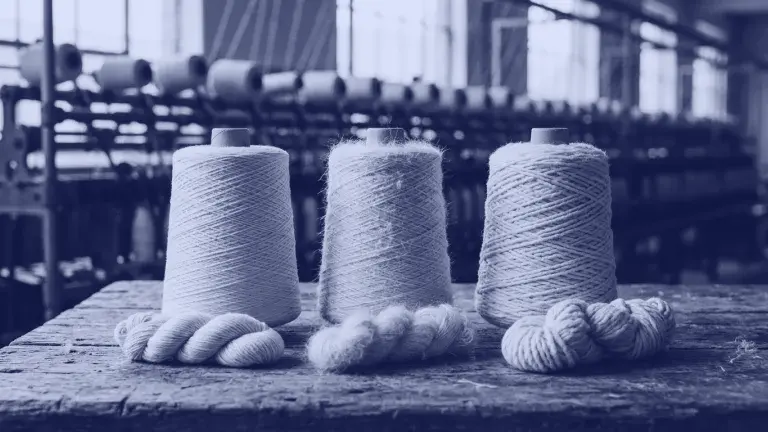
- Samples: ask for cone samples for a small knitting trial; pilling and handle show up in the trial.
- Fastness and washing: ask for wash and light fastness results on the yarn or fabric sample.
What an acrylic yarn quote should state
The yarn type (normal or high-bulk), count and ply (with the name of the system), whether it is raw or dyed, cone or hank packing, price per kilogram and lead time should appear clearly in the quote. If a blend with wool or cotton is wanted, add the ratio. If the product will be labeled in Turkey, remember that the fiber name must be written as in Annex 1 of the Regulation on Textile Fiber Names.
Fiber, bulking treatment and dyeing set the price of acrylic yarn
The raw material is petrochemical-based, so the price per kilogram of the fiber and the exchange rate are reflected in the quote directly. Count, the bulking treatment and dyeing come on top. High-bulk and normal yarn do not come at the same price; compare quotes on the same type.
Where are acrylic yarn manufacturers in Turkey?
The TOBB (Union of Chambers and Commodity Exchanges of Turkey) Industry Database has no separate yarn code for acrylic; staple-fiber yarn containing at least 85% acrylic falls under the code for yarn containing at least 85% synthetic staple fiber (13.10.82). Of the 109 firms with a valid capacity report under this code, 29 are in Gaziantep, 26 in Bursa and 22 in Istanbul (October 2026). Because the code also covers polyester and other synthetic staple-fiber yarns, this distribution is not specific to acrylic producers. Blends with less than 85% acrylic (e.g., wool-acrylic) are not in this code. Under the tariff rule for mixtures (Harmonized System, Section XI, Note 2), a yarn is classified by the fiber that predominates by weight: acrylic-dominant blends fall under the blended yarn code (13.10.83), wool-dominant blends under the wool yarn code (13.10.50). The data cover only manufacturers holding a capacity report; confirm in the quote and with a sample that the firm actually works with acrylic yarn.
Sources (8)
- Regulation on Textile Fiber Names and on the Labeling and Marking of the Fiber Composition of Textile Products (Official Gazette, April 25, 2015, no. 29337; in Turkish; accessed October 11, 2026)
- Yavaşcaoğlu, A. et al. (2019). Investigation of pilling properties of 100% acrylic, polyester/acrylic and cotton/acrylic woven fabrics. Uludağ University Journal of the Faculty of Engineering, 24(2), 1–14 (open-access record; Turkish-language article)
- Sarıoğlu, E., Gültekin, E., Karakan Günaydın, G. (2019). Effect of some process parameters on acrylic yarns and knitted fabrics made of those yarns. Tekstil ve Mühendis, 26(115), 271–280 (record)
- EN ISO 12945-1:2020 Textiles - Determination of fabric propensity to surface pilling, fuzzing or matting - Part 1: Pilling box method (EVS record)
- EN ISO 12945-2:2020 Textiles - Determination of fabric propensity to surface pilling, fuzzing or matting - Part 2: Modified Martindale method (EVS record)
- Bayer AG, US Patent 4,035,884: Process for the production of bulk yarns, 1977 (Google Patents; accessed October 11, 2026)
- TOBB Industry Database, capacity reports by province, product code 13.10.82 (accessed October 11, 2026)
- World Customs Organization (WCO), HS Nomenclature 2022 Edition, Section XI Notes, Note 2: mixtures of textile materials (accessed October 11, 2026)
Frequently asked questions
Which count system is used for acrylic yarn?
It varies by supplier. Nm is common in Europe and for wool yarns, so you may often meet it in acrylic quotes too; some companies use Ne or tex. Nm 50 is about Ne 29.5, so the two values are not identical. Have the name of the system and the count it is based on written in the quote.
How is high-bulk acrylic yarn made?
It is spun from a blend of heat-shrinking acrylic fibers and relaxed (pre-shrunk) acrylic fibers, then given bulk by heat treatment: the shrinking fibers shorten while the others crimp and swell. Details vary by manufacturer; ask to see the method and the result on a sample fabric.
Are acrylic and modacrylic the same fiber?
No. As of the date of this page (October 8, 2026), under the fiber-name list in the Turkish labeling regulation, acrylic is a fiber whose chain is at least 85% acrylonitrile units by mass; in modacrylic the share is above 50% and below 85%. The two are written under separate names on a label. Have the quote and the cone label state which one is being sold, and consult an expert for the label wording.
What decides the minimum order quantity for acrylic yarn?
The type of yarn (normal or high-bulk), the count, and whether it is raw or dyed. For dyed acrylic the color lot is decisive: an approved color may require a full dye lot, while raw yarn may be sold in smaller quantities. The exact quantity depends on the supplier; ask in writing for the unit (kilograms, cones or hanks) and the minimum per color.