Denizli Towel and Bathrobe Industry: How Turkey's Home Textile Hub Works
Why Denizli leads Turkey's towel and bathrobe production, how the chain runs from yarn to sewing, how to read the 2025 numbers and what to ask a supplier.
- Published:
- Fact-checked by:
- Gizem Polat
Key facts
- In the TOBB industry database, 265 of the 333 firms with a capacity report for cotton terry towels are in Denizli (query of October 11, 2026).
- In the Ministry of Trade's 2026 home textiles report, towels stand out in two provinces: Denizli for towels and bed sheets, Bursa for towels, tulle and sheets.
- Terry cloth is woven from a ground warp, a pile warp and a weft, and the weaving, dyeing and sewing can each be done at a different facility.
- The Ministry of Trade's report puts the towel and bathrobe product group at US$309.8 million (12.9%) in 2025, the third-largest home textile group; it is not only towels and bathrobes.
- Per TİM, firms with their registered office in Denizli exported US$4.68 billion in 2025; US$1.37 billion came from the apparel and textile sectors, not from towels and bathrobes alone.
- DENİB's Turkish Towels initiative aims to limit the label to towels and bathrobes made in Turkey from Turkish cotton; the source does not state its legal status (Ekonomist, August 12, 2026).
Denizli is Turkey's main towel and bathrobe production center. The Ministry of Trade's home textiles report names towels and bed sheets as the products concentrated in Denizli, and 265 of the 333 firms with a capacity report for cotton terry towels in the TOBB industry database are in Denizli (query of October 11, 2026). The cluster's strength comes from the whole chain, yarn to sewing, lining up in one province.
To find towel and bathrobe manufacturers in Denizli, select Denizli in the province filter on the towel and bathrobe companies page.
This guide shows how the cluster formed, which stages a towel or bathrobe goes through, what the 2025 numbers show and don't show, and what to ask when you source from Denizli. Information is as of October 16, 2026.
Why is Denizli known for towels and bathrobes?
Denizli is known for towels and bathrobes because yarn, weaving, dyeing and finishing plants sit in the same province; the State Planning Organization's 2007 report on the textile sector (p. 173) gives Denizli in towels, bathrobes and home textiles as one of Turkey's examples of clustering. A cluster is a concentration of related firms and the organizations that serve them in one region; the report lists among those organizations quality-control and R&D laboratories, educational institutions, exporters' associations and chambers. That is a 2007 observation; the Ministry, TOBB and export data below show today's picture.
According to a note by İrfan Sezgin of the Southern Aegean Development Agency (GEKA; undated, with 2008–2010 data), modern industry in Denizli began with cotton gins, spinning mills followed to supply local greige cloth weaving, and dyeing, printing and finishing plants arrived once looms were modernized. Each link grew from the next one's need.
One caution on names: Buldan cloth (Buldan Bezi), the registered indication of source linked to Denizli (No 194, protected since January 27, 2010), is a fabric registration, not a towel registration.
Denizli's towel industry in numbers
The figures about Denizli come from three separate records that must not be added together: the Ministry of Trade for product groups, TOBB for producer counts, and TİM and the exporters' associations for provincial exports. When this article was prepared, we could not find an official public table showing towel exports by province and product.
Towels and bathrobes in Turkey's home textile exports
According to the Ministry of Trade's Home Textiles Sector Report (2026 edition), Turkey's home textile exports fell 3.4% to US$2.4 billion in 2025 (p. 1).
| Product group | 2025 (US$ million) | Share | Change vs. 2024 |
|---|---|---|---|
| Bed sheets | 617.1 | 25.7% | −0.3% |
| Curtain and upholstery fabric | 561.9 | 23.4% | −5.0% |
| Towels and bathrobes | 309.8 | 12.9% | −2.6% |
| Bedspreads | 259.3 | 10.8% | −8.5% |
| Curtains | 204.1 | 8.5% | −2.2% |
| Pillows, quilts and sleeping bags | 172.9 | 7.2% | −4.7% |
| Total (11 groups) | 2,401.3 | 100% | −3.4% |
The report's "towels and bathrobes" group is not made up of towels and bathrobes alone. Its tariff-code (GTİP) list (p. 6) also covers gauze fabric (5803), nightwear and underwear codes (6107, 6108, 6207, 6208), toilet and kitchen linen (6302) and cleaning cloths (6307.10). Cite the US$309.8 million as "the report's towels and bathrobes product group".
The same report puts world home textile exports at US$109.6 billion in 2025 (−1.6%), with China at 54.5% and Turkey 6th (pp. 3–4); Turkey's US$2.70 billion there (ITC Trade Map data) differs from the Ministry's own US$2.40 billion, and the report does not explain the gap. For markets, see Turkey textile and apparel exports.
Denizli's weight in the industrial registry
The industry database of TOBB (the Union of Chambers and Commodity Exchanges of Turkey) counts manufacturers with a valid capacity report by product code and province; the province is the one where the production facility named in the report is located (query: October 11, 2026). Terry cloth and cotton towels have separate codes; bathrobes do not.
| Product code | Scope | Denizli / Turkey | Denizli share |
|---|---|---|---|
| 13.92.14.30 | Cotton terry towels | 265 / 333 | 79.6% |
| 13.20.42 | Terry fabric (cotton) | 61 / 67 | 91.0% |
| 13.30.11 | Yarn and fiber dyeing | 52 / 305 | 17.0% |
The percentages are Tekstil Rehberi's calculation. Rows do not add up, because a firm can appear under several codes, and a firm with facilities in several provinces is counted in each. The towel row does not reflect bathrobes. In yarn and fiber dyeing, Denizli ranks second after Bursa (66).
Denizli's exports
According to TİM's table of exports by province and sector, firms with their registered office in Denizli exported US$4.68 billion in 2025, up 6.9% (the Denizli Chamber of Industry gives the same total). Textiles fall under two sectors: ready-to-wear and apparel at US$1.09 billion (−1.6%) and textiles and raw materials at US$0.27 billion (−3.4%). Together, at US$1.37 billion, they make up about 29% of the province's exports; electrical and electronics, at US$1.02 billion (+16%), is about 22% (shares are Tekstil Rehberi's calculation). The tekstil-konfeksiyon figure in Ekonomi Gazetesi's January 4, 2026 report (US$1.368 billion, −2%) equals the sum of these two sectors. Keep five points in mind:
- The registered-office province is not the production province. TİM assigns exports to the province of a firm's registered office, so a firm that produces in Denizli but is registered elsewhere does not show up under Denizli. The TOBB count, by contrast, uses the province of the production facility.
- A sector heading is not a product. In TİM's classification, home textile product groups sit in the "ready-to-wear and apparel" sector (AKİB, December 2025 report, p. 3). The US$1.37 billion includes garments and cannot be counted as towel and bathrobe exports.
- Two province tables don't match. The province table in AKİB's December 2025 report (p. 5) puts Denizli's ready-to-wear and apparel exports at US$1.05 billion (−3%), against TİM's US$1.09 billion. TİM uses the registered-office province, AKİB does not state its basis, and neither explains the gap, so cite the source of whichever figure you use.
- A provincial total is not a textile total. Ekonomist (August 12, 2026) gives "Denizli textiles" as having "annual exports of about US$5 billion" without a source; that is close to the province's exports across all sectors.
- Statements may not match the tables. In an AA report of December 30, 2025, DENİB (Denizli Exporters' Association) President Hüseyin Memişoğlu cites US$130 million of bathrobe, US$410 million of towel and US$250 million of bed linen exports for the first 11 months of the year. The towel and bathrobe total (US$540 million) exceeds the Ministry report's Turkey-wide group value (US$309.8 million); the product scopes are not explained, so the two cannot be read side by side.
Is "90% of towels come from Denizli" true?
That ratio rests on statements. Nihat Zeybekci, Economy Minister at the time, said in 2014 that 90% of the bathrobes and towels produced in Turkey come from Denizli (Hürriyet, March 7, 2014), and in December 2025 Memişoğlu said about 90% of production of towels, bathrobes and bed linen is in Denizli. Neither report cites a statistic. The closest measurable record is the TOBB count: 79.6% of the firms with a capacity report for cotton terry towels are in Denizli (query of October 11, 2026). That is a share of firms, not of output or exports.
How are terry towels and bathrobes made in Denizli? The chain, stage by stage
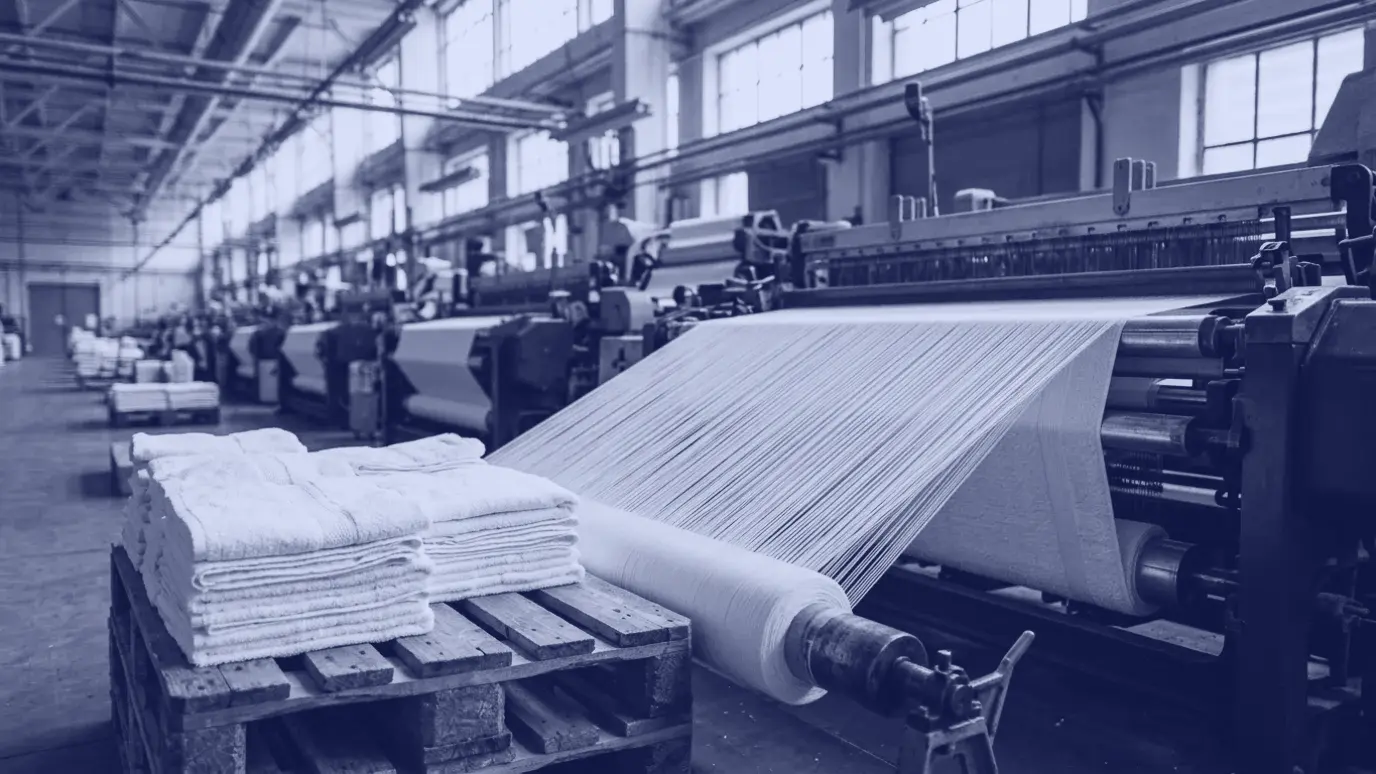
Terry cloth is woven with three yarn systems (ground warp, pile warp and weft), and the pile warp forms the loops. A bathrobe's fabric is usually terry as well, though loopless waffle (honeycomb) weave is also used, and the pieces are sewn after cutting. The cluster lets these stages follow one another in the same province.
| Stage | What happens | What a buyer should ask |
|---|---|---|
| 1. Yarn | Cotton yarn for pile and ground is prepared; the fiber, the twist and the number of plies affect absorbency and linting (see our guide to judging terry towel quality). | Pile yarn: which fiber, how much twist, how many plies |
| 2. Warp preparation and weaving | The warp is wound onto a beam; on the loom the ground warp is held taut and the pile warp slack, which forms the loops. Jacquard can weave patterns and logos into the cloth. | Who weaves, on whose looms; whether the logo is woven or embroidered |
| 3. Dyeing and finishing | Yarn or fabric is dyed; pre-treatment, dyeing and softening affect absorbency and color fastness. | Dyed on yarn or fabric; lab dip and color fastness report |
| 4. Garment-making | A towel's short edge can be hemmed or left fringed (the Bursa Towel specification describes both); bathrobes are cut and sewn; embroidery, printing and labels are added. A contract (fason) workshop can do this stage. | Who sews; size and edge tolerance |
| 5. Quality control and shipment | Dimensions, GSM, color and change after washing are checked. EN 14697 defines minimum properties and test methods for towels, and lots are accepted using AQL. | Which standard the test report follows |
How do Denizli towel manufacturers work, and how do you choose one?
Not every towel manufacturer in Denizli weaves, dyes and sews in its own facility: some firms only weave or only sew and have the rest done elsewhere. The cluster makes this division of work easy, but the color, size and lead time of one lot can then depend on several addresses. Six questions at the quote stage make the picture visible:
- Who does the weaving? Its own looms or a subcontractor? Ask for the production facility's address, industrial registry certificate (sanayi sicil belgesi) and capacity report.
- Where are dyeing and finishing done? On yarn or on fabric? Is there a lab dip and a color fastness report?
- Who does the sewing? Are bathrobe and towel-edge sewing under the same roof?
- Which standard does the test report follow? For towels, EN 14697, which covers domestic and contract use; for harmful substances, documents such as OEKO-TEX STANDARD 100.
- How do MOQ and lead time change with color and logo? A custom color and a jacquard logo generally call for a higher quantity than a stock color.
- How does the sample and color card process work? Duration, cost and number of approval rounds.
If you also need bed linen or other home products, select Denizli in the province filter on the home textiles page; price, MOQ and custom production terms are explained in the category guides.
Company directory
Looking for manufacturers in this field?
Browse companies in the related categories or get quotes from several companies with one form.
Do you manufacture or offer services in this field?
Denizli or Bursa? Two towel centers
The Ministry of Trade report names Bursa, Denizli, Istanbul, Izmir and Uşak as the main provinces for home textile production (p. 1). Towels stand out in two of them; the difference lies in the product mix and in the geographical indication records.
| Topic | Denizli | Bursa |
|---|---|---|
| Products concentrated there, per the Ministry report | Towels and bed sheets | Towels, tulle and sheets |
| Registered indication of source | Buldan cloth (fabric; Buldan district of Denizli province; No 194, 2010) | Bursa Towel (towel; Bursa province; No 1519, January 9, 2024; registered by the Bursa Commodity Exchange) |
| Notable in the specification | Very fine, mostly cotton yarn; perspiration-absorbing bürümcük weave | 100% cotton; at least 400 GSM; at least 3 mm pile; water absorption time at most 10 s for a 10 × 10 cm towel; all production stages in Bursa province |
The Bursa specification's values apply only to products that use the Bursa Towel name; they are not a general quality limit. Wherever a towel is made, ask for GSM, pile yarn and absorbency criteria.
The cluster's institutions and the 2026 agenda
Institutions
- Denizli Organized Industrial Zone: established by a Council of Ministers decision of January 24, 1975; in Honaz, 18 kilometers from the city.
- DENİB: runs the Turkish Towels initiative (below).
The Turkish Towels label: what it means for a buyer
DENİB's Turkish Towels initiative aims to limit the label to towels and bathrobes made in Turkey from Turkish cotton; the stated reason is that the same label is used on products made in other countries. According to the Ekonomist article of August 12, 2026, certification work is under way, and the article does not say whether the label is a trademark or a certificate. So don't treat a labeled product as proof of origin on its own: ask for documents showing the source of the cotton and the place of production.
2026 agenda: statements from the sector
These are statements by the chairman of a Denizli producer (Gelin Tekstil) in the Ekonomist article, not Tekstil Rehberi findings: skilled labor is one of the sector's biggest problems, and the company plans an AI-supported quality control system and readiness for the EU's digital product passport in 2027. The passport's scope for home textiles is not yet clear; see our digital product passport guide.
Sourcing from Denizli: compliance and document checklist
In addition to the six questions, settle these points:
- Ask for the test report together with its standard. Have the method written down, and whether the measurement is taken before or after washing.
- Read labels such as OEKO-TEX STANDARD 100 correctly. This label shows the product was tested for harmful substances; it does not replace absorbency or shrinkage performance.
- If a compliance audit is required, ask about its scope. If your own buyer asks for a BSCI or Sedex SMETA audit, find out which of the weaving, dyeing and sewing facilities the audit report covers.
- If you ship to the EU, settle with your customs broker who will issue the A.TR certificate and at which stage; our A.TR guide covers issuing, validity and verification.
- Write down lot acceptance. Put the acceptance level and the condition (washed or unwashed) in which measurement is done into the contract. For finding and vetting Turkish factories in general, see clothing manufacturers in Turkey.
Summary: how to read Denizli's numbers
Denizli's weight shows in the number of firms in TOBB records (265 of 333 in the cotton terry towel code, query of October 11, 2026) and in a chain laid out from yarn to sewing; when this article was prepared, we could not find an official public table of towel exports by province. When you take a figure, write down its source, product scope and year, and ask the supplier where each stage is carried out.
Frequently asked questions
Why is Denizli known for towels and bathrobes?
Because yarn, weaving, dyeing and finishing plants are concentrated in the same province. Three records show it: in the TOBB industry database, 265 of the 333 firms with a capacity report for cotton terry towels are in Denizli (query of October 11, 2026); the Ministry of Trade's 2026 home textiles report puts towels and bed sheets among the products concentrated in the province; and the State Planning Organization's 2007 textile report cites Denizli as an example of clustering in towels, bathrobes and home textiles.
How are terry towels and bathrobes made in Denizli?
The stages are yarn (pile and ground), warp preparation and terry weaving, dyeing and finishing, cutting and sewing for bathrobes, then quality control and packing. Terry cloth is woven with three yarn systems: a ground warp, a pile warp and a weft. The stages are not always done at the same firm, so ask at which facility each one is carried out.
How big is Denizli's textile export?
According to TİM's table of exports by province and sector, firms with their registered office in Denizli exported US$4.68 billion in 2025. Of that, US$1.09 billion came from ready-to-wear and apparel (−1.6%) and US$0.27 billion from textiles and raw materials (−3.4%): US$1.37 billion in total, about 29% of the province's exports. The registered-office province is not the production province, and the apparel sector includes home textiles, so the figure is not towel and bathrobe exports. AKİB's separate province table shows US$1.05 billion for the apparel sector.
What is the difference between Denizli and Bursa towels?
According to the Ministry of Trade report, Bursa is strong in towels, tulle and sheets, and Denizli in towels and bed sheets. Bursa Towel is a registered indication of source (No 1519, January 9, 2024); its specification requires 100% cotton, at least 400 GSM and at least 3 mm of pile, but those values apply only to products that use that name. In Denizli, the registered indication of source covers fabric, not towels: Buldan cloth (No 194).
What does the Turkish Towels label mean?
Turkish Towels is a branding initiative run by the Denizli Exporters' Association (DENİB). According to an Ekonomist article of August 12, 2026, the sector is working to have the label used only on towels and bathrobes made in Turkey from Turkish cotton; certification work is under way, and the article does not state the label's legal status. Until that is clear, ask for documents showing where the cotton came from and where the product was made.
What should I ask a Denizli towel supplier?
First ask who does the weaving, dyeing and finishing, and sewing, and at which address; in Denizli these stages can be at different facilities. Then ask which standard the test report follows (EN 14697 for towels; documents such as OEKO-TEX STANDARD 100 for harmful substances), how MOQ and lead time change with a custom color and logo, and how long the sample and color card process takes, what it costs and how many approval rounds it has.
Sources (18)
- Ministry of Trade of the Republic of Türkiye, General Directorate of Exports, Home Textiles Sector Report (2026 edition, 2025 data; pp. 1, 3–4 and 6; in Turkish; accessed October 16, 2026)
- TOBB Industry Database, capacity reports by province, product code 13.92.14.30, cotton terry towels (queried and accessed October 11, 2026)
- TOBB Industry Database, capacity reports by province, product code 13.20.42, terry fabric (queried and accessed October 11, 2026)
- TOBB Industry Database, capacity reports by province, product code 13.30.11, yarn and fiber dyeing (queried and accessed October 11, 2026)
- State Planning Organization (DPT), Ninth Development Plan (2007–2013) Textile, Leather and Clothing Industry Specialization Commission Report, Ankara 2007 (p. 173; in Turkish; accessed October 16, 2026)
- TÜRKPATENT, Geographical Indication: Buldan Bezi (Buldan cloth; indication of source, Registration No 194, protection date January 27, 2010; in Turkish; accessed October 16, 2026)
- TÜRKPATENT, Geographical Indication: Bursa Havlusu (Bursa Towel; indication of source, Registration No 1519, registration date January 9, 2024; in Turkish; accessed October 16, 2026)
- İrfan Sezgin (GEKA), Buldan Bezi ve Geleneksel El Dokumacılığı (Buldan Cloth and Traditional Hand Weaving; title translated by Tekstil Rehberi; undated, contains 2008–2010 data; in Turkish; accessed October 16, 2026)
- EN 14697:2005 Textiles - Terry towels and terry towel fabrics - Specification and methods of test (EVS record)
- OEKO-TEX, STANDARD 100 by OEKO-TEX (accessed October 16, 2026)
- TİM (Turkish Exporters Assembly), İl Bazında Sektör Rakamları (Exports by Province and Sector), January–December 2025 (as of December 31, 2025; by the province of each firm's registered office; title translated by Tekstil Rehberi; in Turkish; accessed October 16, 2026)
- Ekonomi Gazetesi, Denizli ihracatı 2025'te 4,7 milyar dolara ulaştı (Denizli's exports reached US$4.7 billion in 2025; January 4, 2026; in Turkish; accessed October 16, 2026)
- Denizli Chamber of Industry, Denizli İhracatında Sektörel Dağılım ve Değişim (Sectoral Distribution and Change in Denizli's Exports; January–December 2025 total; no publication date on the page; in Turkish; accessed October 16, 2026)
- AKİB General Secretariat, Hazır Giyim ve Konfeksiyon Sektörü Aralık 2025 İhracat Rakamları Değerlendirmesi (Evaluation of December 2025 Export Figures for the Ready-to-Wear and Apparel Sector; product table, p. 3; province table, p. 5; exporters' association records; in Turkish; accessed October 16, 2026)
- Ekonomim (AA), Denizli ihracatında ev tekstili öne çıkıyor (Home textiles stand out in Denizli's exports; December 30, 2025; in Turkish; accessed October 16, 2026)
- Ekonomist, Denizlili tekstilciler 'Türk Havlusu' için birleşti (Denizli textile makers join forces for the 'Turkish Towel'; Özlem Bay Yılmaz; August 12, 2026; in Turkish; accessed October 16, 2026)
- Hürriyet, Bornozlu kutlama (A celebration in bathrobes; March 7, 2014; in Turkish; accessed October 16, 2026)
- Denizli Organized Industrial Zone, Tarihçe (History; in Turkish; accessed October 16, 2026)
Author and fact-checking
Written by
Home Textiles Editor
Ayşe Kaya is Tekstil Rehberi's home textiles editor. She covers towels, bathrobes, bed linen, curtains, carpets and upholstery, as well as Turkey's home textile clusters such as Denizli, Bursa and Uşak, and checks product specifications and production data against industry reports and standards.
Content by Ayşe KayaFact-checked by: Gizem Polat
This content was prepared by the Tekstil Rehberi editorial team. Before publication, our verification editor checked its figures, dates and sources against primary sources.
Spotted an error? Email us at [email protected] How we work →
Related articles
Bed Linen Fabric Types: Percale, Sateen and Thread Count
Percale, sateen, ranforce and flannel compared: what thread count means per inch and as the Turkish per-centimeter “tel”, why “600 thread count” can mislead, and a checklist for writing a spec.
How to Judge Terry Towel Quality: GSM, Pile Yarn and Absorbency
Terry towel quality cannot be read from GSM alone. The criteria for pile yarn, pile height, absorbency and post-wash performance, with a checklist for buyers writing a spec.
Textile Trade Fairs 2026-2027: Istanbul and Europe Calendar
Dates, venues and focus of the main textile fairs in Istanbul and Europe from November 2026 to September 2027, which fair suits which buyer, and what to check before you travel.