What is Terry Cloth?
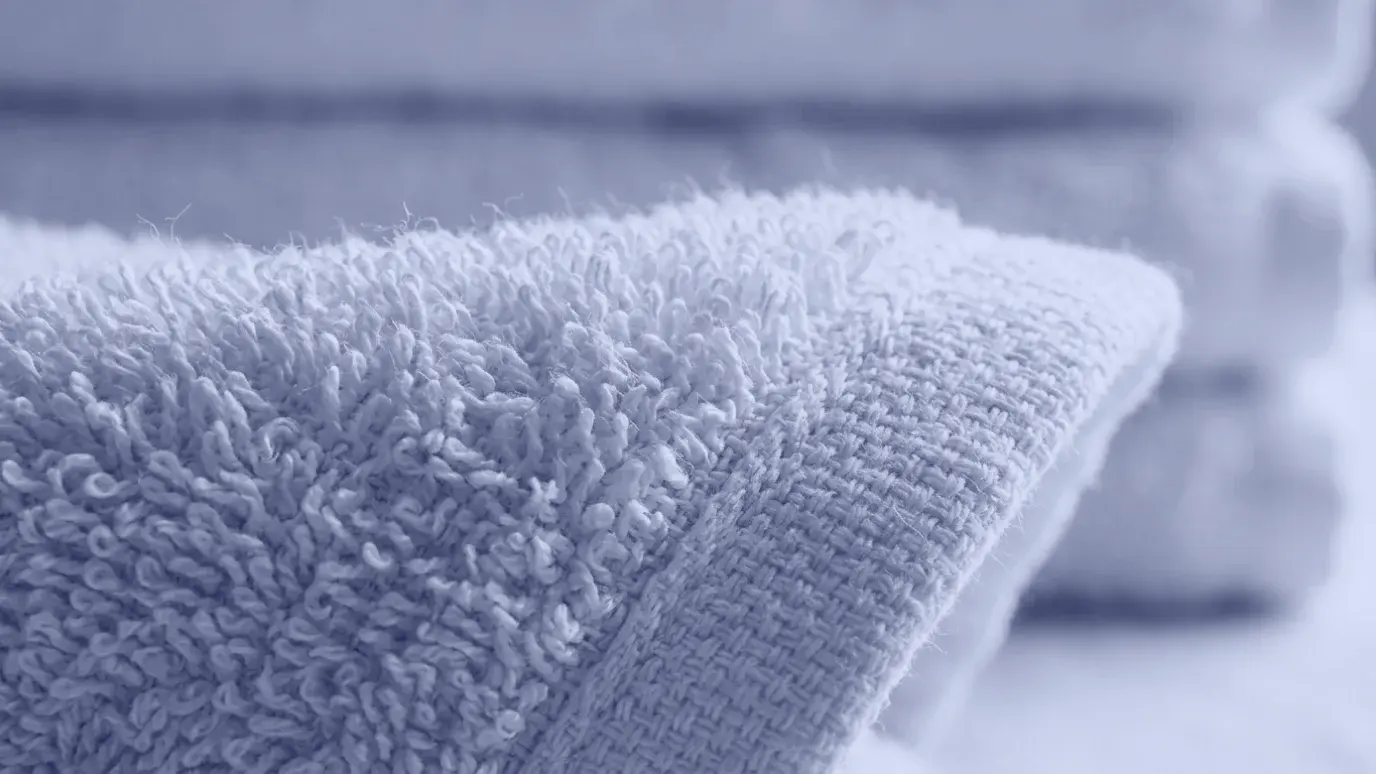
Terry cloth is an absorbent woven fabric with uncut loops (pile) on its surface, woven from a ground warp, a pile warp and a weft. It is widely used for towels, bathrobes and beachwear.
- Published:
- Updated:
- Fact-checked by:
- Gizem Polat
Key facts
- Terry cloth is a woven pile fabric with uncut loops on its surface; in BSI’s EN 14697 definition the loops are on both faces.
- It is woven with three yarn systems: a ground warp, a pile warp and a weft.
- There is no generally accepted weight range; in one study, cotton samples measured about 417–575 g/m².
- Weight alone is not a quality indicator; pile height, density, yarn type and finishing also affect absorbency.
- The Bursa Towel specification asks for at least 400 g/m² and at least 3 mm pile; these values apply only to that indication.
Properties
- Fiber content
- Generally cotton (BSI’s definition in EN 14697); towel fabrics with a linen or bamboo pile yarn and a cotton ground have also been studied
- Structure
- Woven; three yarn systems (ground warp, pile warp and weft); uncut loops (pile) on one or both faces
- Weight range
- There is no single generally accepted range. Measured examples: woven samples with cotton pile yarn, desized and undyed, about 417–575 g/m² (12.3–17.0 oz/yd²) at 5.4–9.0 mm pile height (Sekerden, 2012). The Bursa Towel geographical indication specification requires at least 400 g/m² (11.8 oz/yd²)
- Uses
- Bath and hand towels, bathrobes, beachwear, kitchen towels and cleaning cloths, slippers, baby products
- Care
- Care instructions are set by fiber content and finishing. Dimensional change after washing is measured by ISO 5077, using ISO 6330 washing and drying procedures. The weight and absorbency of raw fabric can change after washing.
Terry cloth is an absorbent woven fabric with uncut loops (pile) on its surface; Turkish suppliers call it havlu kumaş. According to the definition BSI gives for its standard EN 14697, terry cloth is generally a pile fabric woven from cotton and carrying uncut loops on both faces; its typical use is bath towels and bathrobes.
Terry cloth structure
Terry cloth is woven with three yarn systems: a ground warp, a pile warp and a weft (Petrulyte and Baltakyte, 2009; Sekerden, 2012). The ground warp and weft build the body of the fabric. The loops are formed by an independent pile warp system, and this looped area takes on basic functions such as absorbency to a large extent (Jamshaid et al., 2025).
During weaving the ground warp is held tight and the pile warp is held slacker and let off from the loom faster. Several ground picks are inserted without being beaten fully up to the fabric (loose picks); the pile yarns stay free over these picks. The full pick that follows pushes the group of picks up to the fabric, and the loose pile yarns rise from the surface as loops. In the common three-pick arrangement, the loop sequence repeats every three ground picks (Trident Ltd., patent US9534323B1).
Loops can be on one face or on both (Sekerden, 2012). Research has examined pile heights of 5.4–9.0 mm (Sekerden, 2012) and of 6, 9 and 12 mm (Petrulyte and Baltakyte, 2009).
What determines absorbency?
Absorbency cannot be described by a single number; pile height, density, yarn and finishing act together.
- Pile height: In unfinished fabric with a linen pile yarn and a cotton ground, static water absorption was 142.9%, 172.8% and 300.8% at pile heights of 6, 9 and 12 mm respectively (Petrulyte and Baltakyte, 2009). In towels with cotton and bamboo pile yarns too, sinking time got shorter as the pile got higher; the author explains this by the growth of the absorbent surface area (Sekerden, 2012).
- Density: As density rises, absorbency falls; in a densely woven towel yarn contacts increase, pores get smaller and water is absorbed more slowly (Jamshaid et al., 2025). An earlier study reported that percentage water absorption fell as warp and weft density rose (Karahan and Eren, 2006; cited in Sekerden, 2012).
- Yarn and twist: Static water absorption was lowest with open-end yarn and highest with two-ply ring carded yarn (Karahan and Eren, 2006; cited in Petrulyte and Baltakyte, 2009). Cotton towels woven with untwisted pile yarn held more water, absorbed it later and had lower flexural rigidity (Sekerden, 2015). The Bursa Towel specification, by contrast, requires a fully twisted pile so that yarns do not pull out of the towel and the product does not deform in use.
- Finishing: In the same 6 mm pile sample, static absorbency was measured as 142.9% unfinished, 275.1% after washing with industrial detergent, and 310.3% after washing with detergent and a silicone-based softener (Petrulyte and Baltakyte, 2009). The finding belongs to a single study and a specific softener and should not be generalized to other softeners.
Weight (GSM) and a sample specification
There is no single generally accepted weight range for terry cloth. A measured example: in woven samples with cotton pile yarn, desized and undyed, 417.1 g/m² (12.3 oz/yd²) was found at 5.4 mm pile height and a pile-to-ground weight ratio of 1.58, and 574.9 g/m² (17.0 oz/yd²) at 9.0 mm and a ratio of 2.46 (Sekerden, 2012). Weight also varies with the state of measurement: a sample with 6 mm pile weighed 473.6 g/m² unfinished and 552.6 g/m² after washing with detergent and softener, a difference of about 17% (Petrulyte and Baltakyte, 2009). 1 oz/yd² ≈ 33.9 g/m².
The geographical indication Bursa Towel (Bursa Havlusu) is a concrete example of a specification (TÜRKPATENT, indication of source, Registration No 1519, January 9, 2024):
| Property | Bursa Towel specification |
|---|---|
| Yarn | 100% cotton |
| Ground warp | At least Ne 20/2 ring-spun (490–520 turns/m); open-end is not used |
| Pile warp | At least Ne 16/1 single, at least Ne 20/2 two-ply |
| Weft | At least Ne 16/1 |
| Pile height | At least 3 mm, fully twisted |
| Weight | At least 400 g/m² (11.8 oz/yd²) |
| Warp and weft density | At least 18/cm each |
| Water absorption time | ≤ 10 s for a 10×10 cm piece of towel |
The specification does not state which method the water absorption time is measured by. These values apply only to the Bursa Towel indication and are not a general quality limit. The table shows the values in the registration text as of the date of this entry. Use of the indication is supervised under the coordination of the Bursa Commodity Exchange (Bursa Ticaret Borsası), which registered it; anyone planning to use the indication should consult the Exchange or a trademark and patent attorney.
Types and what not to confuse it with
- Velour (sheared pile) towel: Made by shearing the loops on one face after weaving; the surface becomes velvety, the cut loops absorb less liquid, and the product is somewhat less durable than a towel with tightly twisted pile (MÖVE). It is not the same as velour in the sense of a knitted velvet fabric.
- Knitted looped fabrics: French terry is a knitted fabric. According to Cotton Incorporated, the industry calls unbrushed 2-end fleece fabric French terry; its loops are formed by yarn floats, not by terry sinkers, so it is technically not terry cloth (CottonWorks). EN 14697 covers only woven terry structures (BSI); this entry describes woven terry cloth.
- Towel-type fabrics without loops: Huck, waffle-weave, crash and flour-sack towels carry no pile loops; ASTM D4772 does not regard them as terry fabrics and excludes them from its scope.
Production centers in Turkey
According to the Turkish Ministry of Trade’s Home Textiles Sector Report (2026 edition), home textile production is concentrated mostly in Bursa, Denizli, Istanbul, İzmir and Uşak; towel production is concentrated in Bursa and Denizli. In the report’s tariff code list (GTİP, Turkey’s customs tariff position codes), codes 580210 and 580220 appear as “havlu cinsi bukleli mensucat” (terry-type looped fabrics) and 630260 as the code for cotton toilet and kitchen cloths made of terry fabric. These codes are the report’s list as of the date of this entry; for exact classification, consult your customs broker. To find companies, see the towel and bathrobe manufacturers page.
What to specify when sourcing terry cloth
- Do not rely on weight alone: also ask for the pile height, the pile-to-ground ratio, the yarn type and twist, and the warp and weft density.
- Ask in what state the weight was measured: raw or washed.
- Ask for the name of the absorbency test: ASTM D4772 (water flow), AATCC 79 (drop test; Jamshaid et al., 2025) and sinking time (Sekerden, 2012 ran this test to TS EN 14697) measure different things. ASTM D4772 notes that interlaboratory precision is weak; if it is to be used for shipment acceptance, it recommends that buyer and supplier laboratories run comparative tests.
- Ask separately about towel shrinkage: dimensional change should be measured by ISO 5077, with washing and drying done to ISO 6330 procedures.
Frequently asked questions
Does a heavier towel absorb more?
Not always. As pile height rises, both weight and absorbency tend to rise (Petrulyte and Baltakyte, 2009). But if the fabric gets heavier because it is woven more densely, absorbency can fall (Jamshaid et al., 2025); yarn type, twist and finishing also change the result. Weight alone is not a quality indicator.
Does a towel absorb more after it is washed?
Finishing and washing can change absorbency markedly. In one study the unfinished sample absorbed about 1.9 times more water after washing with industrial detergent (Petrulyte and Baltakyte, 2009). This result belongs to unfinished fabric and cannot be carried over directly to a retail towel washed at home. Follow the product’s care label.
Sources (13)
- BSI, BS EN 14697:2005 Textiles. Terry towels and terry towel fabrics. Specifications and methods of test (published September 29, 2005, current; accessed October 9, 2026)
- Petrulyte, S. and Baltakyte, R. (2009). Static Water Absorption in Fabrics of Different Pile Height. Fibres & Textiles in Eastern Europe, 17(3), 60-65
- Sekerden, F. (2012). Effect of Pile Yarn Type on Absorbency, Stiffness, and Abrasion Resistance of Bamboo/Cotton and Cotton Terry Towels. Wood and Fiber Science, 44(2), 189-195
- Sekerden, F. (2015). A Comparative Analysis of Towels Produced From Twisted and Twistless Cotton Pile Yarns in Terms of Absorptive Capacity and Flexural Rigidity. Journal of Engineered Fibers and Fabrics, 10(1), 109-114 (abstract; accessed October 9, 2026)
- Jamshaid, H., Mishra, R. K. et al. (2025). Evaluation of performance properties in woven Terry towel by multi response optimization. Scientific Reports, 15, 32856. DOI: 10.1038/s41598-025-18328-9
- Trident Limited, US patent US9534323B1: Terry fabric weave and resulting terry fabric (January 3, 2017; background section)
- TÜRKPATENT, Geographical Indication: Bursa Havlusu (Bursa Towel; indication of source, Registration No 1519, registered January 9, 2024; registrant Bursa Commodity Exchange; document in Turkish)
- Republic of Türkiye Ministry of Trade, General Directorate of Exports, Ev Tekstili Sektör Raporu (Home Textiles Sector Report; in Turkish; 2026 edition, 2025 data; accessed October 9, 2026)
- ASTM D4772-26 Standard Test Method for Surface Water Absorption of Terry Fabrics (Water Flow) (accessed October 9, 2026)
- CottonWorks (Cotton Incorporated): Single Knits and Double Knits (definition of French terry; accessed October 9, 2026)
- MÖVE: Velour terry towelling, a velvety-soft pile (manufacturer blog page; accessed October 9, 2026)
- ISO 6330:2021 Textiles: Domestic washing and drying procedures for textile testing
- ISO 5077:2007 Textiles: Determination of dimensional change in washing and drying (confirmed in 2022)
Author and fact-checking
Written by
Home Textiles Editor
Ayşe Kaya is Tekstil Rehberi's home textiles editor. She covers towels, bathrobes, bed linen, curtains, carpets and upholstery, as well as Turkey's home textile clusters such as Denizli, Bursa and Uşak, and checks product specifications and production data against industry reports and standards.
Content by Ayşe KayaFact-checked by: Gizem Polat
This content was prepared by the Tekstil Rehberi editorial team. Before publication, our verification editor checked its figures, dates and sources against primary sources.
Spotted an error? Email us at [email protected] How we work →
Articles on this topic
Denizli Towel and Bathrobe Industry: How Turkey's Home Textile Hub Works
Why Denizli leads Turkey's towel and bathrobe production, how the chain runs from yarn to sewing, how to read the 2025 numbers and what to ask a supplier.

How to Judge Terry Towel Quality: GSM, Pile Yarn and Absorbency
Terry towel quality cannot be read from GSM alone. The criteria for pile yarn, pile height, absorbency and post-wash performance, with a checklist for buyers writing a spec.