What is Digital Textile Printing?
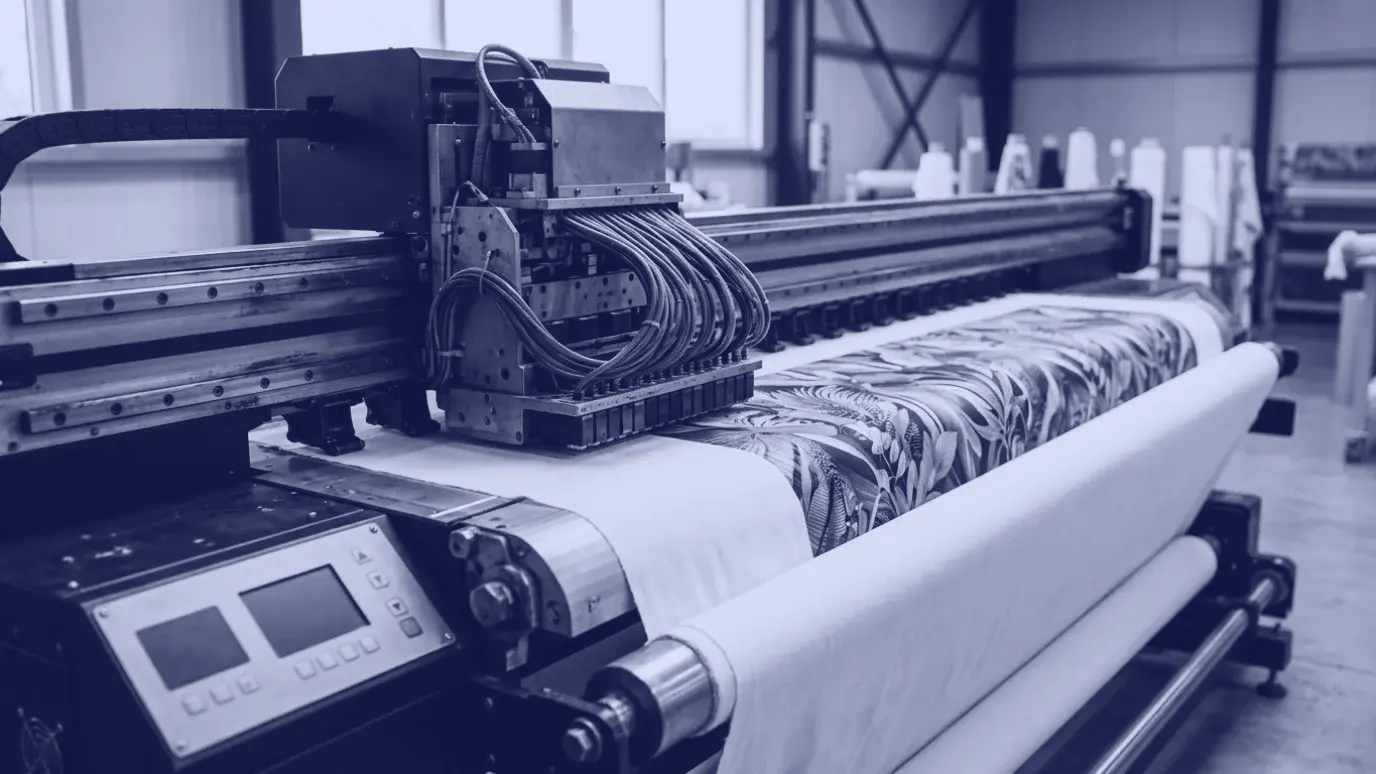
Digital textile printing is a method in which a design is printed straight from a computer file onto fabric or a finished product with inkjet print heads, without preparing screens or cylinders. It has two main uses: industrial digital fabric printing on rolls of fabric and DTG printing on finished items.
- Published:
- Updated:
- Fact-checked by:
- Gizem Polat
Key facts
- In digital printing the image is printed from a computer file with inkjet print heads, without screens or cylinders.
- In textiles it has two main uses: industrial digital fabric printing on rolls of fabric and DTG (direct to garment) printing on finished items.
- The ink class decides the fiber: reactive suits cotton and other cellulosic fibers, acid suits nylon, silk and wool, disperse suits polyester, and pigment can be used on all fibers.
- The number of colors does not add to set-up work, so the method stands out for samples, multicolor designs and short runs.
Digital textile printing is a method in which a design is printed straight from a computer file onto fabric or a finished product with inkjet print heads, without preparing screens or cylinders. The heads place ink on the surface without touching it, as very small droplets (e-PG Pathshala, Chapter 12; CottonWorks). Turkish suppliers call it dijital baskı.
In textiles, “digital printing” covers two separate jobs: industrial digital fabric printing on rolls of fabric, and DTG (direct to garment) printing on finished items. CottonWorks lists both among digital printing methods. Their machines, inks and downstream processes differ, so say which one you mean in your request for quotation.
How digital textile printing works
The design is prepared in graphics software, and RIP software controls how much ink goes where. Colors are mixed on the fabric during printing. After printing, the ink is fixed with heat and/or steam, and some inks also need washing (e-PG Pathshala, Chapter 12). Because there are no screens, the number of colors does not add to set-up work. This is the main difference from screen printing and rotary screen printing.
The ink class determines the fiber
| Ink | Suitable fibers | Fixation and processing |
|---|---|---|
| Reactive | Cellulosic fibers such as cotton; also protein fibers | Pretreatment needed; steaming and washing follow |
| Acid | Nylon, silk, wool | Pretreatment needed; steaming and washing follow |
| Disperse | Polyester | The dye sublimates under heat and passes into the fiber |
| Pigment | All fiber types | Contains a binder; cured with heat or UV. e-PG Pathshala states that no pretreatment is needed |
Pretreatment is a fixing chemical applied to the fabric before the ink. These chemicals cannot be added to the ink formulation, so the fabric is coated beforehand; pigment inks are the exception (e-PG Pathshala, Chapter 12). In DTG, Epson asks for a pretreatment liquid to be applied when printing with white ink, and before printing on polyester. Suppliers of digital printing ink are listed in the textile printing inks category, and the companies that do the printing in the textile printing category.
Two main applications
Industrial digital fabric printing
The heads print the design from the file onto rolls of fabric. Because changeover between designs takes very little downtime, the method stands out for samples, multicolor designs and short runs; for long yardage (printing by the meter) of the same design, rotary printing stands out (CottonWorks). According to Cotton Incorporated, reactive ink always needs pre- and post-treatment, and pigment ink needs a post-treatment (curing). In non-contact printing the dye penetrates the fiber less and fastness can be a problem, but the decisive factor is the choice of dye (CottonPicks, 2018). If you will print the sample digitally and the bulk run on a rotary machine, approve the difference in appearance between the two prints at the start.
A master’s thesis written at Bursa Uludağ University in 2019 compared reactive printing on viscose fabric on a rotary machine and on a multi-pass digital machine, using life cycle assessment, with designs of 1, 6 and 12 colors. As the number of colors rose, digital came out better in many impact categories, while rotary was better in electricity and natural gas consumption. Because the study covers a single plant and a single fabric, do not generalize it to your own job (Rüzgar, 2019).
DTG
DTG holds the finished item on a platen and prints directly onto it (CottonWorks). Epson recommends DTG for cotton and cotton-polyester blends; the ink is then fixed with a heat press. Because preparation is short, even a single piece can be printed, and photographic and multicolor designs are the method’s strong area. The difference between DTG and DTF is summarized in a table in the DTF printing entry.
Advantages and limits
Advantages
- No screen or print-paste preparation is needed; the number of colors is unlimited, and fine lines and detail can be printed.
- Design changes are quick, so samples and short runs are easy (e-PG Pathshala, Chapter 12).
Limits
- Digital inks are expensive and their capacity is limited; print defects such as clogged heads and banding can occur.
- The fabric often needs special preparation or coating.
- Fastness depends on the choice of ink and dye and on pre- and post-treatment.
Often confused with
- DTF and sublimation: In these methods too the image is printed from a digital file by inkjet, but it is printed onto film or paper, not onto the product, and transferred with heat (Epson; SGIA Journal, 2020). That is why they are grouped under “transfer printing”.
- Screen, flatbed screen and rotary printing: These are screen-based and need a separate screen for each color. Digital printing uses no screens.
Frequently asked questions
Is digital printing the same as DTG?
No. DTG is the type of digital printing done on finished products. Digital printing is the broader term and also covers printing on rolls of fabric.
Can digital printing be done on any fabric?
It depends on the ink class. Reactive or pigment ink is used for cotton, disperse ink for polyester, and acid ink for nylon and silk. Confirm exact suitability from the machine and ink manufacturer’s data sheet and from a sample print.
Does digital printing fade in the wash?
It would not be right to give a single number of washes. The result depends on the ink or dye class and on pre- and post-treatment. Have color change and staining tested to a standard method such as ISO 105-C06. For more, see the textile printing methods guide.
Sources (9)
- e-PG Pathshala (INFLIBNET), Textile Colouration and Finishes, Chapter 12: Digital Printing (accessed October 9, 2026)
- CottonWorks (Cotton Incorporated): Cotton Printing Types & Techniques (accessed October 9, 2026)
- Cotton Incorporated, CottonPicks: Printing Techniques, A Comparison of Cotton Printing Techniques (2018)
- Epson: DTG & DTF Printers for Small Businesses (DTG and DTFilm process and FAQ page; accessed October 9, 2026)
- Epson, SureColor F2270 User’s Guide: Overview of the Printing Process (DTG pretreatment; accessed October 9, 2026)
- Epson Europe: DTG and DTF Printing (accessed October 9, 2026)
- Cahill, V. and Hunter, C. Opportunities in Sublimation-Disperse Dye Printing. SGIA Journal, March/April 2020
- Rüzgar, A. (2019). Rotasyon ve dijital reaktif baskıların çevresel etkilerinin yaşam döngüsü analizi tekniğiyle karşılaştırılması (Comparison of the environmental impacts of rotary and digital reactive prints using life cycle assessment; in Turkish). Bursa Uludağ University, master’s thesis
- ISO 105-C06:2010, Textiles, Tests for colour fastness, Part C06: Colour fastness to domestic and commercial laundering
Author and fact-checking
Written by
Dyeing, Printing and Finishing Editor
Deniz Koç is Tekstil Rehberi's dyeing, printing and finishing editor. Deniz covers dyeing methods, digital, screen, transfer and sublimation printing, embroidery, garment washing and fabric finishes, and refers to the relevant test standards on topics such as color fastness and chemical compliance.
Content by Deniz KoçFact-checked by: Gizem Polat
This content was prepared by the Tekstil Rehberi editorial team. Before publication, our verification editor checked its figures, dates and sources against primary sources.
Spotted an error? Email us at [email protected] How we work →
Articles on this topic
Textile Printing Methods: Screen, Rotary, Digital, DTF and Sublimation
How screen, rotary, digital (DTG), DTF, heat transfer and sublimation printing compare, which fibres each suits, and how to brief a print supplier and set test criteria.