Dyeing, Printing and Finishing
Denim Wash Types and Techniques: Stone, Enzyme, Ozone, Laser
Denim wash types explained: dry and wet processes, stone, enzyme, rinse, bleach, ozone and laser, their effects on strength and shrinkage, the sandblasting ban in Turkey and what to ask a washing plant.
- Published:
- Fact-checked by:
- Gizem Polat
Key facts
- Denim washes are either dry processes such as whiskering, distressing, sanding and laser, or wet processes such as desizing, enzyme, stone, rinse and bleach (Palabıyık et al., 2024).
- Rinse is a short, light wash that changes the fabric little; stone wash abrades the indigo with pumice stones to lighten the color and soften the fabric (Gündüz, 2023; Coats).
- Turkey's Ministry of Health circular 2009/24 bans spraying sand or silica-containing material on jeans and denim fabric; machine stone washing with pumice is a separate process.
- In one study the largest strength loss was measured after enzyme-stone washing; in a cotton-hemp denim, most ozone-treated samples had higher tear strength than the raw fabric.
- Ozone can bleach a denim garment without pumice, permanganate or hypochlorite; one study applied an after-wash following ozone to counter yellowing (Palabıyık et al., 2024).
- In a case study of two Vietnamese denim makers, laser finishing cut water use 97% and energy use 70–90% (RMIT Vietnam, January 11, 2023); the figures are specific to those two plants.
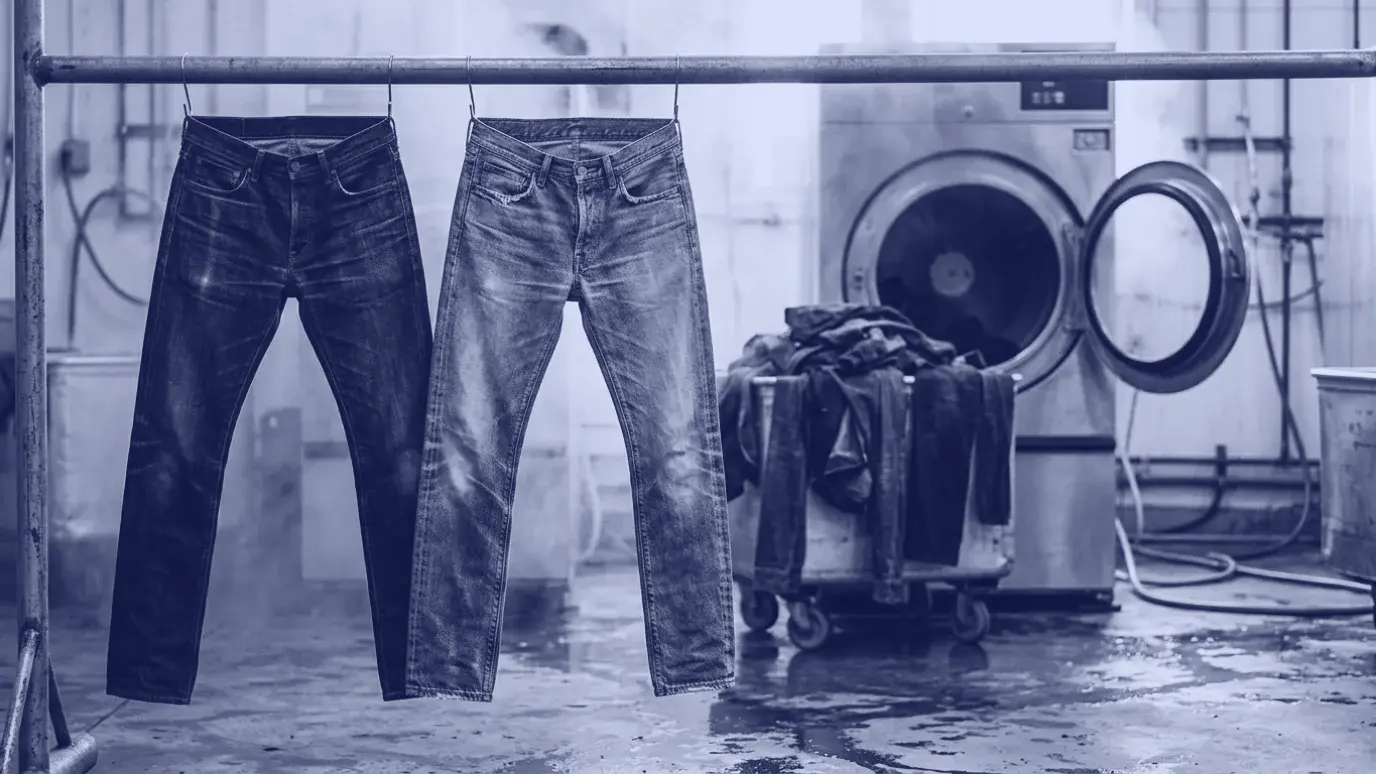
Denim wash types fall into two groups. Dry processes such as whiskering, distressing, sanding and laser give a garment its worn look mechanically; wet processes such as desizing, enzyme, stone wash, rinse, bleach, softening and spray change color and handle with water and chemicals (Palabıyık et al., 2024). Ozone bleaching is a growing alternative to hypochlorite and permanganate. The approved garment sample and the wash recipe decide the result.
Washing can be applied to the fabric or to the sewn garment: fabric washing lightens the color and removes a stiff handle, while garment washing gives the used look that fashion asks for (Gündüz, 2023, p. 6). This guide covers garment washing, with notes for buyers sourcing from Turkey; fabric-stage preparation is the work of dyeing and finishing plants.
Denim wash types: dry and wet processes
Turkish names are in italics for reading supplier quotes; "commercial source" marks statements from the information page of thread maker Coats.
| Process | Class | What it does | Basis |
|---|---|---|---|
| Desizing (haşıl sökme) | Wet | Removes the sizing agent; must come before enzyme | Gündüz, 2023, p. 6; Coats (commercial source) |
| Rinse | Wet | Short, light wash; keeps the color dark and the look bright | Gündüz, 2023, pp. 7–8; Coats (commercial source) |
| Stone wash (taş yıkama) | Wet | Abrades indigo with pumice stones, lightens the color, softens the fabric | Gündüz, 2023, p. 7; Coats (commercial source) |
| Enzyme and enzyme-stone wash (enzim yıkama) | Wet | Removes dye with cellulase, alone or with pumice; gives an aged look | Gündüz, 2023, p. 7; Palabıyık et al., 2024 |
| Bleaching | Wet | Lightens indigo with hypochlorite or permanganate; also done with ozone and enzyme | Gündüz, 2023, p. 7 |
| Spray and tint | Wet | Sprays permanganate, pigment or resin; tint changes the shade after washing | Palabıyık et al., 2024; Coats (commercial source) |
| Whiskering, distressing, sanding (bıyık, yıpratma, zımpara) and kılçık | Dry | Give a used look mechanically | Palabıyık et al., 2024 |
| Laser | Dry | Creates pattern, fading and engraving effects without contact | RMIT Vietnam, 2023 |
| Ozone | Bleaching method | Lightens indigo with ozone gas; has wet and dry applications | Palabıyık et al., 2024; RMIT Vietnam, 2023 |
Sandblasting is not counted among these processes: it is banned on jeans in Turkey and has its own section.
Stone wash vs enzyme wash vs rinse: the classic wet processes
Stone wash (with pumice)
In stone washing, garments tumble with pumice stones in a washing machine. The stones abrade the outer layer of the dyed yarn, the undyed inner fiber shows, the color lightens and the fabric softens (Gündüz, 2023, p. 7; Coats). Coats counts variants made with very small stones (sand wash, micro wash) as subtypes; these are washes with small stones, not sandblasting. In its comparison with enzyme washing, Coats says pumice can abrade the machine and garments and that used stones need disposal (commercial source).
Enzyme wash
Enzyme washing uses cellulase to remove dye, alone or with pumice, and gives denim an aged look (Gündüz, 2023, p. 7). Coats writes that cellulase acts only on cellulose, so sizing must be removed first; that neutral cellulase hurts breaking strength less; that acid cellulase can increase backstaining (indigo sticking back onto the fabric); and that enzyme washing without stones removes stone waste and machine wear (commercial source).
Rinse
Rinse is simpler than the other washes: the garment is washed in cold or warm water for a short or medium time, and because the conditions are mild its physical properties change little (Oğulata and Nergis, 2016, cited in Gündüz, 2023, pp. 7–8). According to Coats, the aim is to keep the fabric as dark as possible, and the drawback is very poor rubbing fastness (commercial source).
Bleaching and spray: lightening color with chemicals
Bleaching lightens color by breaking down indigo in a chemical reaction, using oxidizing or reducing chemicals (Gündüz, 2023, p. 7). More chemical or a longer time gives a more worn look but lowers wear performance (Gündüz, 2023, p. 7). According to Coats, hypochlorite bleaching damages the fiber and produces dirty wastewater, and residual chlorine must be removed after every chlorine bleach (commercial source).
In acid wash, pumice stones soaked beforehand in a hypochlorite or permanganate solution tumble with the garments in a dry drum, giving localized bleaching and a sharp blue-and-white contrast. Coats adds that this hypochlorite process can cause serious strength loss at seams and pockets, breakage and small holes (commercial source).
Some brand programs restrict these processes. Under Material Health, the Ellen MacArthur Foundation's September 9, 2021 Jeans Redesign page says: "Stone finishing, potassium permanganate (PP), and sandblasting are prohibited." This is a condition for participating brands, not a law, and the page does not define "stone finishing"; confirm what is meant against your own specification.
Dry processes and laser finishing
Whiskering, distressing and sanding
These processes give the garment a used look mechanically (Palabıyık et al., 2024). The same source lists kılçık among the dry processes without explaining it; ask the supplier what effect is meant.
Laser finishing
Laser is a contact-free method that gives denim patterns, fading and engraving effects. Citing case studies of two Vietnamese denim manufacturers, RMIT Vietnam's January 11, 2023 release says digital laser saved 97% of water, 70–90% of energy and 60–70% of chemical cost, and cut processing time from 30–45 minutes with the conventional method to two minutes. The release adds that few Vietnamese denim companies use laser and ozone, because of high initial investment and skill requirements. These percentages come from two factories and cannot be carried over to another plant, country or product (underlying article: Nayak et al., 2022). Machine suppliers are in the dyeing and finishing machines category.
Company directory
Looking for manufacturers in this field?
Browse companies in the related categories or get quotes from several companies with one form.
Do you manufacture or offer services in this field?
Ozone wash: bleaching denim without hypochlorite or permanganate
Here, ozone wash means bleaching a denim garment with ozone gas. Ozone is a strong oxidizer that breaks down the structure of indigo, so a garment can be lightened without pumice stones, potassium permanganate or sodium hypochlorite (Palabıyık et al., 2024, p. 882). According to RMIT, ozone can remove indigo from the surface without a chemical or water bath; no rinsing is needed after dry ozonation, and after wet ozonation one or two washes are enough to remove residual ozone.
Palabıyık et al. bleached a denim garment of 78% cotton and 22% hemp at ozone capacities of 25, 50 and 75 g/Nm³ for 5, 10 and 15 minutes. As dose and time rose, color difference (ΔE) and yellowness rose; against the raw fabric, color difference ranged from about 14 to 44. The authors attribute the yellowing to isatin sulfonic acid formed as ozone breaks down indigo; an after-wash with detergent and softener was applied to remove it. Tear strength fell as dose and time rose. It is a single laboratory study, not a general recipe.
Sandblasting jeans is banned in Turkey; stone wash is a separate process
Sandblasting, blasting sand onto jeans and denim fabric to age them (kumlama in Turkish), is banned in Turkey. The basis is circular no. 2009/24 of the Turkish Ministry of Health, General Directorate of Primary Health Care Services (dated March 27, 2009 on the document): no material containing sand (silica dust) or silica crystals may be used in the spraying process. The ministry gives two reasons: silicosis has become more frequent among sandblasting workers, and adequate protection for workers and the environment in these workshops does not seem possible.
Legally this is a ministry circular, not a law or regulation. As of this article's date (October 16, 2026), the information rests on the circular's own text; check the ministry for later changes, and ask an occupational health and safety specialist about practice at the plant. Stone washing with pumice in a machine is a wet process that the circular does not mention. The Turkish word taşlama can be used for either process, so write the full process name on the order and in the specification.
How washing affects strength, size and handle
| Source | Finding | Limit |
|---|---|---|
| Çetinaslan et al. (2013), Karazincir and Duru Baykal (2014), Arıkan et al. (2015), cited in Gündüz, 2023, pp. 9–10 | Washing generally reduced strength; the largest loss came after enzyme-stone washing in one study and after combined stone, enzyme and bleach washing in another; rinse did not affect strength or elongation | Cited summaries; fabrics and tests differ |
| Palabıyık et al. (2024) | Against the raw fabric, ozone-bleached samples were thicker, with lower air permeability and circular bending resistance, and most had higher tear strength; the authors link the higher tear strength to the softener reducing fabric stiffness | One fabric (78% cotton, 22% hemp); tear strength fell as ozone dose and time rose |
| Yılmaz (2024, Istanbul Technical University thesis) | On seven denim fabrics, foam washing gave higher tear strength than stone washing and generally better rubbing and washing fastness; no generalizable result for breaking strength | Thesis abstract only |
Sources point in different directions: the result depends on the fabric, the process and the property measured, and a single study cannot be generalized. Tear strength and breaking strength are not the same test. Our recommendation at Tekstil Rehberi is to have strength measured before and after washing, on your own fabric and with your own recipe.
Do jeans shrink after washing?
They can. Kan and Yuen (2009) studied repeated washing of elastane-containing denim: shrinkage was clear up to the fifth wash, then dimensions stabilized; denim with a higher elastane share showed more shrinkage and more change in mass and thickness (cited in Gündüz, 2023, pp. 8–9). This is a single study, so ask for a repeated-wash trial on your own fabric. ISO 5077 sets how dimensional change is calculated; the wash and dry program is chosen from ISO 6330. To reach the finished size after washing, work out the cutting allowance with the shrinkage calculator.
Water, energy and chemical load: what the sources report
Figures are given only as far as the source gives them, and statements from the commercial source are labeled.
| Process | What is reported | Source and limit |
|---|---|---|
| Laser | 97% less water, 70–90% less energy, 60–70% lower chemical cost | RMIT Vietnam, 2023: two Vietnamese factories; does not carry over to other plants |
| Ozone | Indigo removal without a chemical or water bath; no percentage given | RMIT Vietnam, 2023. Palabıyık et al. (2024) say in the introduction that ozone saves water and energy and leaves no waste, but did not measure either |
| Foam wash | Less water than stone washing | Yılmaz, 2024: thesis abstract gives no figure |
| Enzyme wash | Less stone waste and machine wear | Coats (commercial source) |
| Hypochlorite bleaching | Fiber damage and dirty wastewater; residual chlorine must be removed | Coats (commercial source) |
| Stone wash | Used stones need disposal | Coats (commercial source) |
To judge chemical load, ask the plant which chemical suppliers it uses and how it treats wastewater. The ZDHC MRSL lists substances that must not be intentionally used in chemical formulations or must not exceed limits; conformance is shown at chemical-product level (ZDHC). One certification rule matters: under section 5.10 of OEKO-TEX STANDARD 100 (edition 01.2026), a certified product automatically loses its certified status and the right to use the STANDARD 100 label once it undergoes a professional physical or chemical treatment, including washing and chemical cleaning. This holds as of the article's date; ask your certification body whether the washing falls within your certificate's scope. See the textile certifications guide for more.
What to give and ask a denim washing plant
The wash result depends on how clear the order is. Give the plant these in writing and ask about each:
- Approved physical sample. Tie the agreement to a reference sample signed by both sides, not a verbal description, and use a trial lot to check that the plant can repeat the result in bulk.
- Recipe responsibility. A chemical's result at a given temperature and time is hard to predict, so recipes are developed by trial (Gündüz, 2023, pp. 6–7). Write down who writes the recipe and how it stays confidential.
- Fabric and fiber information. Give the fiber blend, including the elastane share, and any pre-treatment such as shrinkage control; the elastane share affects shrinkage (Kan and Yuen).
- Size and fastness tolerance. Put the post-wash size tolerance in the tech pack (ISO 5077) and tie indigo transfer to rubbing fastness (ISO 105-X12).
- Damage and wastage liability. Write down who bears pieces damaged in washing, re-washing, and the accepted wastage rate.
- Lead time. It depends on the number of wash steps, effects that need handwork, the plant's daily washing and drying capacity, and the trials needed to match the approved sample. If laser or ozone is done at another plant, add transport time and liability for damage in transit.
- Documents. Check which plant a chemical-management document (for example OEKO-TEX STeP, or conformance of the chemicals used with the ZDHC MRSL) covers, and its validity date.
- No sandblasting. Ask for written confirmation that sandblasting, which is banned, is not carried out at the plant.
You can find washing plants in the garment and denim washing category and jeans manufacturers in the denim apparel category.
Frequently asked questions
What are the types of denim wash?
Denim washes fall into dry and wet processes. Dry processes, such as whiskering, distressing, sanding and laser, give a garment a used look mechanically. Wet processes (desizing, enzyme, stone wash, rinse, bleaching, softening and spray) change color and handle with water and chemicals (Palabıyık et al., 2024). Ozone is treated separately as a bleaching method and has wet and dry applications (RMIT Vietnam, 2023).
Is stone wash the same as sandblasting?
No. In stone washing, garments tumble with pumice stones in a washing machine, which is a wet process. Sandblasting means blasting sand onto the garment to age it. Circular 2009/24 of the Turkish Ministry of Health bans spraying with sand or silica-containing material on jeans products and does not mention stone washing (as of October 2026). The Turkish word 'taşlama' can be used for either process, so write the full process name on the order.
What is the difference between stone wash and enzyme wash?
Stone wash abrades the indigo with pumice stones, which lightens the color and softens the fabric. Enzyme wash uses cellulase to remove dye, alone or together with pumice (Gündüz, 2023). In a study by Karazincir and Duru Baykal (2014), enzyme-stone washing reduced strength the most (cited in Gündüz, 2023). According to Coats, enzyme washing without stones removes stone waste and machine wear (commercial source).
What does ozone wash do to denim?
Here, ozone wash means bleaching a denim garment with ozone gas. Ozone breaks down the structure of indigo and lightens the color; pumice, potassium permanganate and sodium hypochlorite are not used. In one study, color difference and yellowness rose with ozone dose and time, and an after-wash with detergent and softener was applied to remove the yellowing (Palabıyık et al., 2024).
How does laser finishing differ from conventional denim washing?
Laser is a contact-free, dry process that creates patterns, fading and engraving effects. In a case study of two Vietnamese denim manufacturers, water use fell 97%, energy 70–90% and chemical cost 60–70%, and processing time dropped from 30–45 minutes with the conventional method to two minutes (RMIT Vietnam, 2023). These results are specific to those two factories; do not assume the same gain at another plant.
Does washing reduce the strength of jeans?
Often, but the result depends on the process and the fabric. In studies cited by Gündüz (2023), washing generally reduced strength; the largest loss came after enzyme-stone washing in one study and after combined stone, enzyme and bleach washing in another, while rinse did not affect strength. In a 78% cotton, 22% hemp denim, most ozone-bleached samples had higher tear strength than the raw fabric, which the authors link to the softener (Palabıyık et al., 2024). Have strength measured on your own fabric before and after washing.
Sources (13)
- Turkish Ministry of Health, General Directorate of Primary Health Care Services, Kot Giysilere Uygulanan Püskürtme İşleminde Kum Kullanımının Yasaklanması Genelgesi (circular banning the use of sand in the spraying process applied to jeans garments; title translated by Tekstil Rehberi; in Turkish), No. 2009/24, dated March 27, 2009 on the document, Yönergeler ve Genelgeler Kitabı (Directives and Circulars Book), section 6.3.11, p. 473 (accessed October 16, 2026)
- Palabıyık, İ., Körlü, A., Özçelik, G., Kenevir İçeren Denim Giysilerin Terbiyesinde Çevre Dostu Bir Yöntem: Ozon ile Yıkama (An Environmentally Friendly Method for Finishing Denim Garments Containing Hemp: Washing with Ozone; title translated by Tekstil Rehberi; in Turkish), Çukurova Üniversitesi Mühendislik Fakültesi Dergisi 39(4), December 2024, pp. 881–895, DOI 10.21605/cukurovaumfd.1605888 (accessed October 16, 2026)
- Gündüz, Y. Ş. (2023). Denim kumaşlarda üretim parametrelerinin tutum ve performans özellikleri üzerine olan etkisinin araştırılması (Investigation of the effect of production parameters on the handle and performance properties of denim fabrics; in Turkish). Bursa Uludağ University Graduate School of Natural and Applied Sciences, master's thesis (pp. 6–10; accessed October 16, 2026)
- RMIT University Vietnam, A "greener" way to make blue jeans, January 11, 2023 (accessed October 16, 2026)
- Nayak, R., George, M., Jajpura, L., Khandual, A., Panwar, T., Laser and ozone applications for circularity journey in denim manufacturing - A developing country perspective, Current Opinion in Green and Sustainable Chemistry 38, 100680, 2022, DOI 10.1016/j.cogsc.2022.100680 (the article behind the RMIT release; citation taken from the Crossref record, full text not read; accessed October 16, 2026)
- Coats, Denim Wash (thread manufacturer's information page, commercial source; undated; accessed October 16, 2026)
- Yılmaz, H., Investigation of physical performance of denim fabrics washed with sustainable foam washing, Istanbul Technical University master's thesis, 2024 (abstract on the record page; accessed October 16, 2026)
- Ellen MacArthur Foundation, Make Fashion Circular launches The Jeans Redesign, September 9, 2021 (accessed October 16, 2026)
- OEKO-TEX, OEKO-TEX STANDARD 100, Standard, Edition 01.2026 (document dated March 3, 2026), section 5.10 (accessed October 16, 2026)
- ZDHC, ZDHC MRSL (accessed October 16, 2026)
- ISO 5077:2007 Textiles: Determination of dimensional change in washing and drying (EVS-EN ISO 5077:2008 record; accessed October 16, 2026)
- ISO 6330:2021 Textiles: Domestic washing and drying procedures for textile testing (EVS-EN ISO 6330:2021 record; accessed October 16, 2026)
- ISO 105-X12:2016 Textiles: Tests for colour fastness, Part X12: Colour fastness to rubbing (EVS-EN ISO 105-X12:2016 record; accessed October 16, 2026)
Author and fact-checking
Written by
Dyeing, Printing and Finishing Editor
Deniz Koç is Tekstil Rehberi's dyeing, printing and finishing editor. Deniz covers dyeing methods, digital, screen, transfer and sublimation printing, embroidery, garment washing and fabric finishes, and refers to the relevant test standards on topics such as color fastness and chemical compliance.
Content by Deniz KoçFact-checked by: Gizem Polat
This content was prepared by the Tekstil Rehberi editorial team. Before publication, our verification editor checked its figures, dates and sources against primary sources.
Spotted an error? Email us at [email protected] How we work →
Related articles
Clothing Manufacturers in Turkey: How to Find, Vet and Work with One
Where Turkish clothing factories are, what to plan for on MOQ, lead time and cost, how EU and UK duty rules work, and how to verify a manufacturer before you place an order.
Textile Printing Methods: Screen, Rotary, Digital, DTF and Sublimation
How screen, rotary, digital (DTG), DTF, heat transfer and sublimation printing compare, which fibres each suits, and how to brief a print supplier and set test criteria.