What is Pilling?
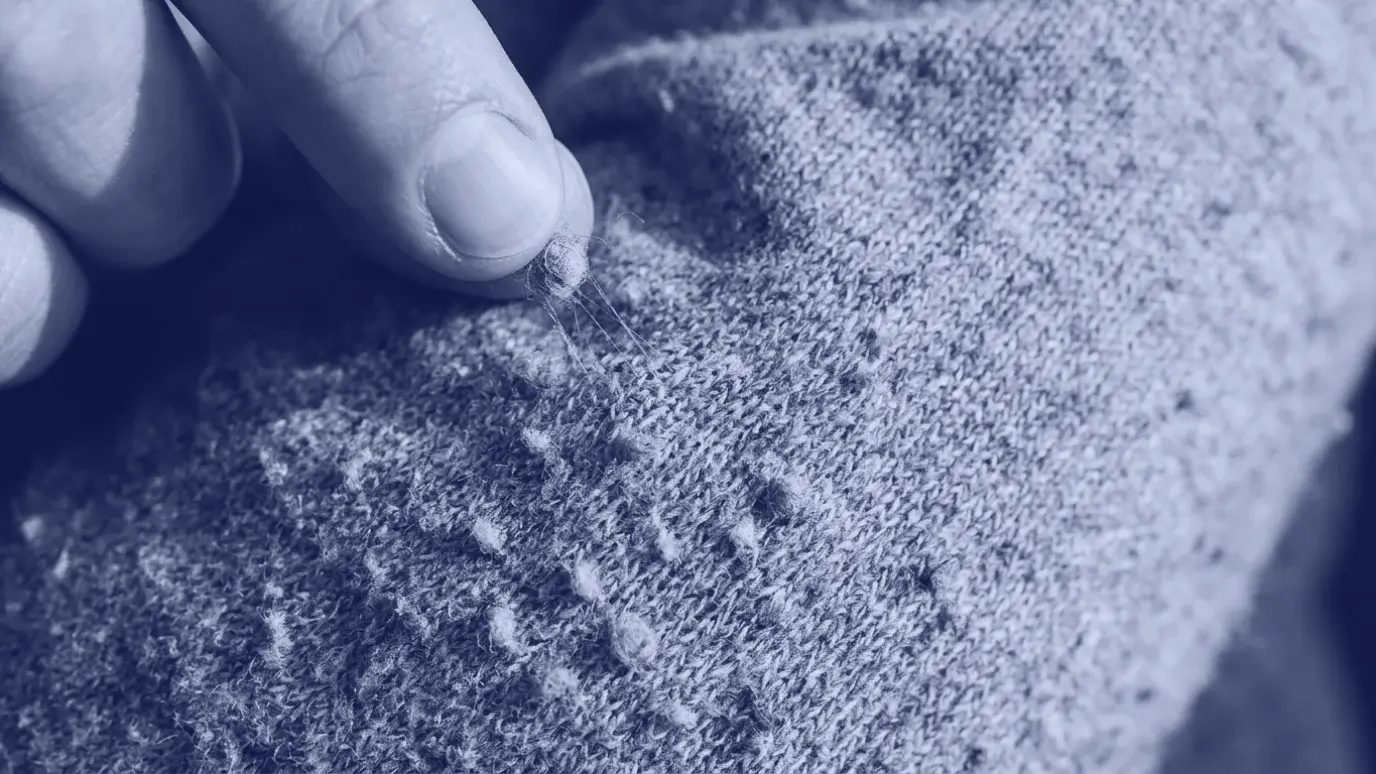
Pilling is the tangling of loose surface fibers into small balls (pills) that cling to the fabric and spoil its appearance. It develops with friction, washing and drying and is measured with the ISO 12945 series. In Turkish it is called boncuklanma.
- Published:
- Fact-checked by:
- Gizem Polat
Key facts
- Pilling is the tangling of loose surface fibers into small balls that stay on the fabric; it is measured with the ISO 12945 series.
- A thesis review (Kahraman, 2006) describes pill formation in four stages: fuzz formation, entanglement, growth and wear-off.
- Strong synthetic fibers hold pills on the surface; blends, fuzzy yarns and knitted fabrics pill more, and continuous filament fabrics normally do not pill.
- ISO 12945 has four parts: pilling box (1), modified Martindale (2), random tumble (3) and visual assessment (4).
- The direction of the grading scale can differ by method; check whether 1 or 5 is the better grade in a report.
- In a polyester-cotton fleece study, singeing combined with heat setting raised the pilling grade from 1 to 4 (Hossain et al., 2021).
Pilling is the formation of small balls of tangled fibers on a fabric surface. The balls, called pills, cling to the fabric by one or more fibers. They form with wear, washing and drying, spoil the fabric's look and are measured with the ISO 12945 series. This entry covers textile pilling only, not skincare or makeup.
Pilling, fuzzing and matting
The title of ISO 12945 names three phenomena: pilling, fuzzing and matting. Part 4 of the standard describes assessing each of them visually and separately (ISO). In this entry fuzzing means loose fiber ends rising to the surface; it is the first step of pill formation, and a pill forms when these fibers tangle and ball up (Kahraman, 2006). Turkish suppliers use boncuklanma for pilling, but tüylenme (literally fuzzing) is sometimes used for pilling too, so name the defect “pilling (boncuklanma)” in a quotation or specification to avoid confusion.
How does pilling form?
Kahraman (2006, pp. 4–6) describes pill formation in four stages:
- Fuzz formation: fiber ends are freed at the yarn surface; this is the first effect of abrasion.
- Entanglement: once the fuzz reaches a critical height that depends on the fiber's properties, the fibers tangle with each other.
- Growth: the pill grows up to a limit.
- Wear-off: if outside forces exceed the combined strength of the fibers anchoring the pill, the pill separates from the fabric.
Whether a pill stays on the fabric depends on the strength of the anchoring fibers. With fibers of low breaking strength and bending resistance (wool and some synthetics) pills leave the surface easily, while with strong synthetic fibers they stay attached (Kahraman, 2006, pp. 4–5).
Why does it happen, and which fabrics pill most?
Kahraman (2006) gathers fiber, yarn, fabric and finishing factors in a literature review; the tendencies below come from the studies reported in that review:
| Factor | Tendency | Thesis page |
|---|---|---|
| Fiber strength | Strong (synthetic) fibers keep pills on the surface; low-strength fibers let pills go quickly | 4, 26 |
| Fiber form | Continuous filament fibers normally do not pill; in staple fibers, longer fibers mean fewer fiber ends per unit area and less pilling | 25 |
| Fiber blend | A blended fabric pills considerably more than a similar fabric of one fiber type; even 5% synthetic fiber can start the problem in wool fabric | 26 |
| Yarn | More in fuzzy yarn; less as twist and ply increase; in one reported study, carded yarn pilled more than combed (penye) and open-end rotor yarn in the random tumble and Martindale tests, while the order differed in the ICI box | 27–30 |
| Fabric structure | Fibers migrate to the surface more easily in knits, so pilling is more common in knits; tightly and densely woven fabric (for example denim) pills very little or not at all | 30–31 |
| Finishing | Softeners and lubricants (silicones and derivatives) increase the tendency to pill | 31 |
How is a pilling test read?
ISO 12945 has four parts: Part 1 is the pilling box, Part 2 the modified Martindale, Part 3 random tumble and Part 4 visual assessment (ISO). Part 3 does not apply to fabrics that cannot tumble freely. The visual grade has five steps: Hossain et al. (2021) report the ISO 12945-1 scale as 1 = severe pilling and 5 = no change.
The direction of the scale is not the same in every method. Kahraman (2006, p. 17) gives the scale for the Du Pont random tumble apparatus with 1 as “no pilling” and 5 as “very heavy pilling”, and a biopolishing study used a panel index from 0 (none) to 5 (severe) (Thiyagarajan and Hari, 2014). Always confirm in which direction the grade in a report reads. For how the methods are run, see the fabric testing standards guide.
How can pilling be reduced?
- Singeing and heat setting: on polyester-cotton blended fleece, untreated fabric scored grade 1, heat setting alone 2, singeing alone 3 and the two together 4 (ISO 12945-1:2000, 14,400 revolutions; Hossain et al., 2021). The same order appeared in three different blends; it is still one study.
- Biopolishing (cotton): cellulase enzyme partly breaks down the fiber ends sticking out of the surface. On a cotton fabric knitted from 20s carded yarn, enzyme washing significantly lowered the pilling index given by a panel (Thiyagarajan and Hari, 2014). Cellulase breaks down cellulose, so the method suits cellulosic fibers.
- “Anti-pilling” claims: the ISO 12945 records reviewed for this entry contain no definition of the term; have the claim backed by a grade measured to ISO 12945.
How to specify pilling in an order
- State the method: ISO 12945-1, -2 or -3. Test devices respond differently to different factors (Kahraman, 2006, pp. 20–21).
- Fix the revolutions or the duration: the number and size of pills change with the test time (Kahraman, 2006, p. 21).
- Write the acceptance grade together with the direction of the scale.
- Ask for a measurement after washing too: in a study reported by Kahraman (2006, p. 27), the tendency to pill rose as the number of washes increased.
Frequently asked questions
What does pilling mean in fabric?
Pilling is the formation of small balls of tangled fiber on the surface of a fabric. In the title of ISO 12945 it is named together with fuzzing (fiber ends rising to the surface) and matting.
What causes pilling?
Friction in wear, washing and drying frees fiber ends at the surface, and these tangle into balls. Strong synthetic fibers, fiber blends, fuzzy yarns and knitted structures make pills more likely to form and to stay (Kahraman, 2006).
What does anti-pilling mean?
It is the name given to fiber, yarn or finishing solutions meant to reduce pilling; the ISO 12945 records reviewed contain no definition of it. Ask for the claim as a grade measured to ISO 12945.
What is a pilling test?
It is a laboratory test of a fabric's tendency to form pills. ISO 12945 treats it together with fuzzing and matting: the specimen is abraded under standard conditions, the surface is graded visually, and the result is reported as a grade, not as a number of rubs. The fabric testing standards guide explains the steps.
Sources (8)
- Kahraman, B. (2006). Örme kumaşlarda boncuklanma nedenlerinin incelenmesi (Investigation of the causes of pilling in knitted fabrics; in Turkish, English title translated by us). Marmara University Institute of Pure and Applied Sciences, Department of Textile Education, master's thesis, supervisor: S. M. Yükseloğlu (open access record; page numbers in the text are the thesis's own pages, and chapter II is a review of other researchers' work; accessed October 22, 2026)
- Kahraman, B. (2006), full-text PDF of the same thesis (Marmara University library catalog; accessed October 22, 2026)
- ISO 12945-1:2020 Textiles: Determination of fabric propensity to surface pilling, fuzzing or matting, Part 1: Pilling box method (ISO record page; accessed October 22, 2026)
- ISO 12945-2:2020 Textiles: Determination of fabric propensity to surface pilling, fuzzing or matting, Part 2: Modified Martindale method (ISO record page; accessed October 22, 2026)
- ISO 12945-3:2020 Textiles: Determination of fabric propensity to surface pilling, fuzzing or matting, Part 3: Random tumble pilling method (ISO record page; accessed October 22, 2026)
- ISO 12945-4:2020 Textiles: Determination of fabric propensity to surface pilling, fuzzing or matting, Part 4: Assessment of pilling, fuzzing and matting by visual analysis (ISO record page; accessed October 22, 2026)
- Hossain, M. S., Islam, M. M., Dey, S. C., Hasan, N. (2021). An approach to improve the pilling resistance properties of three thread polyester cotton blended fleece fabric. Heliyon, 7(4), e06921
- Thiyagarajan, S. S. and Hari, K. (2014). Optimization of Wash Bath Temperature for Effective Biopolishing of Textile Garments. Journal of Textile and Apparel, Technology and Management, 9(1), NC State University
Author and fact-checking
Written by
Fabrics and Fibers Editor
Elif Karaca is Tekstil Rehberi's fabrics and fibers editor. She writes guides and glossary entries on knitted, woven and nonwoven fabrics, fiber properties and choosing the right fabric for each product, and bases values such as GSM, width, shrinkage and color fastness on standards and mill technical data sheets.
Content by Elif KaracaFact-checked by: Gizem Polat
This content was prepared by the Tekstil Rehberi editorial team. Before publication, our verification editor checked its figures, dates and sources against primary sources.
Spotted an error? Email us at [email protected] How we work →
Articles on this topic

Fabric Testing Standards: Color Fastness, Martindale, Pilling, Shrinkage and Strength Tests
The standards behind color fastness, Martindale abrasion, pilling, shrinkage and strength tests, how to read a fabric test report, and how to write a test line into a supplier spec.

Bed Linen Fabric Types: Percale, Sateen and Thread Count
Percale, sateen, ranforce and flannel compared: what thread count means per inch and as the Turkish per-centimeter “tel”, why “600 thread count” can mislead, and a checklist for writing a spec.

How to Judge Terry Towel Quality: GSM, Pile Yarn and Absorbency
Terry towel quality cannot be read from GSM alone. The criteria for pile yarn, pile height, absorbency and post-wash performance, with a checklist for buyers writing a spec.