
Technical Textiles
Protective Clothing and Workwear Standards: EN ISO 20471, 11612, 11611
11 min read
Searches companies, categories, products, listings, guides and the glossary.
Browse sectors
Manufacturers of protective clothing (safety workwear) against flame, heat, low visibility and chemical risks in Turkey. Choose the right supplier by risk, standard and certificate scope.
For buyers
No companies are listed on this page yet. You do not have to wait for the list: describe what you need and request quotes.
Tell us the product, quantity and delivery location. You confirm your request with the link we e-mail you; requests are screened for spam, and our team reviews your first request. It is then sent to up to 20 companies working in this field and stays open for quotes in their company panel for 30 days. You compare the quotes you receive on one page.
Technical Textiles
Get your company listed on this page. If you manufacture or provide services in this field, create your free profile; companies are listed after our team has reviewed them.
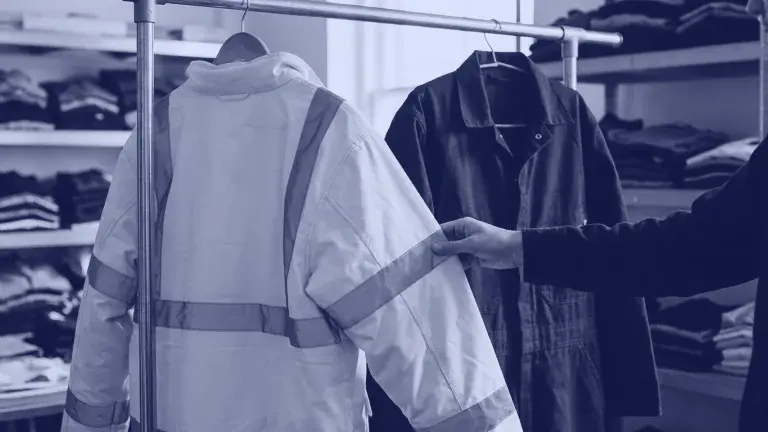
List your company for freeProtective clothing, or safety workwear, is the clothing group of personal protective equipment (PPE): garments designed to protect the wearer from hazards such as flame, high heat, welding sparks, low visibility, chemical splashes, cold and rain, with performance measured against a standard. This page lists companies that make such certified garments or supply their fabric: flame-retardant workwear (called “yanmaz”, non-flammable, in everyday Turkish), high-visibility vests, chemical protective coveralls and similar.
Uncertified workwear, corporate uniforms, school uniforms and scrubs for hospital staff are listed under workwear and uniforms; for surgical gowns and drapes see medical textiles. Parent sector: technical textiles.
The right garment is determined by the workplace risk assessment: which hazard, at what level. The standard and performance code come out of that assessment. Commonly encountered standards are:
For chemical protective coveralls, the applicable standard also comes out of the risk assessment; ask the company in writing for the standard number and the certificate scope.
The European Commission's list of September 4, 2026 (harmonized standards for personal protective equipment) includes EN ISO 20471, EN 1149-5 and EN ISO 13688, but not EN ISO 11611 or EN ISO 11612. For garments certified to those two standards, ask which edition of the standard the type-examination certificate rests on. For what each standard covers, see our protective workwear standards guide.
As of the date of this page (October 8, 2026), protective garments fall under Regulation (EU) 2016/425 in the EU and under the Personal Protective Equipment Regulation (Kişisel Koruyucu Donanım Yönetmeliği) in Turkey (Official Gazette, May 1, 2019, no. 30761, in Turkish). In Category I, the manufacturer declares conformity itself through internal production control. In Categories II and III an EU type-examination by a notified body is required, and in Category III production also comes under the notified body's supervision. The type-examination is carried out on the garment model, so a fabric report alone is not enough: sewing thread, zipper, reflective tape and model design also affect the result. For your product's category and your obligations at the workplace, consult your occupational safety specialist or a consulting and certification firm.
The fabric construction (whether flame retardancy comes from the fiber itself or from a treatment applied afterwards), reflective tape, multi-layer constructions, certification and testing cost, model and size range, embroidery and order quantity set the price. Looking at service life (the number of washes the garment withstands) rather than the label price shows the total cost more accurately.
The label should carry the CE mark and the number of the applied standard; ask the company for its EU declaration of conformity. For garments in Category II and III, an EU type-examination certificate issued by a notified body is also required. Check that the certificate covers the model and fabric you are buying.
No. A flame-retardant fabric does not show that the garment is certified. The garment must carry the standard number and the performance codes. For example, in EN ISO 11612, A1 and A2 indicate limited flame spread, B convective heat and C radiant heat; the digit after B or C is the level reached.
EN ISO 20471 divides garments into Classes 1, 2 and 3 according to the minimum area of fluorescent background and retroreflective material; Class 3 gives the highest visibility. Which class is required is determined by the risk assessment of the working environment.
The company and the model set the minimum; ask whether there is a per-model floor. Special-fiber fabric supply, logos and embroidery can lengthen lead time. Because in Categories II and III the type examination is done on the garment model, ask for quantity and lead time together with the model and fabric covered by the certificate.
The fabric construction (whether flame retardancy comes from the fiber itself or from a treatment applied afterwards), reflective tape, multi-layer constructions, certification and test cost, model and size range, embroidery and order quantity set the price. Looking at service life, meaning the number of washes the garment withstands, rather than the label price shows the total cost more accurately.